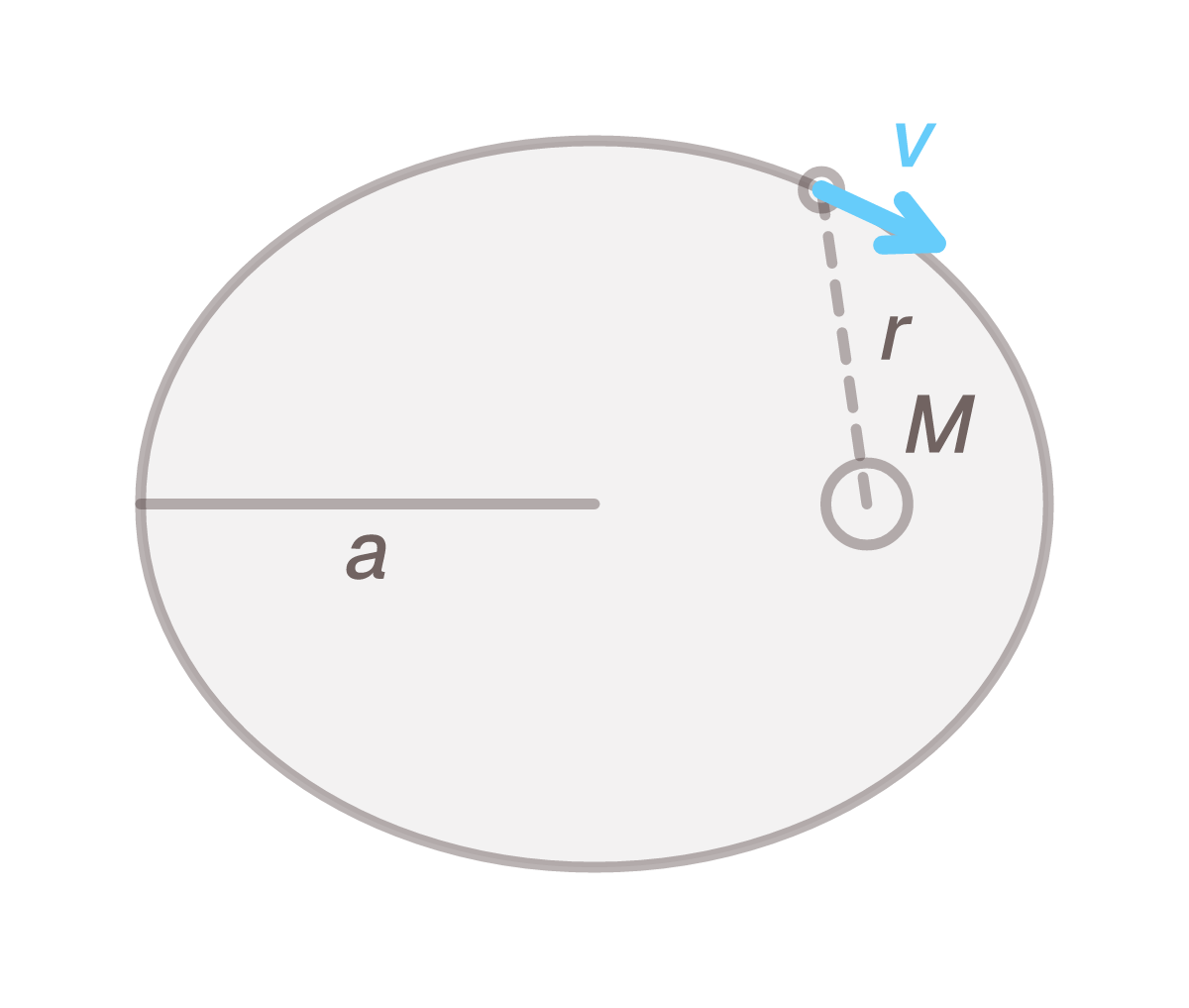
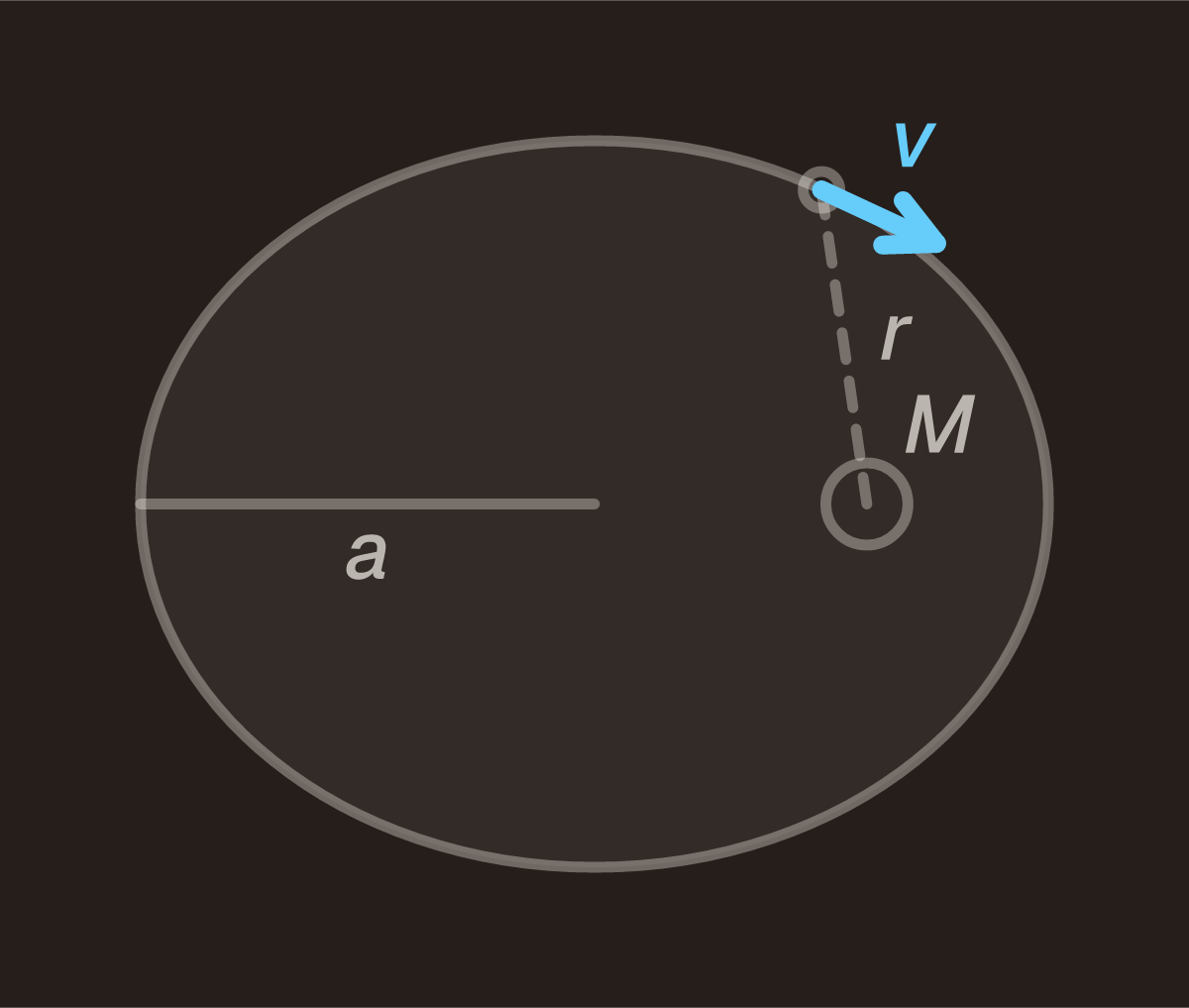
v² = G · M · (2/r − 1/a)
G is the gravitational constant, 6.6743 · 10⁻¹¹ N·m²/kg², M the mass of the body orbited, r the
distance from its centre at the point you are asking about, a the semi-major axis of the ellipse — half
its longest diameter — and v the speed there. All lengths are in metres.
Holds when one body is much heavier than the other, so the heavy one stays put at a focus, and nothing but
their mutual gravity acts — no drag, no engine burning.
A spacecraft leaving the Earth’s orbit on a transfer ellipse to Mars. The ellipse touches the
Earth’s orbit at r = 149.6 · 10⁹ m and Mars’s at 228.0 · 10⁹ m (NASA’s planetary fact sheet), so
a = (149.6 + 228.0) / 2 · 10⁹ = 188.8 · 10⁹ m. With the Sun’s mass 1.9884 · 10³⁰ kg:
v² = 6.6743 · 10⁻¹¹ · 1.9884 · 10³⁰ · (2 / 149.6 · 10⁹ − 1 / 188.8 · 10⁹), v ≈ 32.7 km/s.
The Earth itself moves at about 29.8 km/s, so the spacecraft needs about 2.9 km/s more than the planet it
leaves.
Where it comes from
It is energy conservation per kilogram. Kinetic energy is ½v² and
potential energy −GM/r, and on an
ellipse their sum is the same at every point, −GM/(2a):
½v² − GM/r = −GM/(2a).
Multiply by 2 and move GM/r over: v² = 2GM/r − GM/a = GM(2/r − 1/a).
r and a are not the same length
The common mistake is to put the same number in for both. Then 2/r − 1/a becomes 1/r, and the equation
gives the circular orbital velocity √(GM/r) —
29.8 km/s in the example above instead of 32.7. The answer looks reasonable and is the speed of a
different orbit. r is where the body is now; a is a property of the whole ellipse and does not change
round the orbit.
The other end of the ellipse
Arriving at Mars’s distance, r = 228.0 · 10⁹ m on the same ellipse:
v² = 6.6743 · 10⁻¹¹ · 1.9884 · 10³⁰ · (2 / 228.0 · 10⁹ − 1 / 188.8 · 10⁹), v ≈ 21.5 km/s.
Mars moves at about 24.1 km/s, so the spacecraft arrives slower than the planet and needs a second push of
roughly 2.6 km/s to stay alongside it.
The special cases
| Case |
2/r − 1/a becomes |
Speed |
| Circle, r = a |
1/r |
√(GM/r), the orbital velocity |
| Escape, a → ∞ |
2/r |
√(2GM/r), the escape velocity |
| Closest point, r = a(1 − e), e the eccentricity |
(1 + e)/(a(1 − e)) |
the fastest point |
The formula covers ellipses with r between the closest and the furthest point, which is at most 2a from
the centre.
Common mistakes
- The same number for r and a. That only holds on a circle.
- Altitude for r. r is measured from the centre of the body orbited.
- Forgetting the square. The equation gives v²; take the root at the end.
- Kilometres. G is in metres, so r and a must be too.
Frequently asked questions
What does “vis viva” mean?
Latin for “living force”, an old name for what is now kinetic energy (it was mv², without the half). The
equation is energy conservation in that sense.
Why is a body fastest at its closest point?
The total energy is fixed. Closest in, the potential energy is at its lowest, so the kinetic energy and
the speed are at their highest. Kepler’s second law says the same thing as equal areas in equal times.
How do I find a from the closest and furthest distances?
a is their average: a = (r_min + r_max) / 2, both measured from the centre of the body orbited.