Momentum
The relation
p
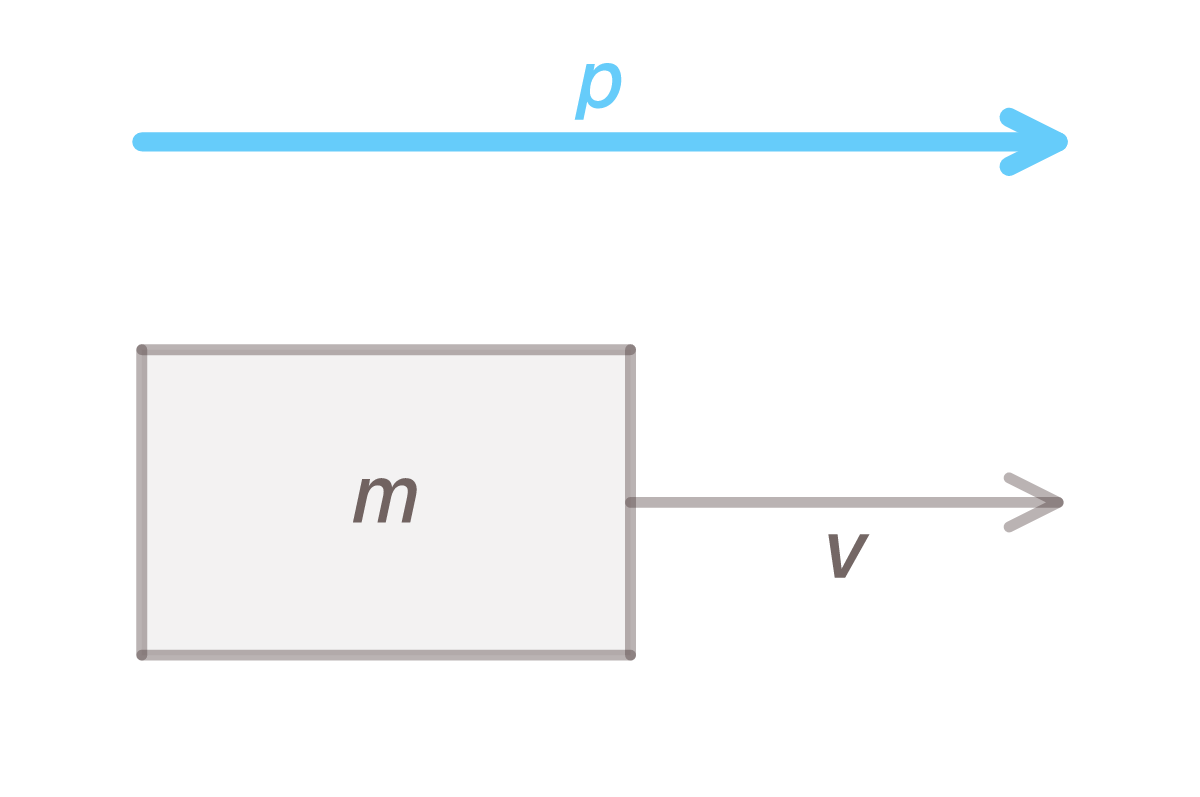
Mass times velocity. In a collision the total is the same before and after, which is what makes it worth a name of its own.
Solve for
p=30,000kg·m/s
p equals 1,200 times 25, equals 30,000 kg·m/s
Den här sidan finns på svenska. Byt till svenska
Definition — what does that mean?
Mass times velocity — and the total is the same before and after a crash.
In Swedish: Rörelsemängd
p
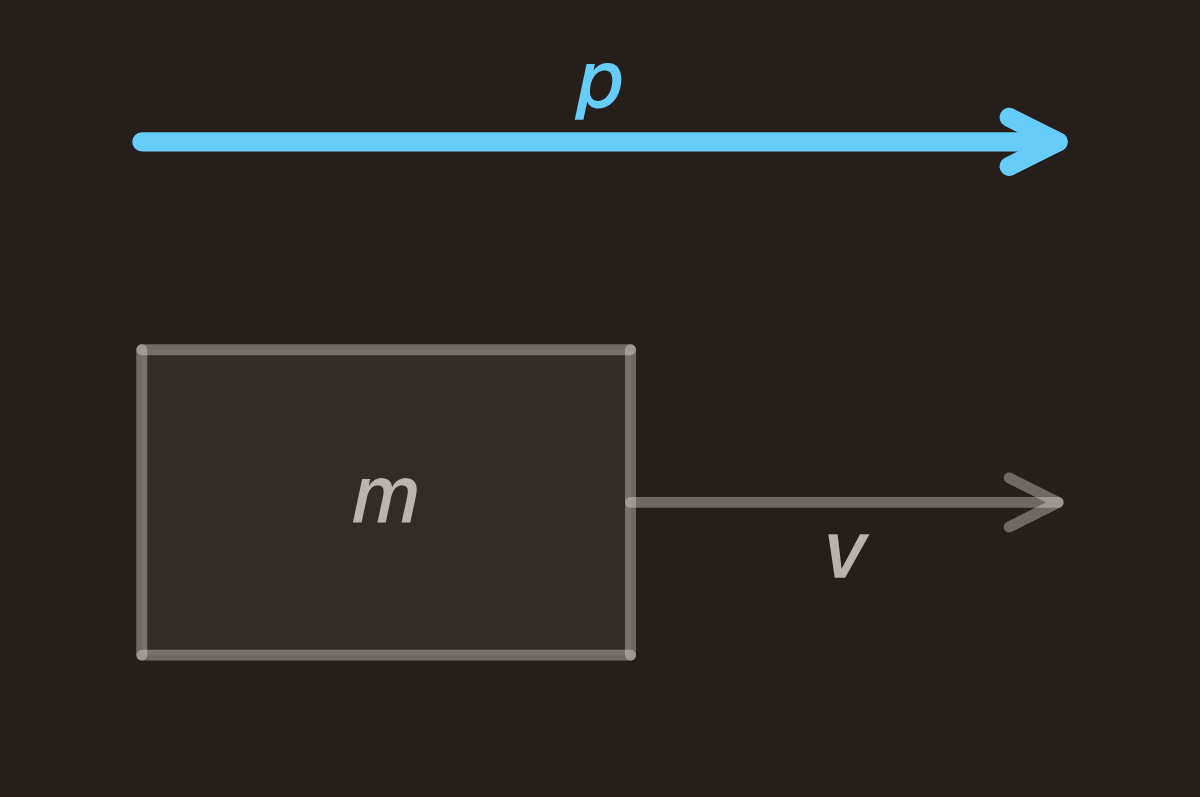
Mass times velocity. In a collision the total is the same before and after, which is what makes it worth a name of its own.
p=30,000kg·m/s
p equals 1,200 times 25, equals 30,000 kg·m/s
You are given
m is the mass in kilograms, v the velocity in m/s and p the momentum in kg·m/s. A 1,200 kg car at
25 m/s has a momentum of 1,200 · 25 = 30,000 kg·m/s.
It is also called linear momentum.
A formula that only multiplies two numbers earns a name of its own only if the product does something special. This one does: momentum is conserved. With no external force acting, the total is the same before and after a collision, however wrecked the collision left things.
It holds equally for a bouncing ball and for two cars that end up stuck together, and it makes momentum useful where energy is not enough: kinetic energy is lost in a crash, to heat and deformation, but momentum is not.
Momentum also has a direction. In one dimension a sign is enough: positive to the right, negative to the left.
A lorry and a bicycle. The 12,000 kg lorry at 2 m/s has p = 24,000 kg·m/s. The 80 kg bicycle needs v = 24,000 / 80 = 300 m/s to match it.
A collision where they stick. A 2 kg trolley at 3 m/s runs into a stationary 1 kg one. Before: p = 2 · 3 = 6 kg·m/s. Afterwards 3 kg move together: v = 6 / 3 = 2 m/s.
A recoil. A 60 kg skater pushes off a 40 kg one who ends up at 2 m/s. The total was zero, so the skater goes 40 · 2 / 60 ≈ 1.3 m/s the other way.
The two are often confused and are different quantities:
| Momentum | Kinetic energy | |
|---|---|---|
| Formula | p = m·v | E = m·v²/2 |
| Unit | kg·m/s | joules |
| Direction | Has one | Has none |
| In a collision | Conserved with no external force | Conserved only if the collision is elastic |
The square is the difference that matters most: double the speed and the momentum doubles while the energy quadruples.
Why is momentum called p?
The origin is uncertain. An often repeated explanation is the Latin petere, to seek or press towards.
The letter m was taken by the mass in any case.
What is impulse?
Force times the time it acts, and it equals the change in momentum. That is why an airbag helps: the
same change in momentum spread over a longer time means less force — see
Newton’s second law.
Does light have momentum?
Yes, even though photons have no mass. The formula on this page does not apply there — it is for
objects with mass at everyday speeds.
| Solve for | Rearranged | With the numbers | Comes to |
|---|---|---|---|
| m | pv | 30,00025 | 1,200 kg |
| v | pm | 30,0001,200 | 25 m/s |
| p | mv | 1,200·25 | 30,000 kg·m/s |
Last reviewed October 6, 2026 ·How pages are reviewed
Sheets that ask this formula, with their answer keys. Open one to see the questions or print it.
Four questions on momentum, four on impulse and eight on collisions where momentum is conserved. The first one is worked. Calculator allowed.
Copy the code into your page where the formula card should appear. It loads from lovetocalc.com, so it stays current on its own — all we ask is that the credit line comes with it.