Skip to content
LoveToCalc

Definition — what does that mean?

Orbital velocity

A satellite is always falling towards the Earth, but moves sideways so fast that it never gets there.

In Swedish: Omloppshastighet

Orbital velocity

The relation

v=GMr

The speed that keeps a satellite in a circular orbit, where gravity supplies exactly the centripetal force. The further out, the slower.
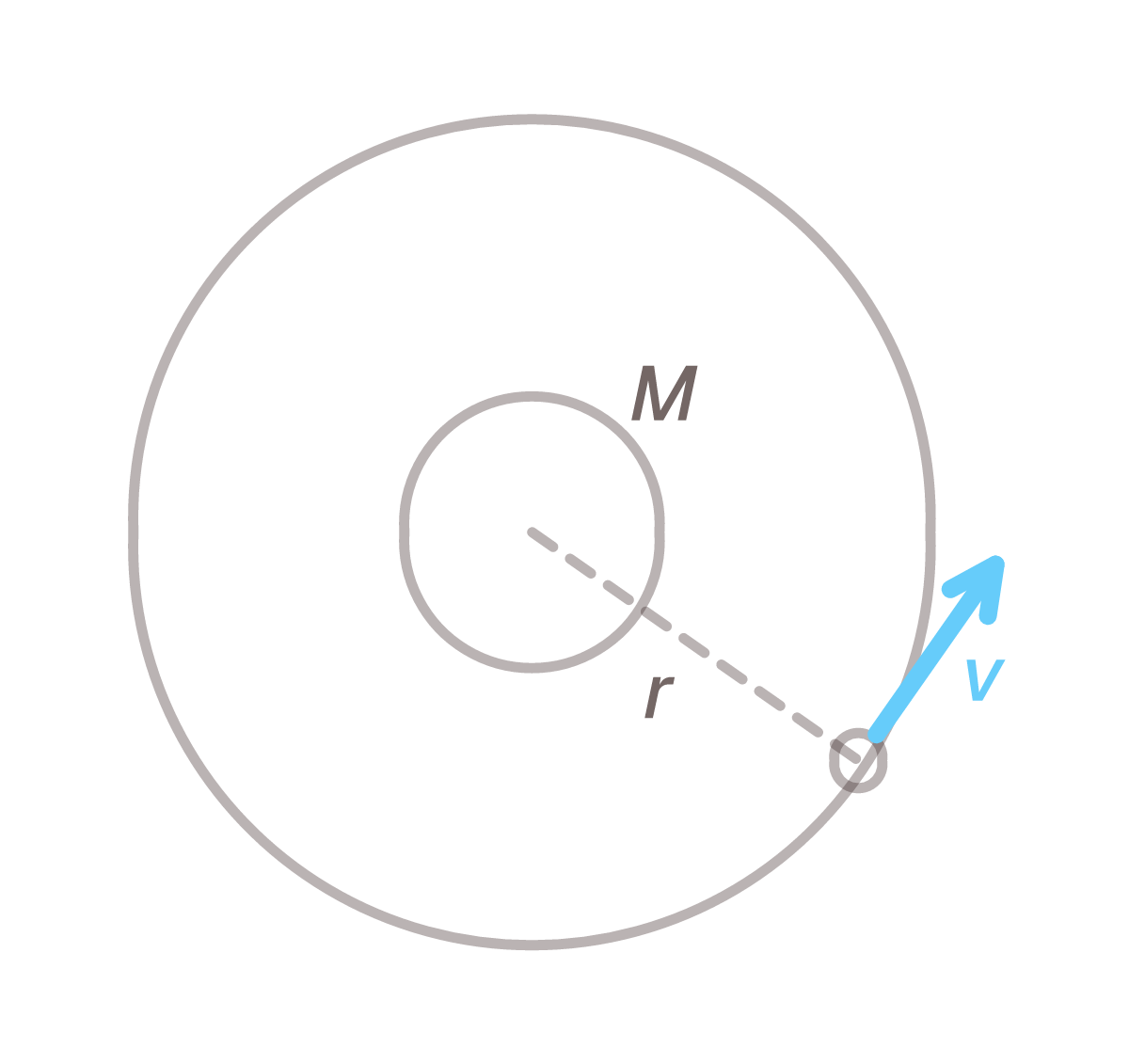
A satellite on a circular orbit around a body of mass M. The line from the centre to the satellite is the orbit radius r, and an arrow along the orbit, at a right angle to that line, is the speed v.
Solve for

v≈7,672.318m/s

v equals the square root of ((6.674 times 10 to the power of minus 11 times 5.972 times 10 to the power of 24) divided by 6,771,000), is approximately the square root of (3.986 times 10 to the power of 14 divided by 6,771,000), equals the square root of (58,864,463.1517), is approximately 7,672.318 m/s

Working4 steps

The formula

v = √(G · M / r)

v is the speed in m/s, G the gravitational constant, M the mass at the centre in kilograms and r the radius of the orbit, measured from the centre, in metres.

Holds for a circular orbit around a spherically symmetric body whose mass is far larger than the satellite’s.

Where it comes from

In a circular orbit gravity has to supply exactly the centripetal force needed: G · M · m / r² = m · v² / r. The satellite’s mass m cancels, which leaves v² = G · M / r.

Worked examples

The space station. 400 km above the surface, r = 6,771,000 m: v = √(6.674 · 10⁻¹¹ · 5.972 · 10²⁴ / 6,771,000) ≈ 7,670 m/s, about 27,600 km/h. One orbit then takes 2π · 6,771,000 / 7,670 ≈ 5,550 s, around 92 minutes.

The Moon. With r = 384,400,000 m, v ≈ 1,020 m/s. Further out is slower.

Common mistakes

Frequently asked questions

Why do the outer planets move more slowly? Gravity is weaker far out, so less speed is needed to hold the orbit. Neptune moves at about 5 km/s, the Earth at 30 km/s.

Looking for another letter? The formula solved for each one
Solved for each letter
Solve forRearrangedWith the numbersComes to
Gv²rM7,672.32²·6,771,0005.972 × 10²⁴6.674 × 10⁻¹¹ N·m²/kg²
Mv²rG7,672.32²·6,771,0006.674 × 10⁻¹¹5.972 × 10²⁴ kg
rGMv²6.674 × 10⁻¹¹·5.972 × 10²⁴7,672.32²6,771,000 m
vGMr6.674 × 10⁻¹¹·5.972 × 10²⁴6,771,0007,672.32 m/s

The solar system

Table

The solar system
BodyTypeMass (kg)Mean radius (km)Density (kg/m³)Surface gravity (m/s²)Escape velocity (km/s)Rotation period (h)OrbitsOrbital period (days)Mean distance (10⁶ km)Orbital velocity (km/s)
SunStar1.9884 × 10³⁰695,7001,408274.0617.6609.12NoneNot applicableNot applicableNot applicable
MercuryPlanet3.3 × 10²³2,439.55,4293.74.31,407.6The Sun88.057.947.4
VenusPlanet4.87 × 10²⁴6,0525,2438.910.4−5,832.5The Sun224.7108.235.0
EarthPlanet5.97 × 10²⁴6,3785,5149.811.223.9The Sun365.2149.629.8
MoonMoon7.3 × 10²²1,737.53,3401.62.4655.7The Earth27.30.3841.0
MarsPlanet6.42 × 10²³3,3963,9343.75.024.6The Sun687.0228.024.1
JupiterPlanet1.898 × 10²⁷71,4921,32623.159.59.9The Sun4,331778.513.1
SaturnPlanet5.68 × 10²⁶60,2686879.035.510.7The Sun10,7471,432.09.7
UranusPlanet8.68 × 10²⁵25,5591,2708.721.3−17.2The Sun30,5892,867.06.8
NeptunePlanet1.02 × 10²⁶24,7641,63811.023.516.1The Sun59,8004,515.05.4
PlutoDwarf planet1.3 × 10²²1,1881,8500.71.3−153.3The Sun90,5605,906.44.7

Sources

(2)

Last reviewed October 6, 2026 ·How pages are reviewed

MechanicsAll formulas

Put this formula on your site

Copy the code into your page where the formula card should appear. It loads from lovetocalc.com, so it stays current on its own — all we ask is that the credit line comes with it.