Work
The relation
W
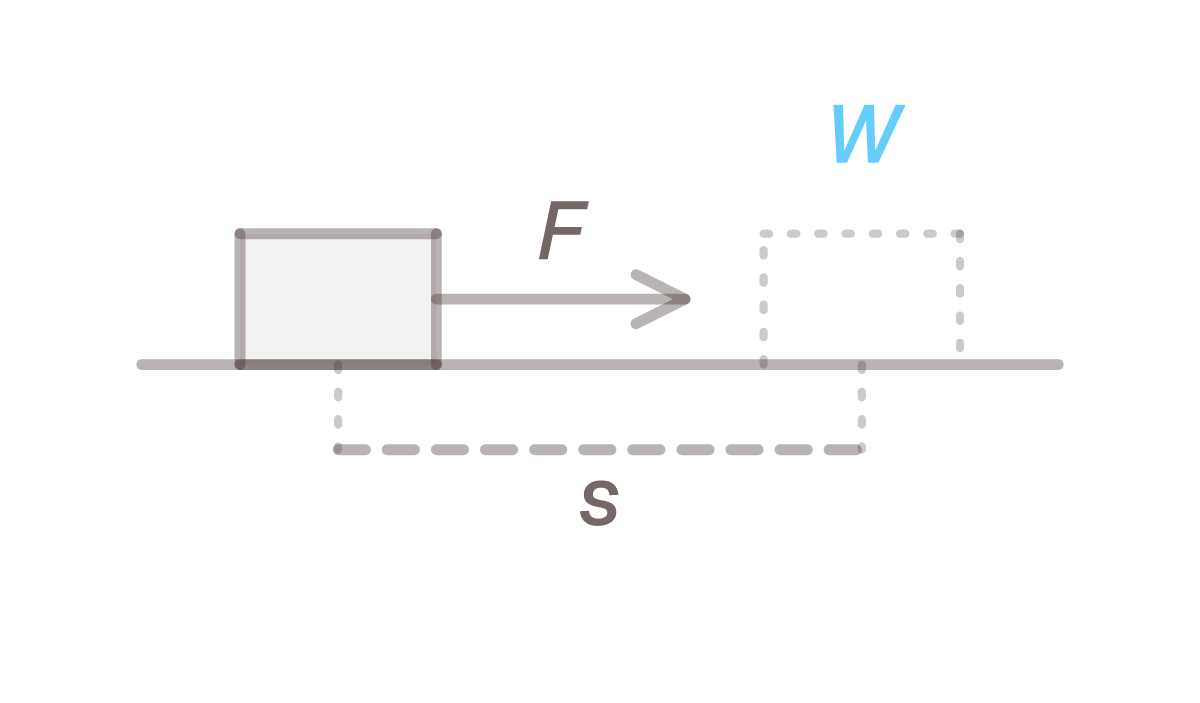
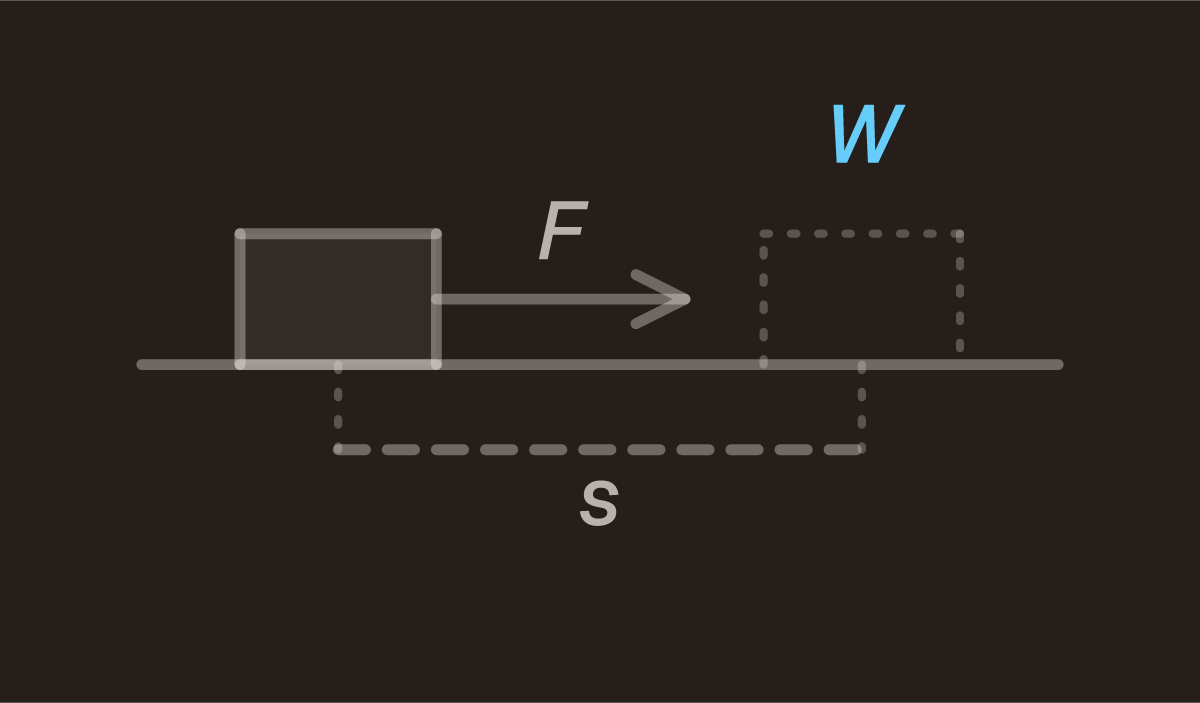
Force times the distance moved. Holding something still is hard and is no work at all — nothing moved.
Solve for
W=1,000J
W equals 200 times 5, equals 1,000 J
Den här sidan finns på svenska. Byt till svenska
Definition — what does that mean?
Force times distance — and standing there holding something is no work at all.
In Swedish: Arbete
W
Force times the distance moved. Holding something still is hard and is no work at all — nothing moved.
W=1,000J
W equals 200 times 5, equals 1,000 J
You are given
F is the force in newtons, s the distance in metres and W the work in joules. A force of 200 N over
5 metres does 200 · 5 = 1,000 J.
The difficulty here is one of language. Standing with a box in your arms
for ten minutes is exhausting — but the box does not move, s is zero, and the work is zero. Everyday
“work” and the physicist’s are two different ideas sharing one word.
It still tires your muscles because the body spends energy holding the tension, not because any work is done on the box.
Direction matters the same way: only the part of the force pointing along the motion counts. Carry a bag straight ahead and the lifting force is upward while the motion is forward, and the lifting force does no work on the bag.
1 J is 1 N over 1 m. That is a small number, so larger energies are counted in kilojoules or kilowatt-hours:
| Unit | In joules |
|---|---|
| 1 J | 1 |
| 1 kJ | 1,000 |
| 1 kcal | 4,184 |
| 1 Wh | 3,600 |
| 1 kWh | 3,600,000 |
Work and energy share a unit because the work you do on something is energy transferred to it.
A box across the floor. 80 N of friction over 12 m: 80 · 12 = 960 J.
A lift. 25 kg straight up weighs 25 · 9.81 = 245.25 N. Lifted two metres: 245.25 · 2 = 490.5 J. That is also the box’s potential energy up there.
Force from the work. 3,000 J over 15 m means the force was 3,000 / 15 = 200 N.
How far does it go? 500 J against 40 N of friction lasts 500 / 40 = 12.5 m.
Can work be negative?
Yes. If the force points against the motion — friction, or a hand slowing something down — energy is
taken out of the motion, and the work counts as negative.
Are work and energy the same thing?
They share a unit and they are linked: the work you do on something is the energy it gains. Energy is
what something has; work is the transfer.
Why is the unit called a joule?
After James Prescott Joule, who showed that mechanical work and heat are the same quantity — stirring
water warms it.
| Solve for | Rearranged | With the numbers | Comes to |
|---|---|---|---|
| F | Ws | 1,0005 | 200 N |
| s | WF | 1,000200 | 5 m |
| W | Fs | 200·5 | 1,000 J |
Last reviewed October 6, 2026 ·How pages are reviewed
Sheets that ask this formula, with their answer keys. Open one to see the questions or print it.
Sixteen questions on work, kinetic energy, potential energy and mechanical power.
Copy the code into your page where the formula card should appear. It loads from lovetocalc.com, so it stays current on its own — all we ask is that the credit line comes with it.