W = p · ΔV
p is the pressure in pascals, ΔV the change in volume in cubic metres and W the work the gas does on its
surroundings, in joules. ΔV = V₂ − V₁, so it is positive when the gas expands and negative when it is compressed.
Holds when the pressure stays constant through the whole change in volume. When the pressure changes as the gas
expands, as it does at constant temperature, isothermal work
applies instead.
A piston pushed out. A gas at 200 kPa expands by 3 dm³ against a piston. In SI units that is 200,000 Pa and
0.003 m³:
W = 200,000 · 0.003 = 600 J.
The units
Pascals times cubic metres are joules. Mixing units gives an answer off by a factor of a thousand, one way or the
other:
| Working |
W |
| Right: 200,000 Pa · 0.003 m³ |
600 J |
| Pa with dm³: 200,000 · 3 |
600,000 |
| kPa with m³: 200 · 0.003 |
0.6 |
| kPa with dm³: 200 · 3 |
600 |
The last row gives the right answer, because 1 kPa · 1 dm³ = 1,000 Pa · 0.001 m³ = 1 J. It is the same coincidence
that lets the ideal gas law be worked in kPa and dm³. It only works
when both are in those units.
A second example: compression
A gas at a constant 300 kPa is compressed so that its volume falls by 2 dm³. ΔV = −0.002 m³:
W = 300,000 · (−0.002) = −600 J.
The work is negative: the surroundings do 600 J of work on the gas.
The sign and the first law
Here W is the work the gas does, the same sign as in the
first law of thermodynamics written
ΔU = Q − W. A gas that takes in 1,500 J of heat while doing 600 J of work as it expands has ΔU = 1,500 − 600 = 900 J.
Some books take W as the work done on the gas and write ΔU = Q + W. With that
convention W = −p · ΔV, and the expansion above gives −600 J. The two say the same thing. What does not work is taking
the sign from one book and the first law from the other.
Common mistakes
- Mixing kPa and Pa, or dm³ and m³. Work in Pa and m³, or in kPa and dm³, and nothing else.
- Dropping the sign of ΔV. On compression ΔV is negative, and so is W.
- Using the formula when the pressure changes. W = p · ΔV holds at constant pressure.
- Mixing sign conventions. Check whether the book counts the work done by the gas or on it.
Common questions
What does pressure–volume work have to do with enthalpy?
At constant pressure, the enthalpy change is ΔH = ΔU + p · ΔV. A reaction that forms gas at atmospheric pressure does
pressure–volume work against the air, and ΔH includes it.
Does the formula hold for liquids and solids?
Yes, but their volume changes so little that the work is nearly always negligible. Gases are what the formula is
used for.
What does the work look like on a pV diagram?
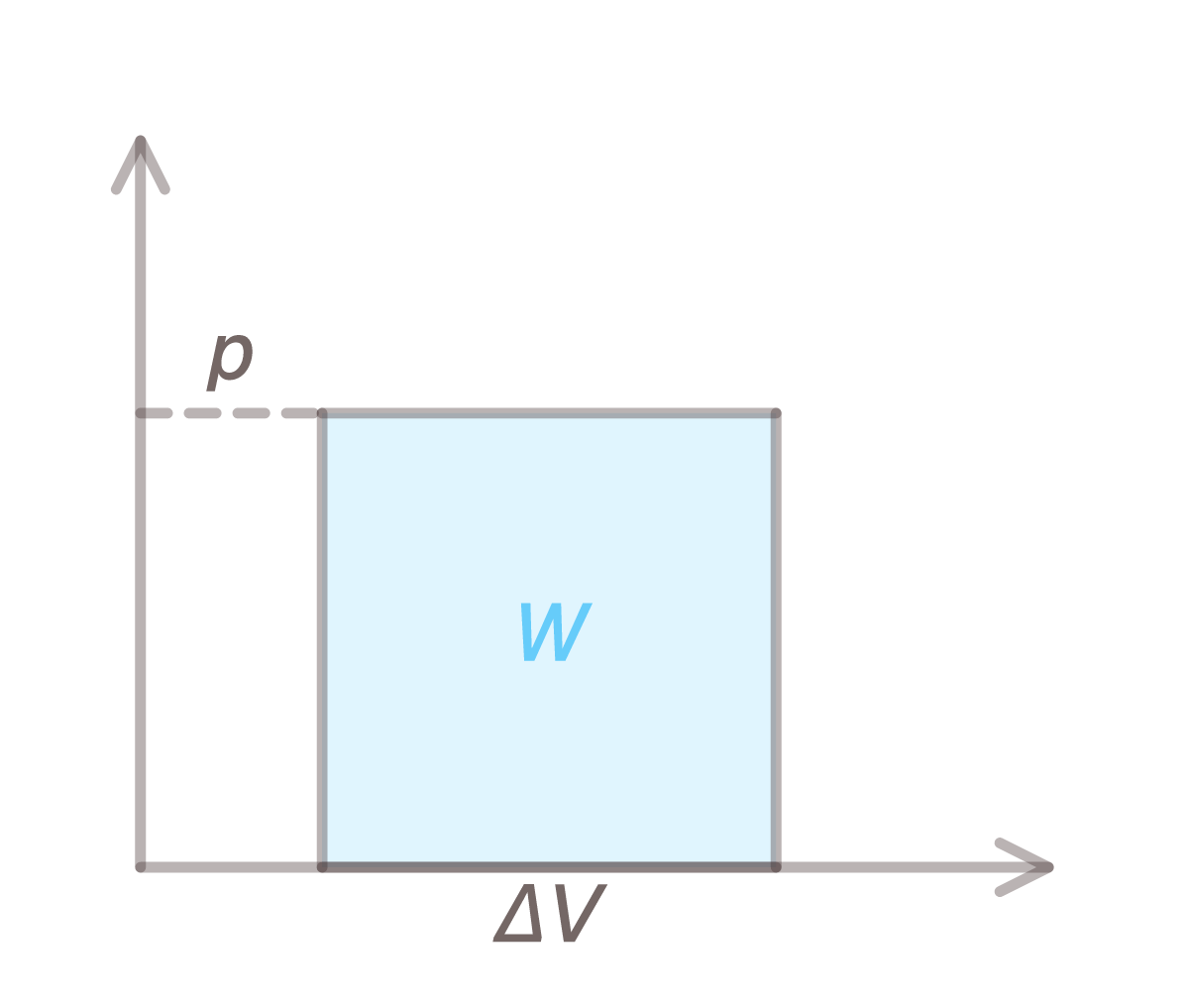
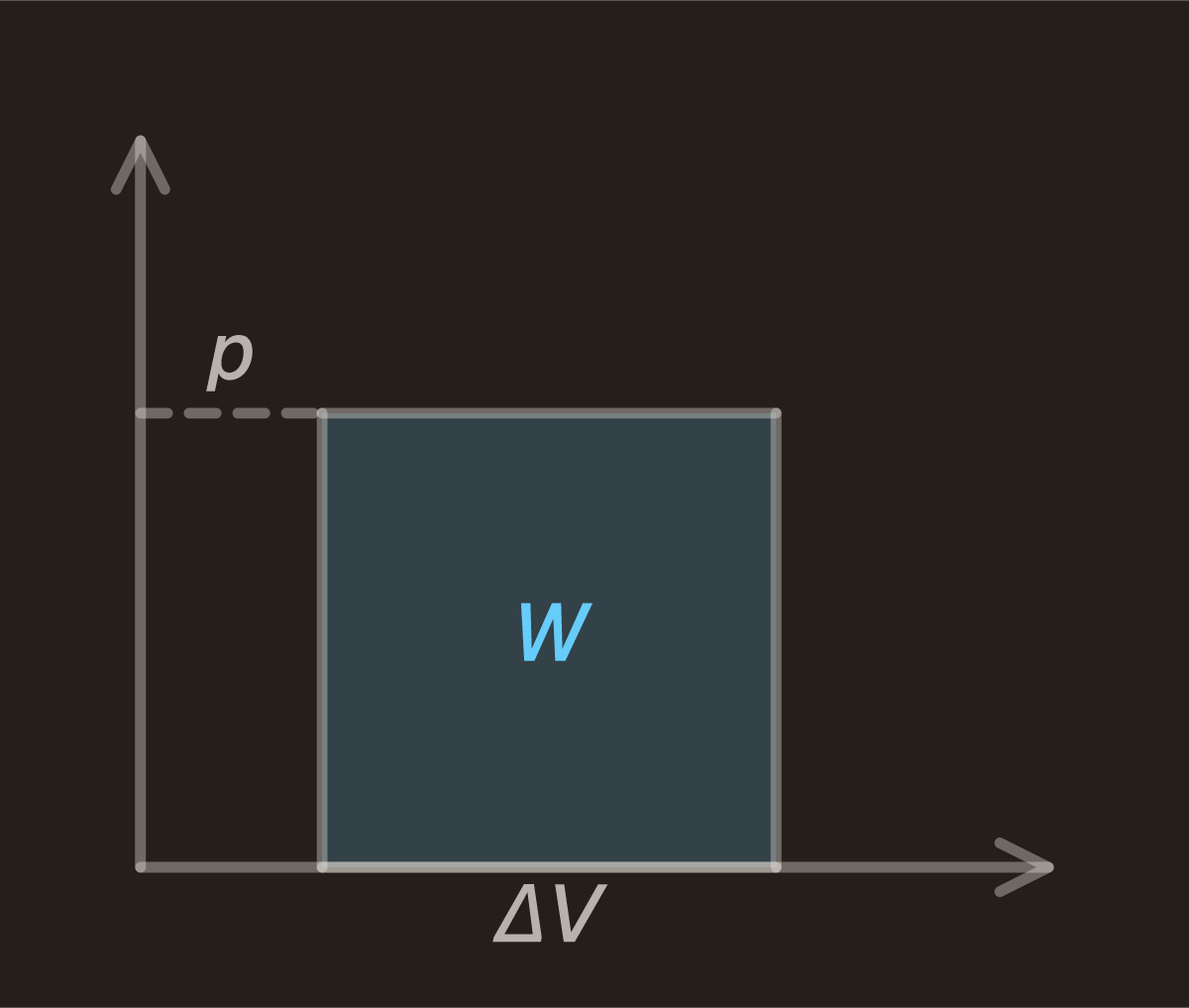
It is the area under the curve. At constant pressure the curve is a horizontal line, and the area is a rectangle of
height p and width ΔV.