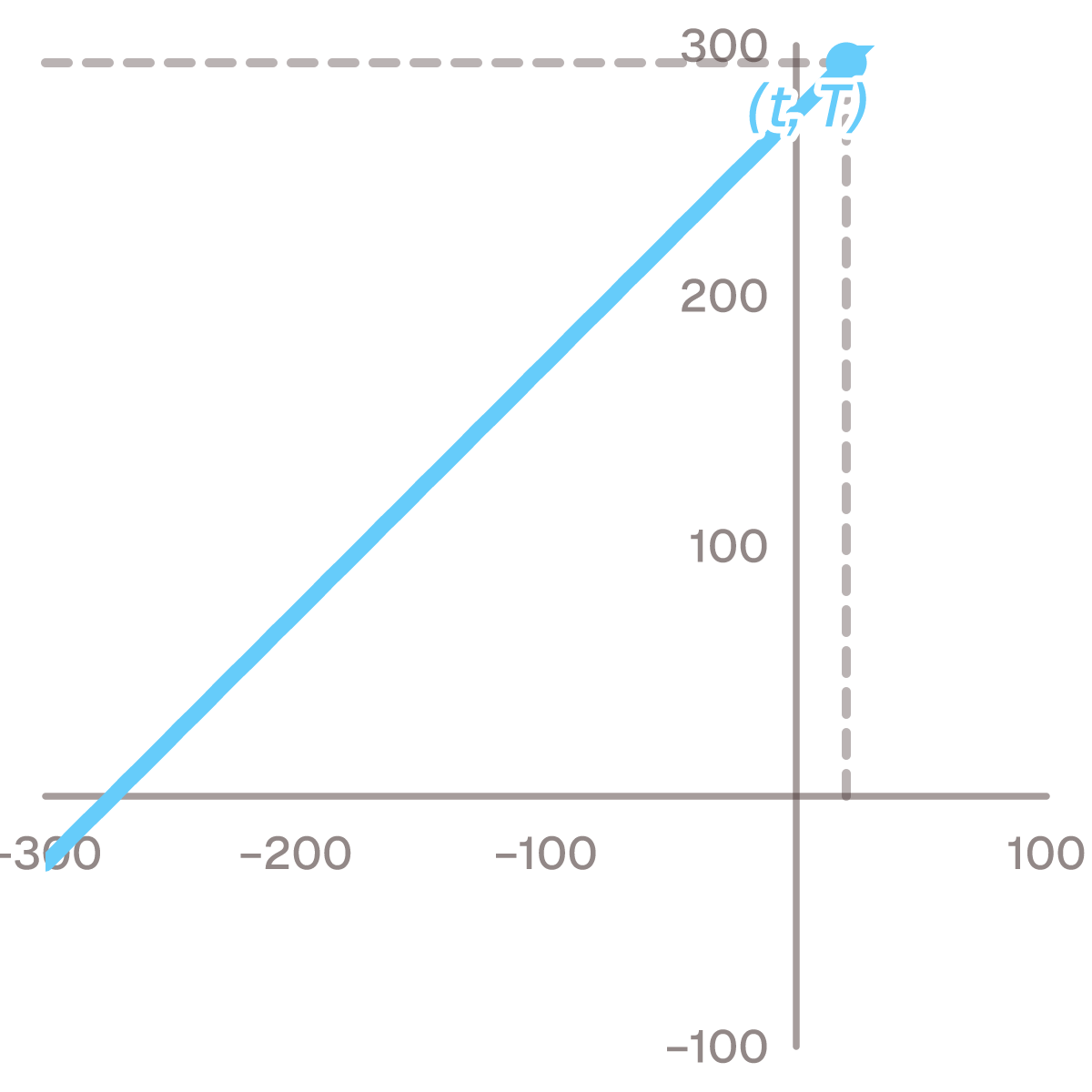
Only the zero point differs
Celsius and kelvin are the same scale with different starting points. One degree is exactly the same
size in both. That is the difference from
Fahrenheit, where both the starting point
and the degree differ, and it makes kelvin far easier to work with.
Kelvin starts at absolute zero — the lowest temperature there is, where a substance cannot give up
any more energy. The molecules still do not stand completely still; quantum mechanics leaves a zero-point
energy behind. It lies 273.15 Celsius degrees below the freezing point of water. So no degree
symbol is written with kelvin: it is 300 K, not 300 °K, because the scale does not count degrees
from anything but measures temperature directly.
What usually goes wrong: differences
Because the degree is the same size, something holds here that does not hold for Fahrenheit:
A temperature difference is the same number in °C and in K.
If the temperature rises by 25 °C it rises by 25 K. That is why
heat energy can take ΔT in either °C or K with nothing
converted, and why the specific heat capacity of water is written both as 4,180 J/(kg·°C) and
4,180 J/(kg·K) — it is the same number.
A temperature, though, must be converted. The gas laws are one place where it matters a great deal: in pV = nRT, T is an
absolute temperature, and putting in 20 instead of 293.15 puts the answer out by a factor of more than
fourteen.
Common temperatures
|
°C |
K |
| Absolute zero |
−273.15 |
0 |
| Nitrogen boils |
−195.79 |
77.36 |
| Dry ice (sublimes) |
−78.5 |
194.65 |
| Water freezes |
0 |
273.15 |
| Room temperature |
20 |
293.15 |
| Body temperature |
37 |
310.15 |
| Water boils |
100 |
373.15 |
Every kelvin value ends in .15 when the Celsius temperature is a whole number. If yours ends in anything
else, something has gone wrong.
Where 273.15 comes from
The number is defined, not measured. The SI Brochure gives the relation between the Celsius
temperature t and the thermodynamic temperature T as
t/°C = T/K − 273.15
which is this page’s formula read backwards. Since 2019 the kelvin has been defined through the Boltzmann
constant, and the degree Celsius is defined through the kelvin — the freezing point of water is no longer
the definition but simply a measured value that lands near 273.15 K.
Sources: BIPM, SI Brochure, 9th edition
and NIST, SI Units — Temperature. Both checked
22 September 2026.
Frequently asked questions
Is it “degrees kelvin”?
No. The unit is the kelvin, written K, with no degree sign. “300 kelvin”, not “300 degrees kelvin”. The
name of the unit is lower case; the symbol is a capital K.
Are there temperatures below 0 K?
Not on the ordinary scale. Absolute zero is a lower bound that can be approached but not reached.
Laboratories have got below a billionth of a kelvin but never to zero.
Why not just round to 273?
For school problems accurate to a few per cent it rarely matters. For gas laws and lab reports it does:
0.15 K in 273 is 0.05%, and that is enough to change the third significant figure of the answer.