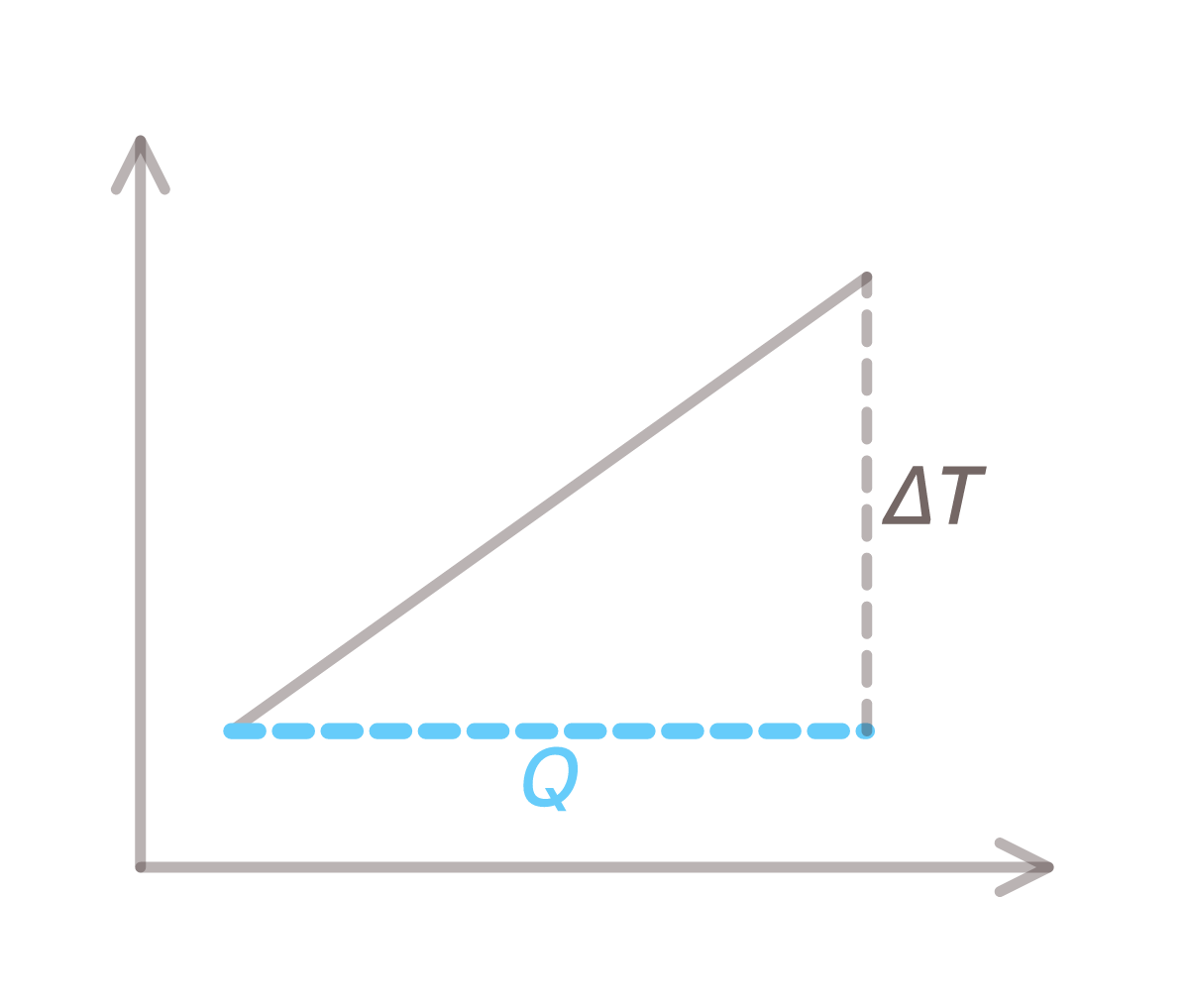
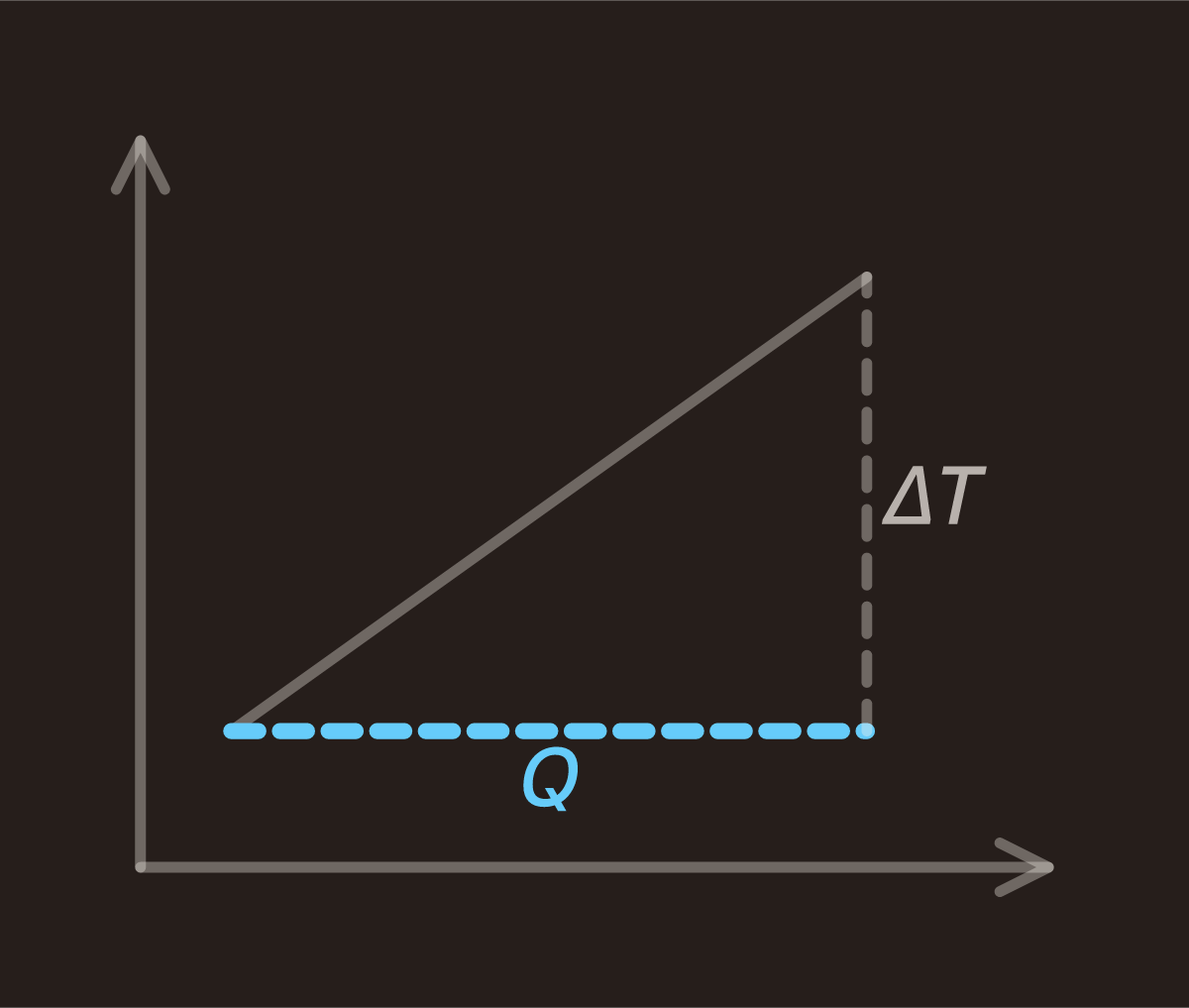
c is the specific heat capacity in J/(kg·°C), m the mass in kilograms, ΔT the temperature change in
degrees and Q the energy in joules. Two litres of water 30 degrees warmer: 4,180 · 2 · 30 =
250,800 J.
Holds when the substance does not change phase and c can be taken as constant over the temperature range.
ΔT is a difference, not a temperature. From 20 °C to 50 °C is ΔT = 30, and because it is a
difference it makes no odds whether you work in celsius or kelvin — the steps are the same size.
Specific heat capacity
The number c says how many joules a kilogram of the substance needs to get one degree warmer. It is a
property of the material, and it varies more than people expect: water takes nearly five times as much
as aluminium and more than thirty times as much as lead. The table at the foot of the page has the values, each
with the source it was read from and the temperature it holds at.
c is an input on the card above rather than a number hidden inside the formula, for the same reason
gravity is on free fall: your own book may quote a different
value, and you should be able to put yours in.
Why water is so slow
Water has one of the highest heat capacities among common substances — more than nine times iron’s. Three
consequences, all the same number seen from different sides:
- The sea warms slowly and cools slowly. It is why coastal climates are milder than inland ones.
- The kettle draws a lot of power. Bringing a litre to the boil from room temperature takes
335,000 J, and to do it in a few minutes the kettle draws about 2,000 W.
- Water makes an excellent coolant. An engine is cooled with water precisely because water can
absorb a lot of energy without getting very hot itself.
Lead is the opposite: a kilogram of lead gets a degree warmer on 130 J, thirty-two times easier to heat
than water.
Worked examples
A cup of tea. 0.25 kg of water from 20 to 100 degrees: 4,180 · 0.25 · 80 = 83,600 J. With a
2,000 W kettle that takes 83,600 / 2,000 ≈ 42 seconds.
A bath. 150 litres from 10 to 40 degrees: 4,180 · 150 · 30 = 18,810,000 J, that is 5.2 kWh.
A piece of iron. 2 kg of iron 100 degrees warmer: 450 · 2 · 100 = 90,000 J — about a ninth
of what two kilograms of water would have taken.
How hot does it get? 50,000 J into 1 kg of aluminium: ΔT = 50,000 / 900 ≈ 56 degrees.
Common mistakes
- Putting in the temperature instead of the change. It is
ΔT, the end minus the start.
- Working in grams. Use kilograms, because
c is per kilogram.
- Using water’s 4,180 for everything. Most materials are below a thousand.
- Forgetting that a change of state does not appear in the formula. Melting ice or boiling water
takes energy without the temperature moving at all, and that is a different formula.
Frequently asked questions
Does the formula hold while something melts or boils?
No. During a change of state the temperature stays put while energy still goes in. Then you work with
the latent heat of fusion or vaporisation instead.
Celsius or kelvin?
It makes no difference, because ΔT is a difference and the steps are the same size on both scales. A
change of 30 degrees is a change of 30 kelvin.
What does heating the bath cost?
Convert joules to kWh by dividing by 3,600,000 and multiply by your electricity price. The bath above
comes to 5.2 kWh.