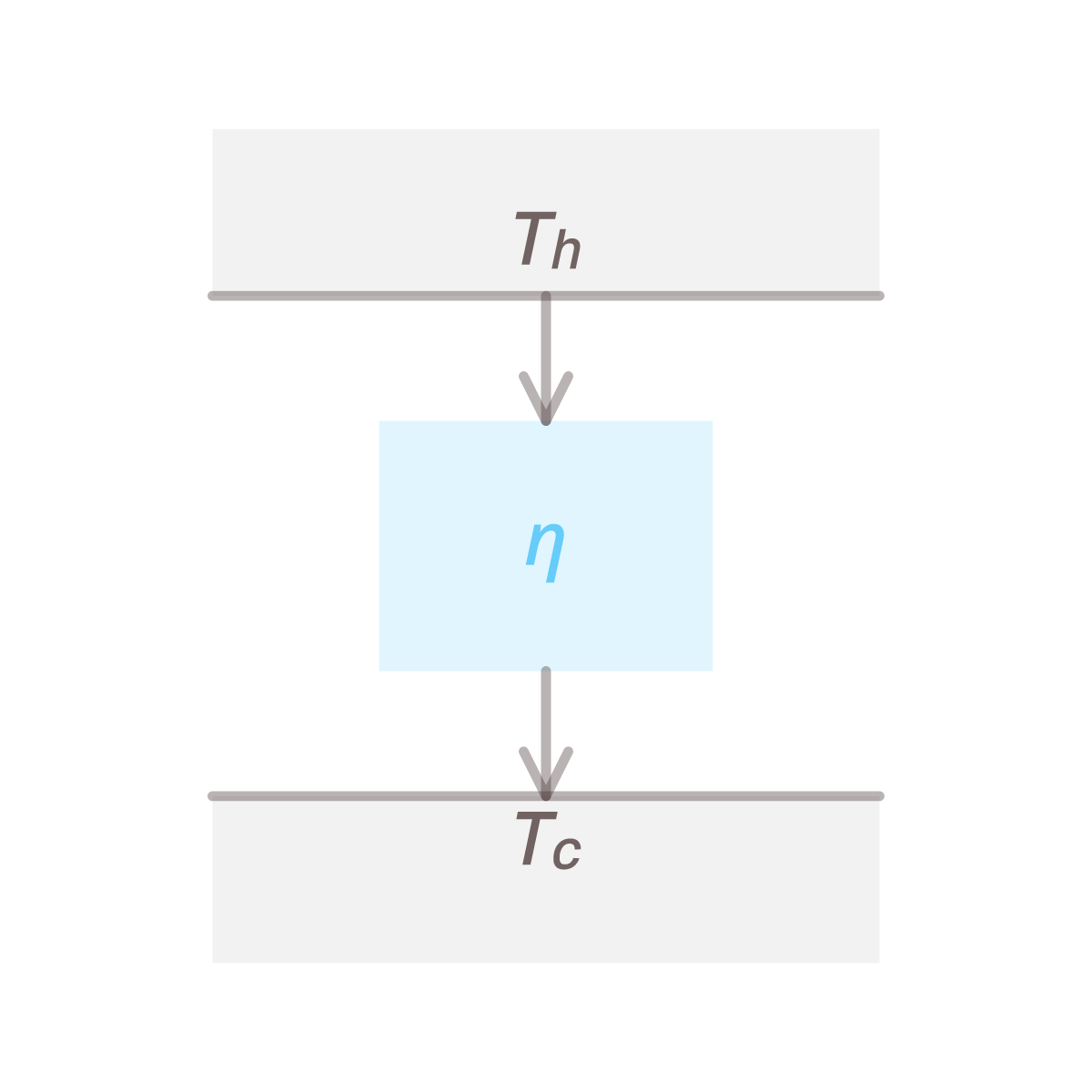
Th is the temperature of the hot reservoir, Tc that of the cold one, both in
kelvin, and η (eta) the highest possible efficiency in percent.
Holds for a heat engine between two reservoirs at fixed temperatures. Only an ideal, reversible engine
reaches the ceiling.
An engine between 600 K and 300 K: (1 − 300 / 600) · 100 = 50%.
Why there is a ceiling
A heat engine takes heat from something hot, turns part of it into work and releases the rest to something
cold. The rest has to go — otherwise the engine would draw heat from a single source and turn all of it
into work, which the second law of thermodynamics forbids.
Sadi Carnot showed in 1824 how small that rest can be, and that it depends only on the temperatures. The
fuel, the gas, the design make no difference. Real engines never reach the ceiling, but they can never
pass it.
Kelvin, not Celsius
The formula rests on the ratio of the temperatures, and a ratio needs a scale that starts at
absolute zero.
A power station with steam at 550 °C and cooling water at 25 °C:
- Right: 550 °C = 823 K and 25 °C = 298 K, so η = 1 − 298 / 823 ≈ 64%.
- Wrong: 1 − 25 / 550 ≈ 95%.
Worked examples
The power station. The ceiling is 64%. Real steam power stations reach about 40%, and the rest
leaves as heat in the cooling water — or goes to district heating, where it is useful after all.
Ocean heat. Surface water at 25 °C and deep water at 5 °C: 1 − 278 / 298 ≈ 6.7%. That is why
making electricity from the ocean’s temperature difference is so hard.
How hot does it need to be? For a ceiling of 70% with cooling at 300 K you need
Th = 300 / (1 − 0.7) = 1,000 K, about 730 °C.
Common mistakes
- Degrees Celsius. Always kelvin.
- Swapping the temperatures. The cold one goes on top. The answer has to be below 100%.
- Thinking a good enough engine could reach 100%. Only if the cold side were at 0 K, and nothing gets
there.
Frequently asked questions
How does it differ from ordinary efficiency?
Efficiency is useful energy over energy supplied, for a
real machine. The Carnot efficiency is the highest that ratio can ever be for a heat engine.
Does the ceiling apply to electric motors?
No. An electric motor does not turn heat into work, so it has no Carnot ceiling and can pass 95%.