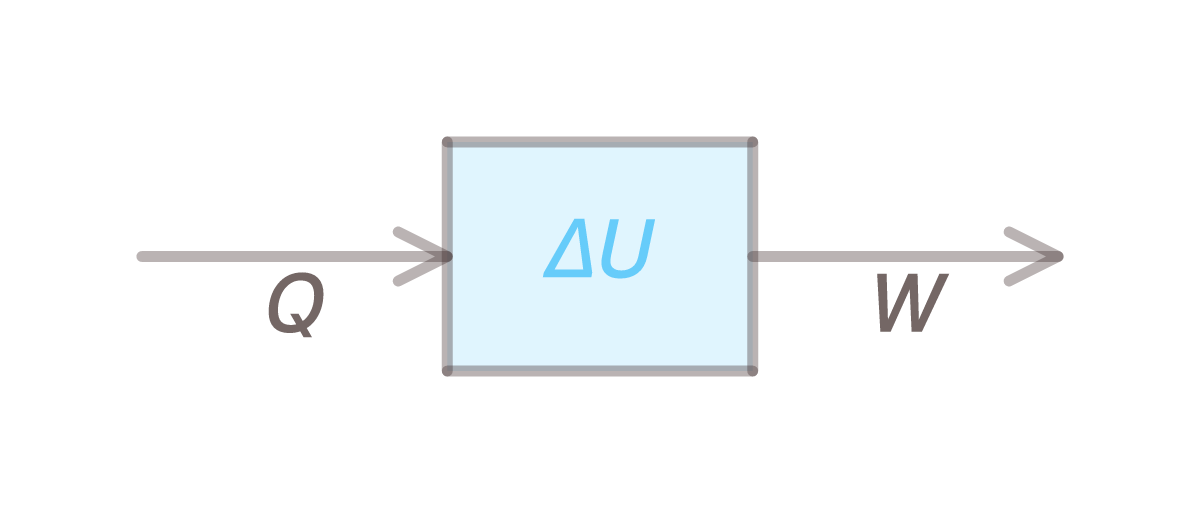
Q is the heat added to the system, W the work the system does on its surroundings and ΔU the change
in the system’s internal energy. All in joules.
Holds for a closed system, with no matter crossing its boundary, using the signs in the table below.
A gas takes in 500 J of heat and pushes a piston out with 200 J of work: ΔU = 500 − 200 = 300 J.
The signs
The arithmetic is simple; the signs need thought:
|
Positive |
Negative |
| Q |
Heat flows into the system |
Heat leaves the system |
| W |
The system does work (expands) |
Work is done on the system (compressed) |
| ΔU |
Internal energy rises (usually warmer) |
Internal energy falls |
Note: some books write ΔU = Q + W and take W as the work done on the system. It is the same law
with the sign of W reversed. Check which your book uses.
What it says
The first law is energy conservation for a system that can both be heated and do work. The internal
energy is the sum of all the molecules’ kinetic and potential energy, and it can only change in two ways:
heat flowing in or out, or work being done.
When no work is done, ΔU = Q, and for a liquid or a solid that becomes
Q = c · m · ΔT.
Worked examples
The bicycle pump. You compress the air with 300 J of work, so fast that no heat escapes: Q = 0 and
W = −300. ΔU = 0 − (−300) = +300 J. The air heats up, and you feel it on the pump.
The engine. The gas in a cylinder gets 2,000 J of heat from combustion and pushes the piston with
800 J: ΔU = 2,000 − 800 = 1,200 J left in the gas, which leaves with the exhaust.
Constant temperature. An ideal gas expanding slowly at constant temperature has ΔU = 0, so Q = W:
all the heat added becomes work.
Common mistakes
- Mixing sign conventions. Decide what W means before you calculate.
- Treating heat and temperature as the same thing. Heat is energy on the move; temperature says
how large the molecules’ average kinetic energy is.
- Forgetting that work done on the system raises U. Compressed gas gets warmer, with no flame.
Frequently asked questions
Can an engine do more work than the heat it takes in?
No. That would mean creating energy from nothing, which is exactly what the first law forbids. The
second law goes further: not even all the heat can become work. See
Carnot efficiency.