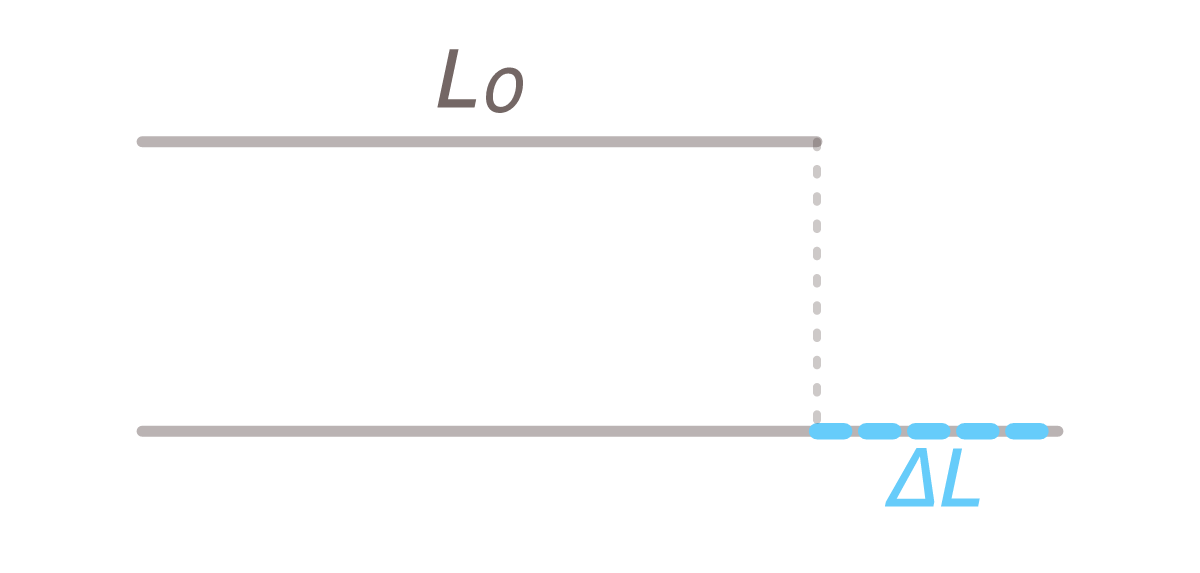
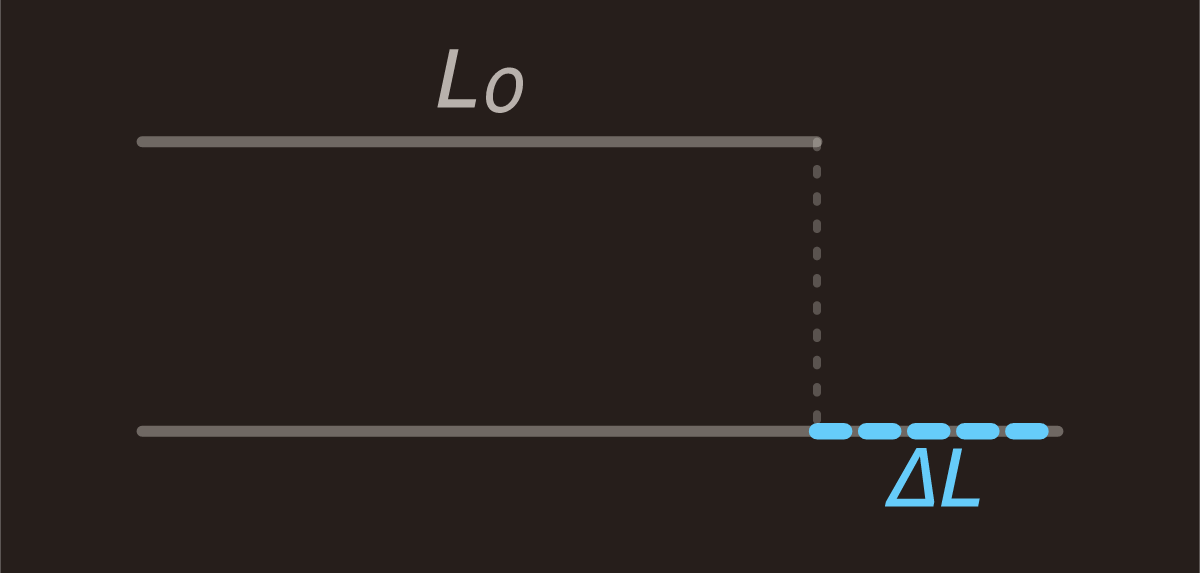
L₀ is the original length, α (alpha) the material’s coefficient of linear expansion per kelvin, ΔT
the change in temperature and ΔL how much longer it gets, in the same unit as L₀.
Holds for solids over moderate temperature differences, where α can be taken as constant.
100 m of steel rail warming by 25 degrees: 100 · 10.7 · 10⁻⁶ · 25 ≈ 0.027 m, just under 3 cm.
Coefficients
| Material |
α (per K), at 20 °C |
| Carbon steel |
10.7 · 10⁻⁶ |
| Iron |
11.8 · 10⁻⁶ |
| Concrete |
9.8 · 10⁻⁶ |
| Copper |
16.5 · 10⁻⁶ |
| Aluminium |
23.1 · 10⁻⁶ |
| Float glass |
7.5 · 10⁻⁶ |
| Borosilicate glass |
2.8 · 10⁻⁶ |
The numbers are small, but they are multiplied by long lengths and large temperature swings. They come
from the table of expansion coefficients, with a
source for every row. Textbooks often round steel to 12 · 10⁻⁶; an alloy can differ from carbon steel.
Worked examples
The Eiffel Tower. 300 m of iron, from −10 °C on a winter night to 30 °C on a summer day:
300 · 11.8 · 10⁻⁶ · 40 ≈ 0.14 m. The tower is about 14 cm taller in summer.
A kilometre of rail. Between −25 °C and 35 °C, ΔT = 60: 1,000 · 10.7 · 10⁻⁶ · 60 ≈ 0.64 m. Without
joints or pre-tensioning the rail would buckle.
An aluminium window frame. A 2 m frame warming by 40 degrees: 2 · 23.1 · 10⁻⁶ · 40 ≈ 1.8 mm. The
wall has to leave room for it.
Why reinforced concrete works
Steel and concrete have almost the same α. They grow and shrink together, so the reinforcement stays put
and the concrete does not crack from temperature.
Common mistakes
- Dropping the power of ten. α is often listed as “12” in a table with “· 10⁻⁶” in the heading.
- Celsius or kelvin? It makes no difference here, since it is a temperature difference. 25 degrees
is 25 kelvin.
- Using the final length as L₀. The change is so small it rarely shows, but L₀ is the length before
heating.
Frequently asked questions
Why does a stuck jar lid loosen under hot water?
The metal lid has a larger α than the glass jar. Warm both, and the lid grows more and lets go.
What about volume?
Volume grows about three times as much, relatively: the volume expansion coefficient of a solid is about
3α.