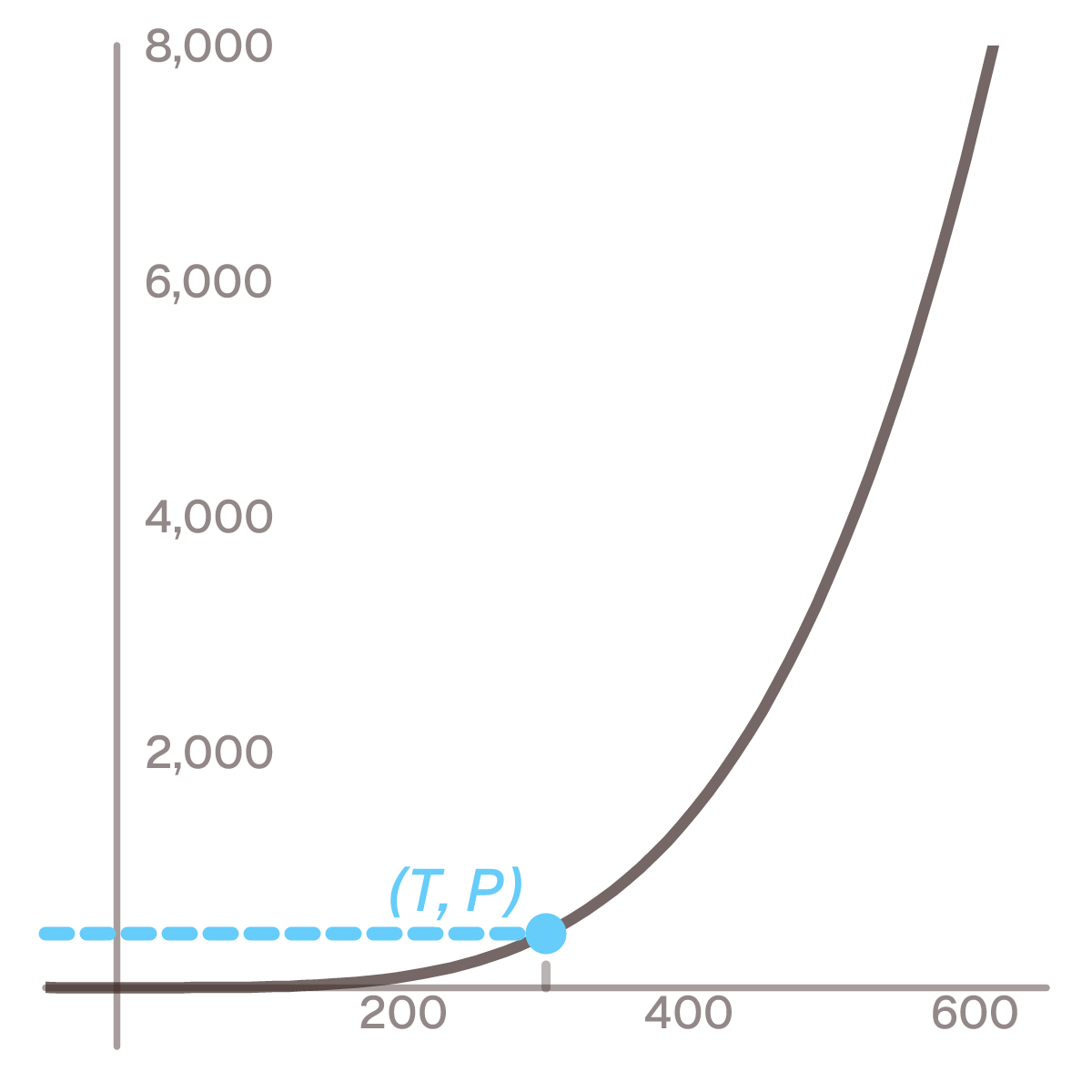
σ is the Stefan–Boltzmann constant, 5.670 · 10⁻⁸ W/(m²·K⁴), A the surface area in square metres,
T the absolute temperature in kelvins and P the radiated power in watts.
Holds for a black body, one that absorbs every wavelength falling on it. Real surfaces
radiate less by a factor ε, the emissivity, between 0 and 1: P = ε · σ · A · T⁴. Skin, matt paint and soot
are close to 1; polished metal is far below.
Worked examples
One square metre at room temperature, 300 K: P = 5.670 · 10⁻⁸ · 1 · 300⁴ ≈ 459 W.
One square metre of the Sun’s surface, 5,800 K: P ≈ 6.4 · 10⁷ W, 64 megawatts from each square
metre.
Double the temperature, 600 K: 2⁴ = 16, so the power is sixteen times as large, about 7.3 kW per
square metre.
You radiate too
A person has about 1.8 m² of skin at about 306 K and radiates σ · 1.8 · 306⁴ ≈ 895 W. The walls of a room
at 293 K radiate almost as much back, and the net loss is
- σ · 1.8 · (306⁴ − 293⁴) ≈ 143 W
of the same order as the heat a resting body produces. That is why a room with cold walls feels chilly even
when the air is warm: the walls are sending less back.
Common mistakes
- Using Celsius. At 27 °C, T is 300. With 27 the answer is wrong by a factor of over 15,000.
- Forgetting the return radiation. A body at 306 K in a room at 293 K does not lose 895 W; it loses the
difference.
- Treating every surface as black. For polished metal or a low-emissivity window coating, ε changes the
answer many times over.
Questions people ask
What colour does the radiation have?
That depends on the temperature too, and Wien’s displacement law
gives the peak wavelength. At room temperature it is deep in the infrared, so thermal cameras
can see people in the dark.
Can it tell the temperature of a star?
Yes, turned around. Knowing a star’s total power and its radius, T = (P / (σA))^(1/4) gives its surface
temperature.