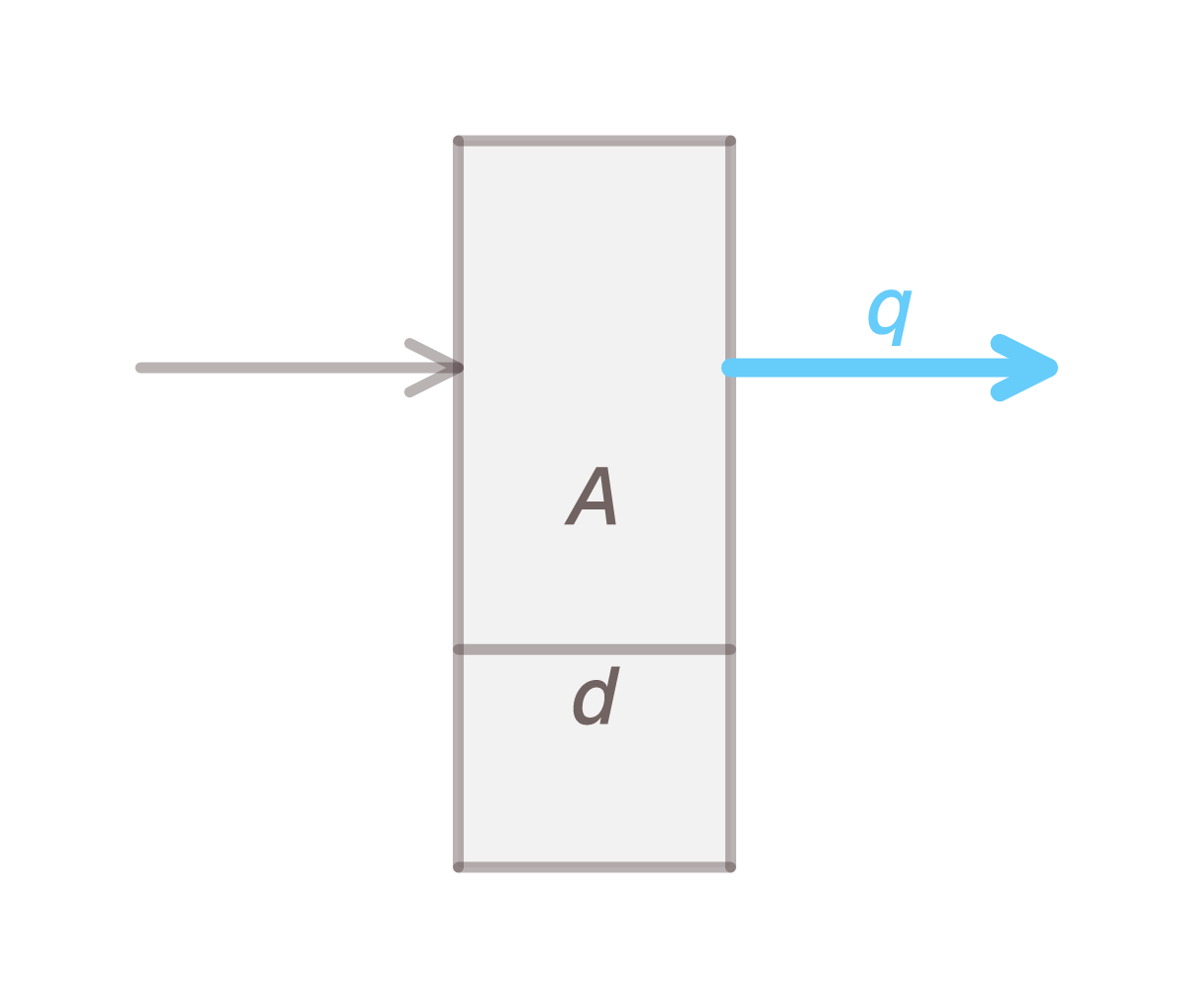
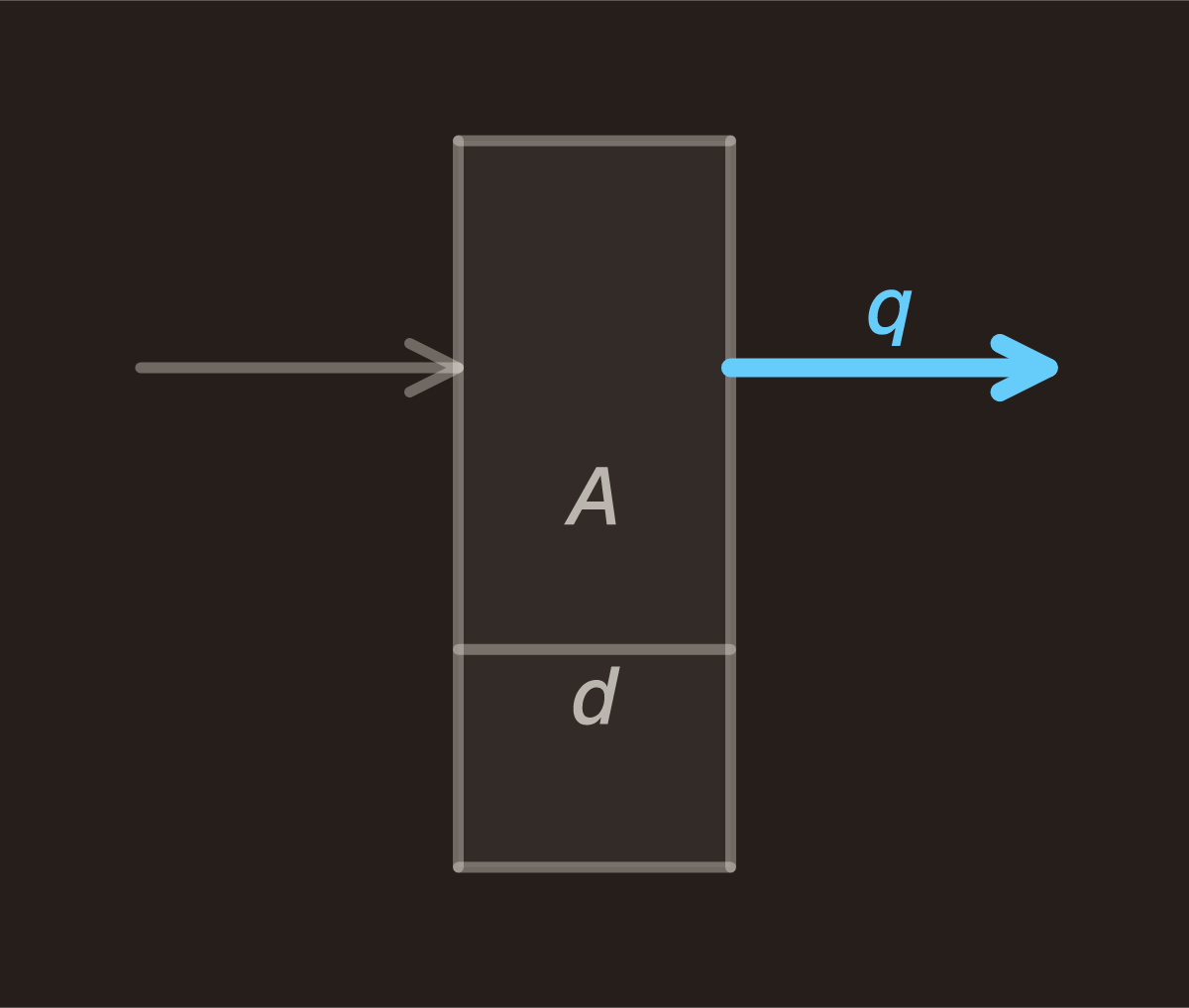
k is the thermal conductivity of the material in W/(m·K), A the area in square metres, ΔT the
temperature difference between the two faces in kelvins (or degrees Celsius — a difference is the same in
both), d the thickness in metres, and q the rate of heat flow in watts.
It is also called Fourier’s law.
Holds for a flat slab in a steady state: the temperatures on each side are held fixed, and the heat flows
straight through.
| Material |
k, W/(m·K) |
| Copper (0 °C) |
403 |
| Carbon steel (0 °C) |
52 |
| Brick, dense |
1.31 |
| Window glass |
0.96 |
| Pine |
0.12 |
| Mineral wool |
0.04 |
| Still air (0 °C) |
0.024 |
The values come from the table of thermal conductivities,
which states the source and temperature for every row. Stainless steel conducts only 14.5, so “steel”
with no further detail is a rough figure.
Worked examples
A pane of glass. k = 0.96, A = 2 m², ΔT = 15 K and d = 4 mm:
q = 0.96 · 2 · 15 / 0.004 = 7,200 W.
The same area of insulated wall. Mineral wool with k = 0.04, 20 cm thick:
q = 0.04 · 2 · 15 / 0.2 = 6 W. More than a thousand times less, from a material 25 times worse at
conducting and 50 times thicker.
Why a real window loses far less than 7,200 W
The formula counts only the glass. In a real window, a thin layer of almost still air clings to each side,
and air conducts about forty times worse than glass. Those two films, not the glass, set most of the
resistance, which is why a double-glazed window works: the gap between the panes is another layer of air.
To add layers in series, add their resistances d / (k · A) and divide ΔT by the sum, the way resistors in
series share a voltage.
Common mistakes
- Thickness in centimetres or millimetres. With k in W/(m·K), d must be in metres; 4 mm is 0.004.
- Mixing up conductivity and the U-value. A U-value, used for building parts, already includes the
thickness and the air films: q = U · A · ΔT.
- Using it while temperatures change. The formula is for a steady state. A wall heating up in the
morning sun stores heat as well as passing it on.
Questions people ask
Why does metal feel colder than wood at the same temperature?
Metal conducts heat away from your hand hundreds of times faster, so your skin cools more quickly. Your
fingers sense heat flow, not temperature.
Is this the only way heat moves?
No. Conduction is one of three; the others are convection, where a fluid carries heat with it, and
radiation, which the Stefan–Boltzmann law
describes.