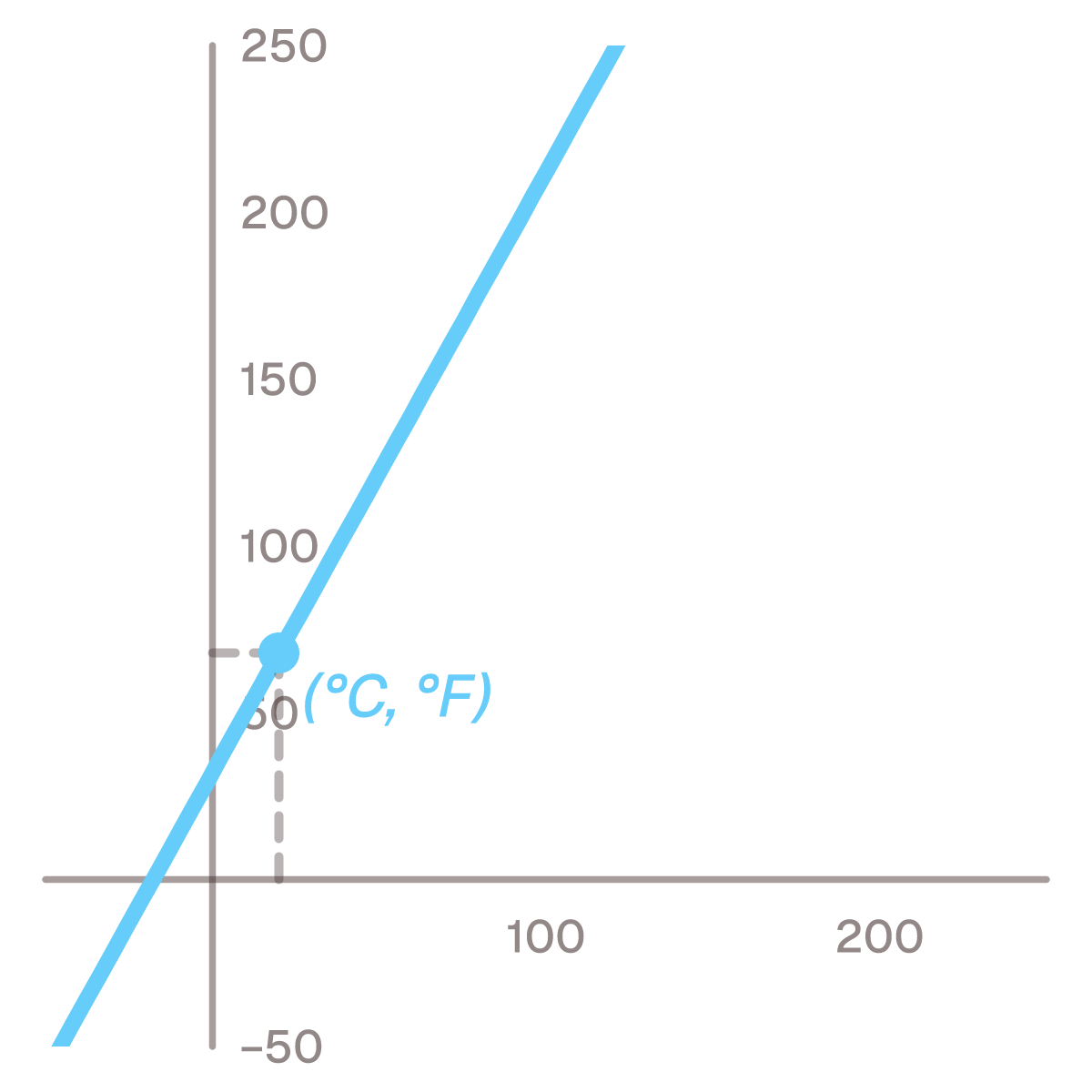
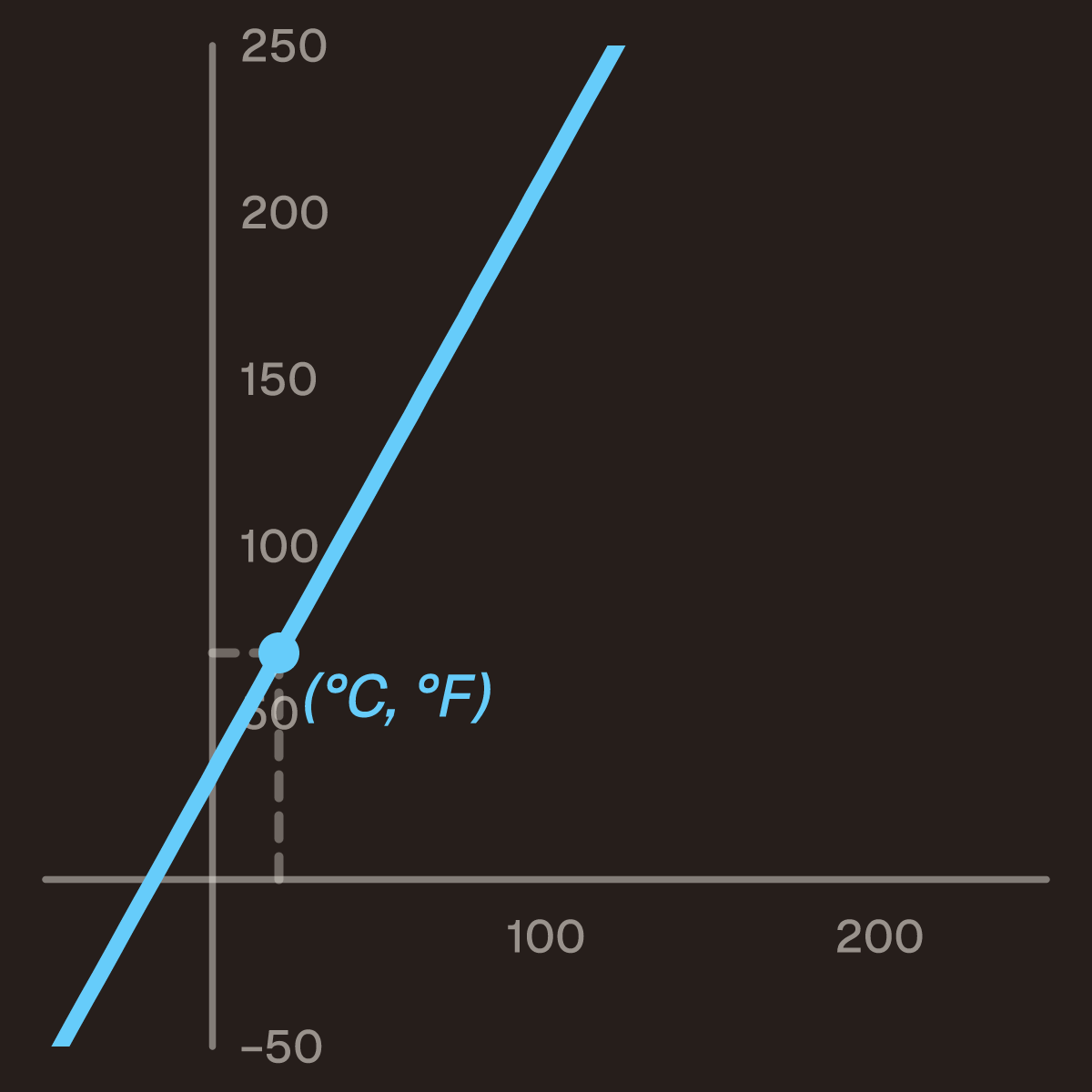
Two numbers to keep straight
The conversion is made of two things, and they do different jobs:
- The factor 9/5. One Celsius degree is 1.8 Fahrenheit degrees. The scales count at different rates.
- The offset 32. Water freezes at 0 °C but at 32 °F. The scales start in different places.
Both are needed, and the order is fixed: multiply first, then add. Add the 32 before you multiply and
the factor scales the offset up as well, which is wrong.
Going the other way is the same thing backwards: subtract 32 first, then divide by 9/5 (that is, multiply
by 5/9). The derivation under the formula does exactly those steps.
Common temperatures
|
°C |
°F |
| Absolute zero |
−273.15 |
−459.67 |
| Cold winter day |
−20 |
−4 |
| Water freezes |
0 |
32 |
| Refrigerator |
5 |
41 |
| Room temperature |
20 |
68 |
| Warm summer day |
30 |
86 |
| Body temperature |
37 |
98.6 |
| Sauna |
90 |
194 |
| Water boils |
100 |
212 |
−40 is the same number on both scales. It is the one temperature where they meet, and it follows
straight from the formula: set °F = °C and solve, and you get −40. It makes a good check on your
arithmetic.
In your head
Roughly. Double it and add 30. 20 °C ≈ 70 °F (the real answer is 68). The error grows with the
temperature, but for weather it will do.
Exactly, without fractions. Multiply by 9, divide by 5, add 32. For 35 °C: 35 · 9 = 315, 315 / 5 = 63,
63 + 32 = 95 °F.
From Fahrenheit. Subtract 32, divide by 9, multiply by 5. For 86 °F: 86 − 32 = 54, 54 / 9 = 6,
6 · 5 = 30 °C.
Differences do not convert the same way
This is a common trap, and it has nothing to do with mental arithmetic. If the temperature rises by
10 °C it rises by 18 °F, not by 50 °F. The offset of 32 is about where you are on the scale, not about
how far you have moved.
- A temperature converts with °F = °C · 9/5 + 32.
- A temperature difference converts with ΔF = ΔC · 9/5.
The same thing matters when you work out heat energy:
there ΔT is a difference, and a difference in °C is the same number as a difference in kelvin — but not
the same number as a difference in °F.
Where the scales come from
Fahrenheit is the older one. In 1724 Daniel Gabriel Fahrenheit put his zero at the lowest temperature he
could reach with ice, water and ammonium chloride, and 96 at body temperature. In 1742 Anders Celsius
proposed a scale with 100 steps between the freezing and boiling points of water — originally with 0 at
boiling and 100 at freezing, the reverse of today.
Both scales are now defined from the kelvin rather than from water, and the conversion between them is
exact rather than measured. NIST prints it under the heading “Temperature Conversion (Exact)”
(NIST, SI Units — Temperature, checked
22 September 2026).
Frequently asked questions
Which countries use Fahrenheit?
The United States above all, plus a few smaller places — the Bahamas, Belize, the Cayman Islands, Palau
and a handful of others. The United Kingdom is officially Celsius but Fahrenheit still turns up in
weather reporting. The rest of the world uses Celsius.
Why 9/5 in particular?
Between the freezing and boiling points of water there are 100 Celsius degrees but 180 Fahrenheit
degrees (212 − 32). The ratio 180/100 is 9/5.
Is 1.8 the same as 9/5?
Yes, exactly the same number. 9/5 is easier in your head when you are dividing by 5 anyway, and 1.8 is
easier on a calculator.