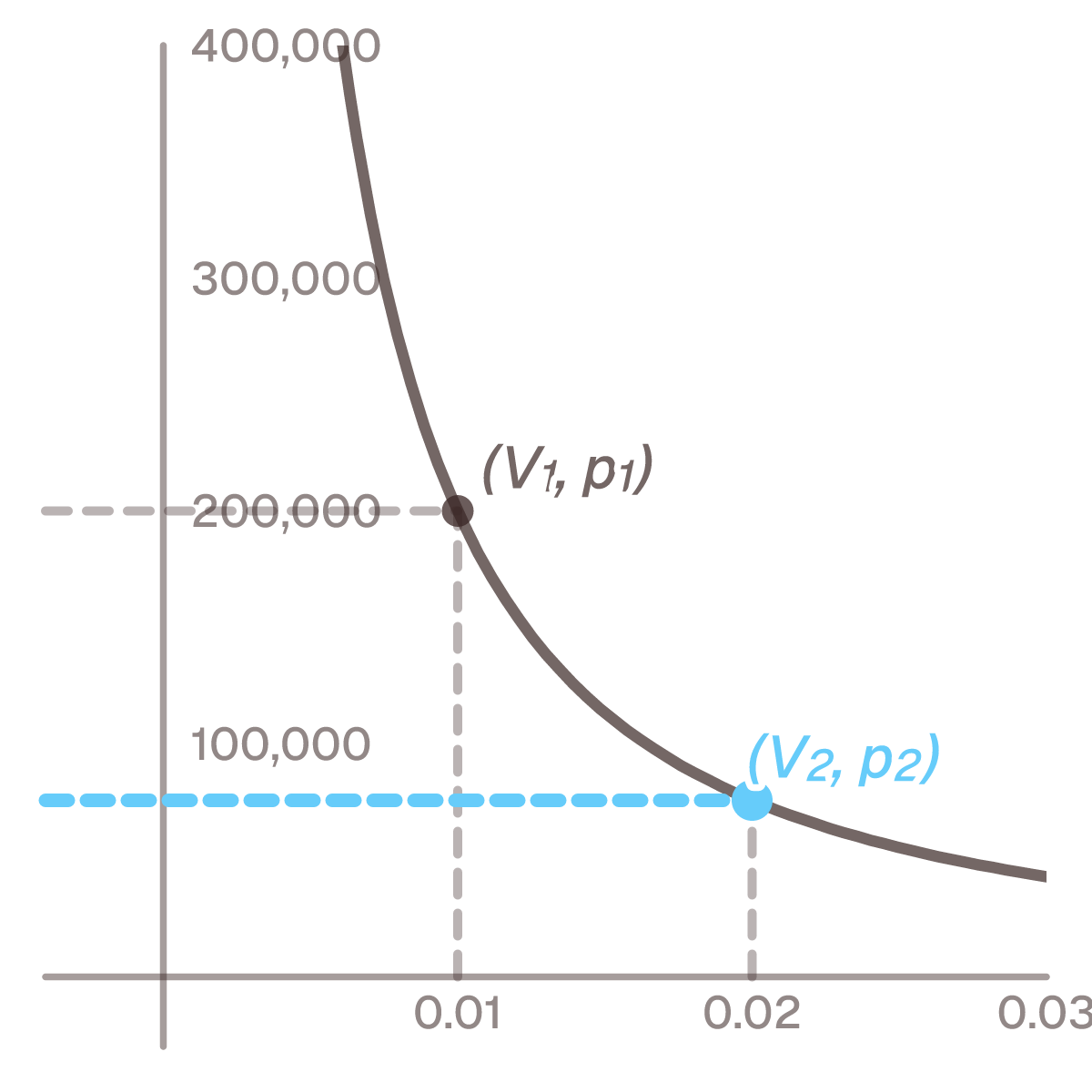
p₁ and V₁ are the pressure and volume before, p₂ and V₂ after, and γ the heat capacity ratio
c_p / c_v of the gas. No heat enters or leaves, so any work done on the gas goes straight into its internal
energy, and the temperature follows:
- T₁ · V₁^(γ−1) = T₂ · V₂^(γ−1)
Holds for an ideal gas changing with no heat exchange and no friction, with γ constant.
| Gas |
γ |
| Monatomic (helium, argon) |
5/3 ≈ 1.67 |
| Diatomic (air, nitrogen, oxygen) |
7/5 = 1.4 |
Worked examples
Air at 200 kPa expands from 10 L to 20 L: p₂ = 200,000 · (10 / 20)^1.4 ≈ 75.8 kPa.
An isothermal expansion over the same volumes ends at
100 kPa, as Boyle’s law would give. The adiabatic gas ends
lower because it has also cooled: it paid for its work out of its own internal energy.
The diesel engine. Air at 1 bar and 293 K is compressed to 1/18 of its volume. The pressure becomes
18^1.4 ≈ 57 bar, and the temperature 293 · 18^0.4 ≈ 931 K, about 658 °C. That is hot enough to
ignite the fuel as it is injected, which is why a diesel needs no spark plug.
Adiabatic or isothermal?
The two are the extremes. A change that is slow, in a container that conducts well, stays at the
temperature of the surroundings. A change that is fast, or well insulated, has no time to exchange heat.
Sound waves are adiabatic: the compressions come and go far too quickly for heat to follow, and the speed
of sound depends on γ for that reason.
Common mistakes
- Leaving out γ. p₁V₁ = p₂V₂ is the isothermal law. With γ = 1.4 the result differs noticeably.
- Using γ − 1 in the pressure formula. The pressure law has γ; the temperature law has γ − 1.
- Using Celsius in the temperature form. The temperatures must be in kelvins.
Questions people ask
Why does a bicycle pump get hot?
Each stroke compresses the air quickly, close to adiabatically, so the work you do raises its temperature.
Some of that heat reaches the barrel.
Does adiabatic mean the temperature is constant?
No, it means no heat is exchanged. The temperature changes precisely because no heat can flow in or out to
hold it steady.