Mass–luminosity relation
The relation
L
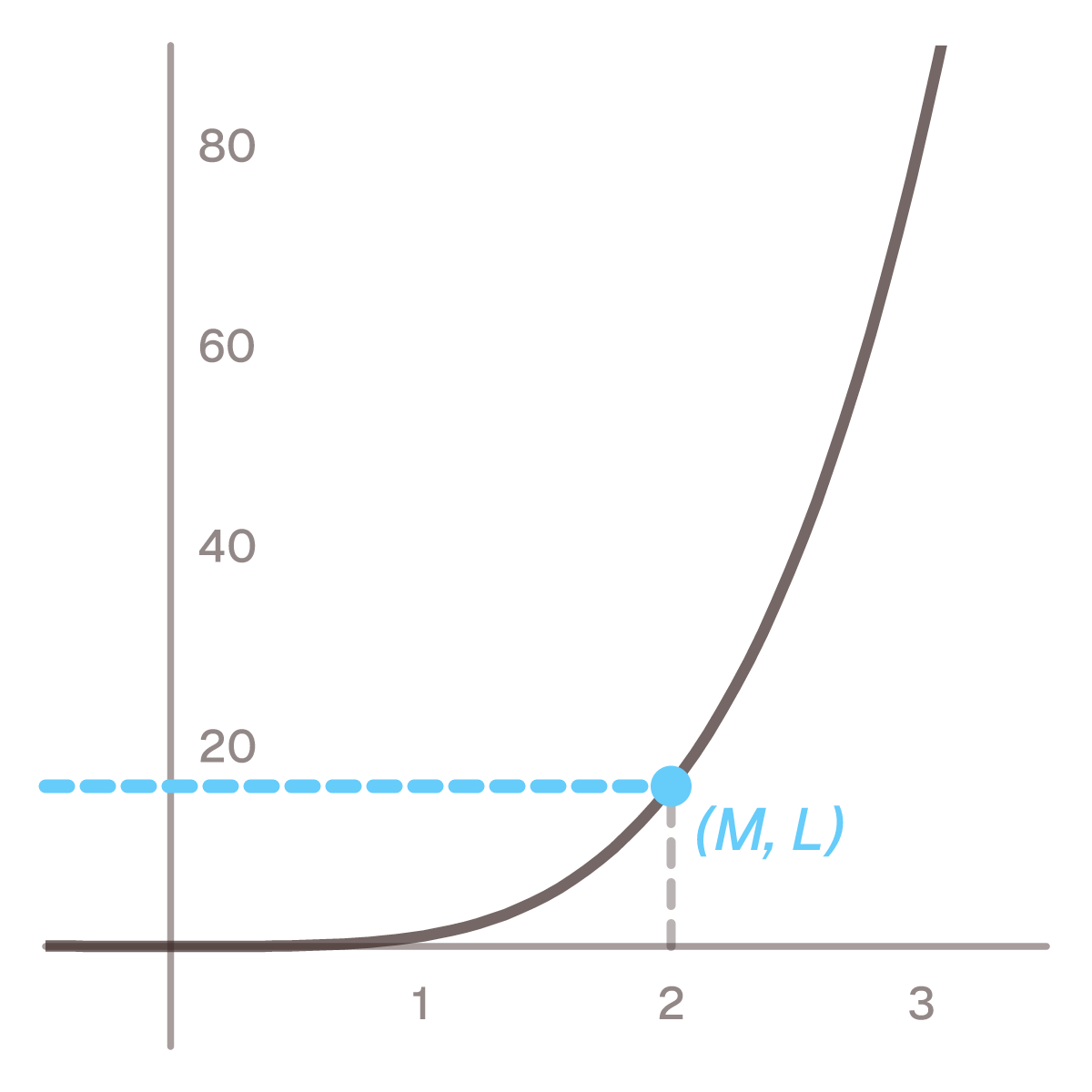
A main-sequence star twice as massive as the Sun shines about 16 times as brightly. Mass and luminosity are both in solar units.
Solve for
L=16
L equals 2 to the power of 4, equals 16
Den här sidan finns på svenska. Byt till svenska
A star twice the Sun's mass shines about sixteen times as brightly. Small differences in mass make large differences in light.
In Swedish: Mass-luminositetsrelationen
L
A main-sequence star twice as massive as the Sun shines about 16 times as brightly. Mass and luminosity are both in solar units.
L=16
L equals 2 to the power of 4, equals 16
You are given
Round to 2 decimals.
Source: Fraknoi A, Morrison D, Wolff SC (2022). Astronomy 2e, §18.2 Measuring Stellar Masses. OpenStax, Rice University. — checked October 7, 2026
M is the star’s mass in solar masses, L its luminosity in solar luminosities and a an exponent that is
measured, not derived. The card opens on a = 4, which the textbook Astronomy 2e (OpenStax) works with;
other textbooks print a = 3.5. Change the exponent if yours uses another.
Holds approximately when the star is on the main sequence, burning hydrogen in its core, like the Sun. Red giants and white dwarfs do not follow it, and for the lightest and heaviest stars the exponent is smaller.
Twice the Sun’s mass. L = 2⁴ = 16 solar luminosities. With a = 3.5 it is 2^3.5 ≈ 11.
A third of the mass. L = (1/3)⁴ = 1/81: the star shines 81 times more faintly than one three times as massive.
Sirius from its luminosity. Sirius A has a luminosity of about 23 solar luminosities. Then M = 23^(1/4) ≈ 2.2 solar masses.
A star of ten solar masses has ten times the fuel but burns it 10⁴ = 10,000 times as fast. It lives about a thousandth as long as the Sun, around ten million years rather than ten billion.
| Mass | L with a = 4 | L with a = 3.5 |
|---|---|---|
| 0.5 | 0.06 | 0.09 |
| 1 | 1 | 1 |
| 2 | 16 | 11 |
| 5 | 625 | 280 |
| 10 | 10,000 | 3,160 |
Luminosity connects to how bright the star looks through Pogson’s relation and the distance.
Why does luminosity climb so fast with mass?
A heavier star has higher pressure and temperature in its core, and fusion runs much faster when hotter.
How are stellar masses measured?
In binary stars, from the orbital period and the separation of the two stars using Kepler’s third law.
Is the exponent 3.5 or 4?
Both are in use. Different samples of stars give different fits, which is why the exponent can be changed
on the card.
| Solve for | Rearranged | With the numbers | Comes to |
|---|---|---|---|
| M | L1a | 1614 | 2 |
| a | ln(L)ln(M) | ln(16)ln(2) | 4 |
| L | Ma | 24 | 16 |
Last reviewed October 7, 2026 ·How pages are reviewed
Copy the code into your page where the formula card should appear. It loads from lovetocalc.com, so it stays current on its own — all we ask is that the credit line comes with it.