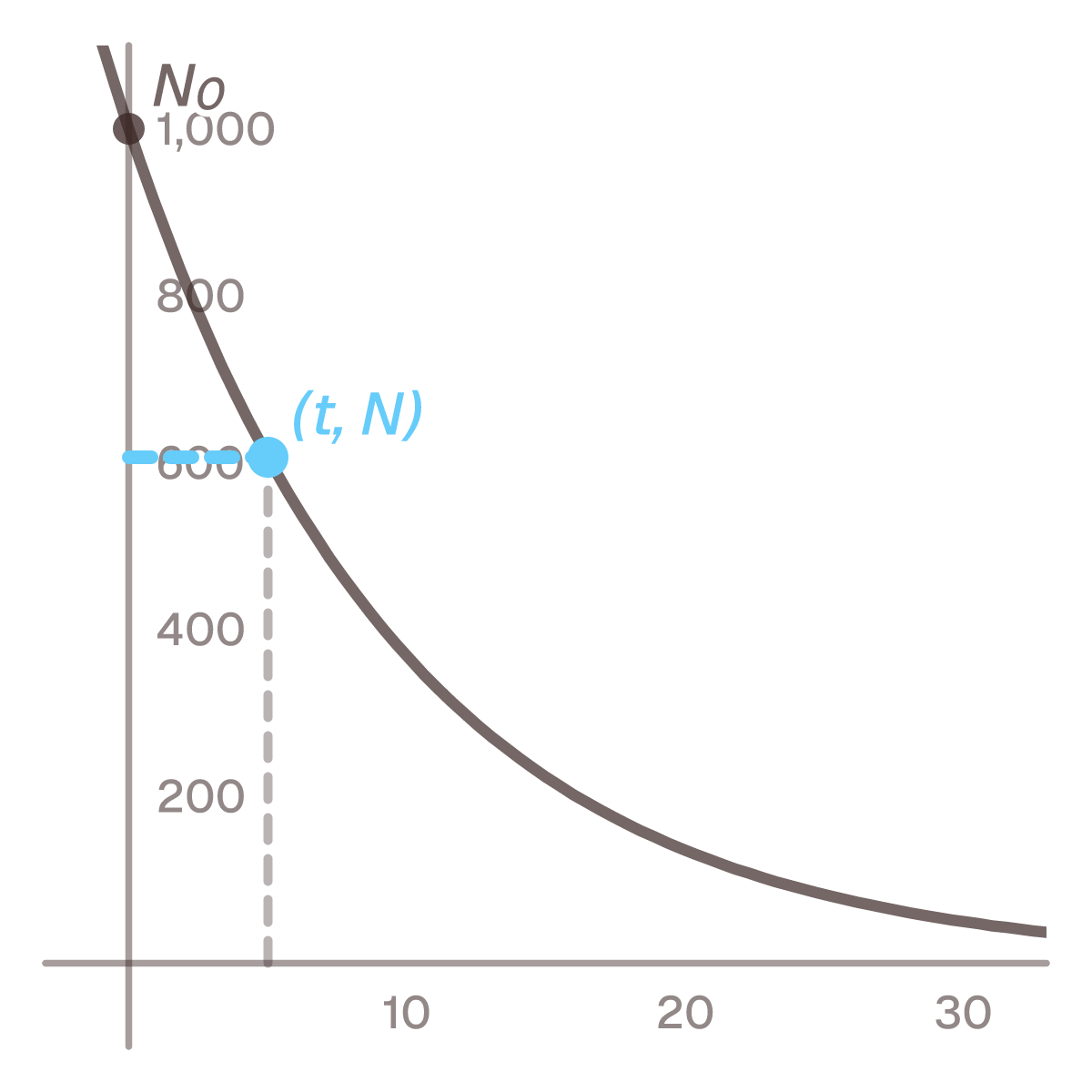
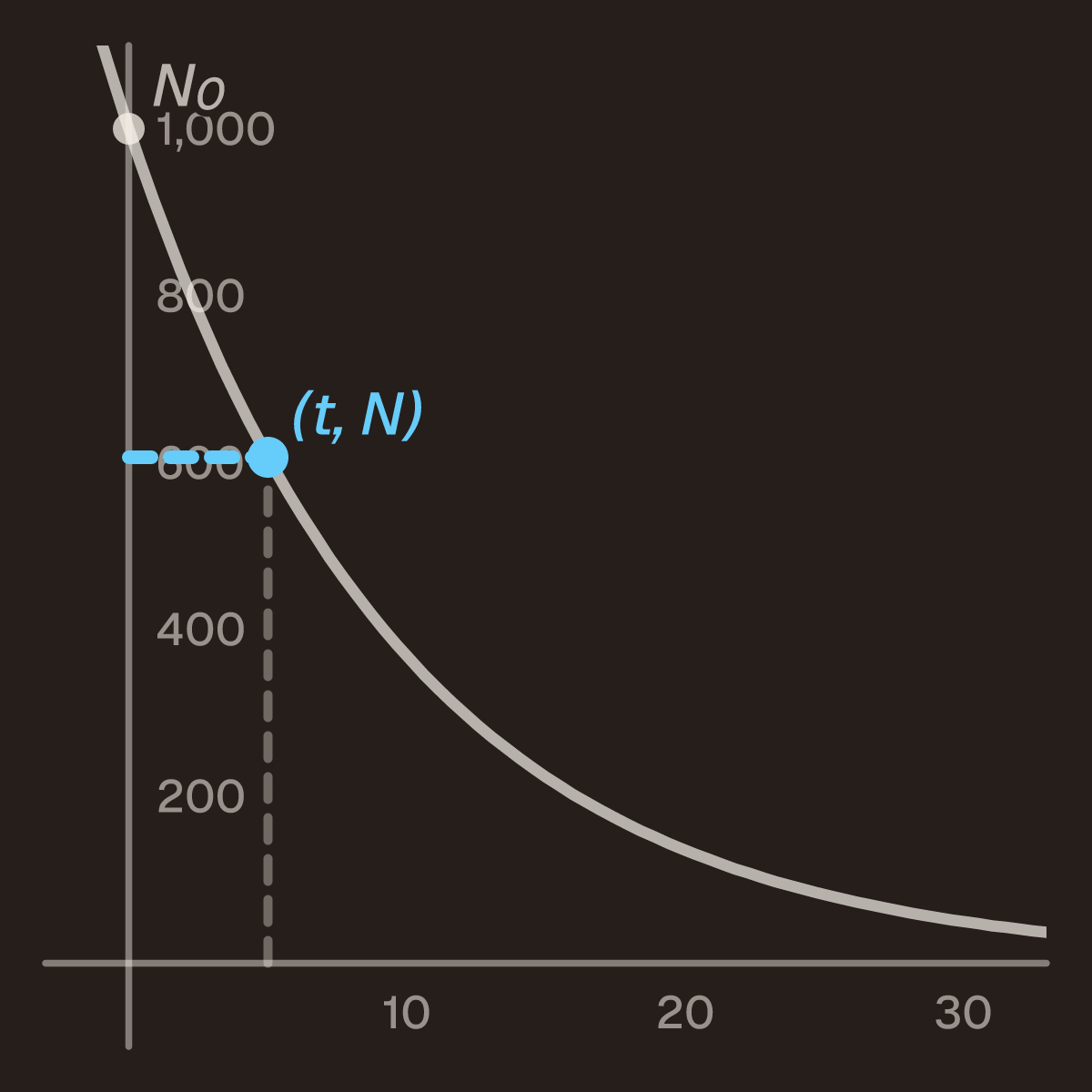
N₀ is the number of nuclei (or the amount, or the activity) at the start, λ (lambda) the decay
constant, t the time and N what remains.
Holds for a large number of nuclei of one kind, when no new nuclei of that kind form meanwhile.
Every nucleus has the same chance of decaying in the next second, however long it has already existed.
So the same share of what remains always disappears, and that gives an exponential. The curve never
reaches zero; it just halves over and over.
The units have to match. If λ is per year, t must be in years. The product λ · t has no unit, and
that is all that is required.
The same thing with half-life
More often than λ, the half-life
T½ is given. Then the formula can be written without e:
Both give the same answer, because λ = ln 2 / T½. The second form is often easier: after three
half-lives an eighth is left, after ten about a thousandth.
Worked examples
Iodine-131 after a month. The half-life is 8.02 days, so λ = 0.693 / 8.02 = 0.0864 per day. After 30
days the share left is e^(−0.0864 · 30) = e^(−2.59) ≈ 0.075, or 7.5%. That is why iodine-131 from a
reactor release is a problem for weeks but not for years.
Carbon-14 in a 10,000-year-old bone. λ = 1.21 · 10⁻⁴ per year gives
e^(−1.21 · 10⁻⁴ · 10,000) = e^(−1.21) ≈ 0.30. Just under a third of the carbon-14 remains.
How old? A sample has 25% of its carbon-14 left. Two half-lives: 2 · 5,730 = 11,460 years. By
the formula: t = ln(N₀ / N) / λ = ln 4 / 1.21 · 10⁻⁴ ≈ 11,460 years.
Common mistakes
- Mixing time units. λ per second and t in years gives an answer off by a factor of 31 million.
- Thinking everything is gone after two half-lives. After two half-lives a quarter is left. Half of
half, not half of the original taken away twice.
- Working linearly. 50% gone after one half-life does not mean 100% gone after two.
Frequently asked questions
Does the formula work for activity too?
Yes. The activity — decays per second, in becquerels — is proportional to the number of nuclei and so
falls off in exactly the same way: A = A₀ · e^(−λt).
Can decay be sped up?
In practice, no. Heat, pressure and chemistry change a half-life by about a percent at most, and noticeably
only for nuclei that decay by electron capture or internal conversion. Decay happens in the nucleus, and so it works as a clock for
dating finds.