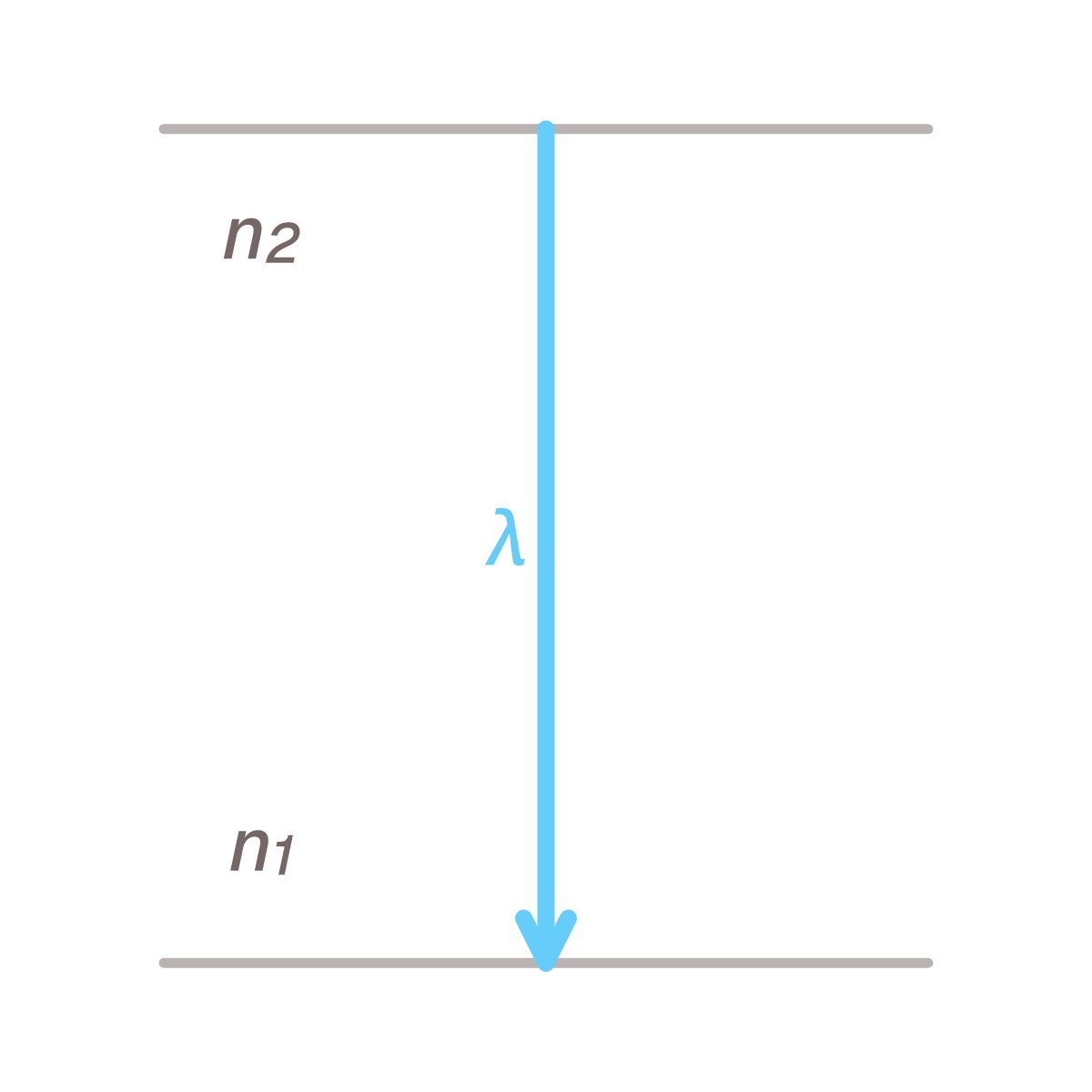
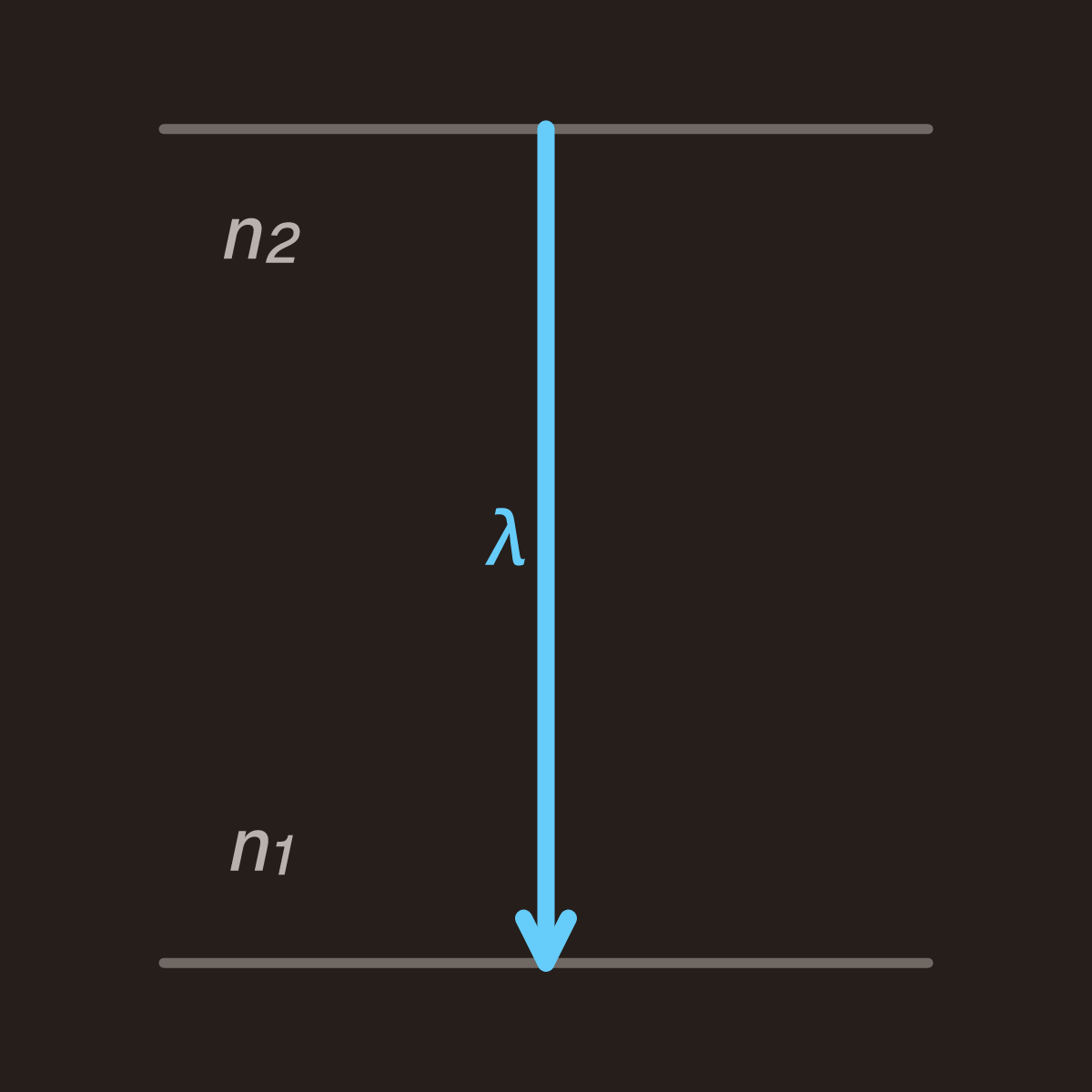
- 1 / λ = R∞ · (1 / n₁² − 1 / n₂²)
n₁ is the lower level the electron falls to, n₂ the upper level it falls from (n₂ > n₁), R∞ the Rydberg
constant, 1.0974 · 10⁷ m⁻¹, and λ the wavelength of the emitted light.
Holds for hydrogen and for one-electron ions, where R∞ is multiplied by Z².
It is the same physics as the Bohr energy levels:
the photon carries away the energy difference between two levels, and
E = h · c / λ turns that energy into a
wavelength.
Worked examples
The red line, 3 → 2: 1/4 − 1/9 = 5/36, so 1 / λ = 1.0974 · 10⁷ · 5/36 and λ ≈ 656 nm. This is Hα,
the colour of glowing hydrogen in nebula photographs.
The blue-green line, 4 → 2: 1/4 − 1/16 = 3/16, so λ ≈ 486 nm.
Ultraviolet, 2 → 1: 1 − 1/4 = 3/4, so λ ≈ 122 nm. This is Lyman-α, invisible to the eye.
The series limit, ∞ → 2: 1/n₂² goes to zero, so λ = 4 / R∞ ≈ 365 nm. No Balmer line is shorter.
The series
Each lower level gives a family of lines.
| n₁ |
Name |
Region |
| 1 |
Lyman |
ultraviolet |
| 2 |
Balmer |
visible |
| 3 |
Paschen |
infrared |
The Balmer series was the first one found, in 1885, as a pattern in measured wavelengths — nearly thirty
years before anyone could explain it.
Common mistakes
- Getting the levels backwards. n₁ is the lower level. With them swapped the bracket is negative.
- Forgetting to invert. The formula gives 1 / λ in m⁻¹. Take the reciprocal to get metres, then
multiply by 10⁹ for nanometres.
- Expecting the fourth decimal. R∞ assumes an infinitely heavy nucleus. Hydrogen’s real constant is
0.05% smaller, which moves the red line from 656.1 to 656.5 nm in vacuum, 656.3 nm in air.
Questions people ask
Does it work for other atoms?
Only for atoms with a single electron. For He⁺ or Li²⁺ multiply by Z², the square of the nuclear charge.
With more electrons they screen each other and the simple pattern breaks.
What about absorption?
The same wavelengths are absorbed when an electron jumps up from n₁ to n₂. That is why hydrogen shows up as
dark lines in starlight.