n is the number of the energy level, 1, 2, 3 and so on, and E₁ = 13.6 eV is hydrogen’s ionisation
energy. Eₙ is the electron’s energy on level n, measured from a free electron at rest.
Holds for the hydrogen atom, and for one-electron ions if 13.6 eV is multiplied by Z².
Why is the energy negative?
Zero is where the electron is only just free. A bound electron has less energy than that, and needs
energy supplied to get loose. So every bound level is negative.
| Level |
Energy |
| n = 1 (ground state) |
−13.6 eV |
| n = 2 |
−3.40 eV |
| n = 3 |
−1.51 eV |
| n = 4 |
−0.85 eV |
| n = ∞ (free) |
0 eV |
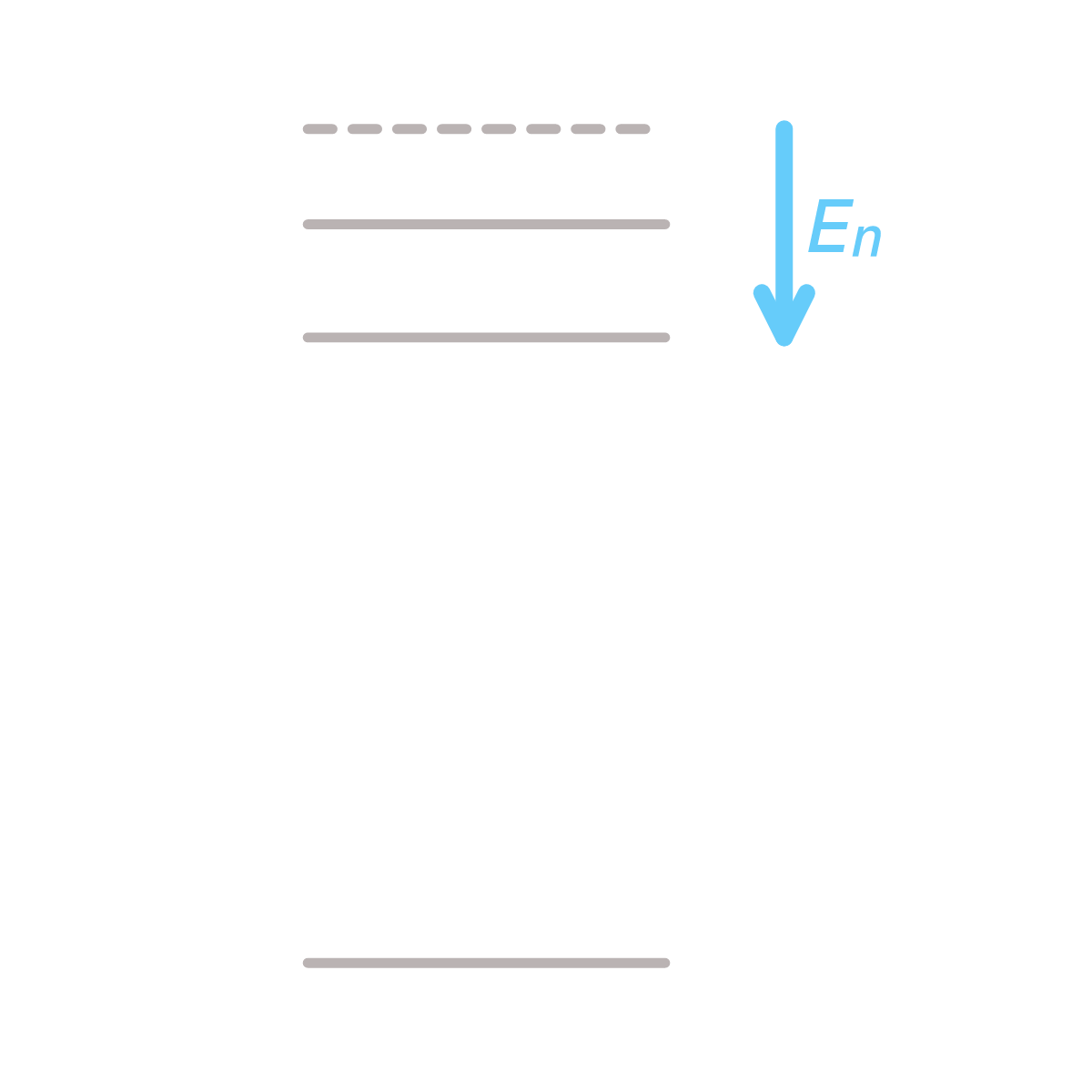
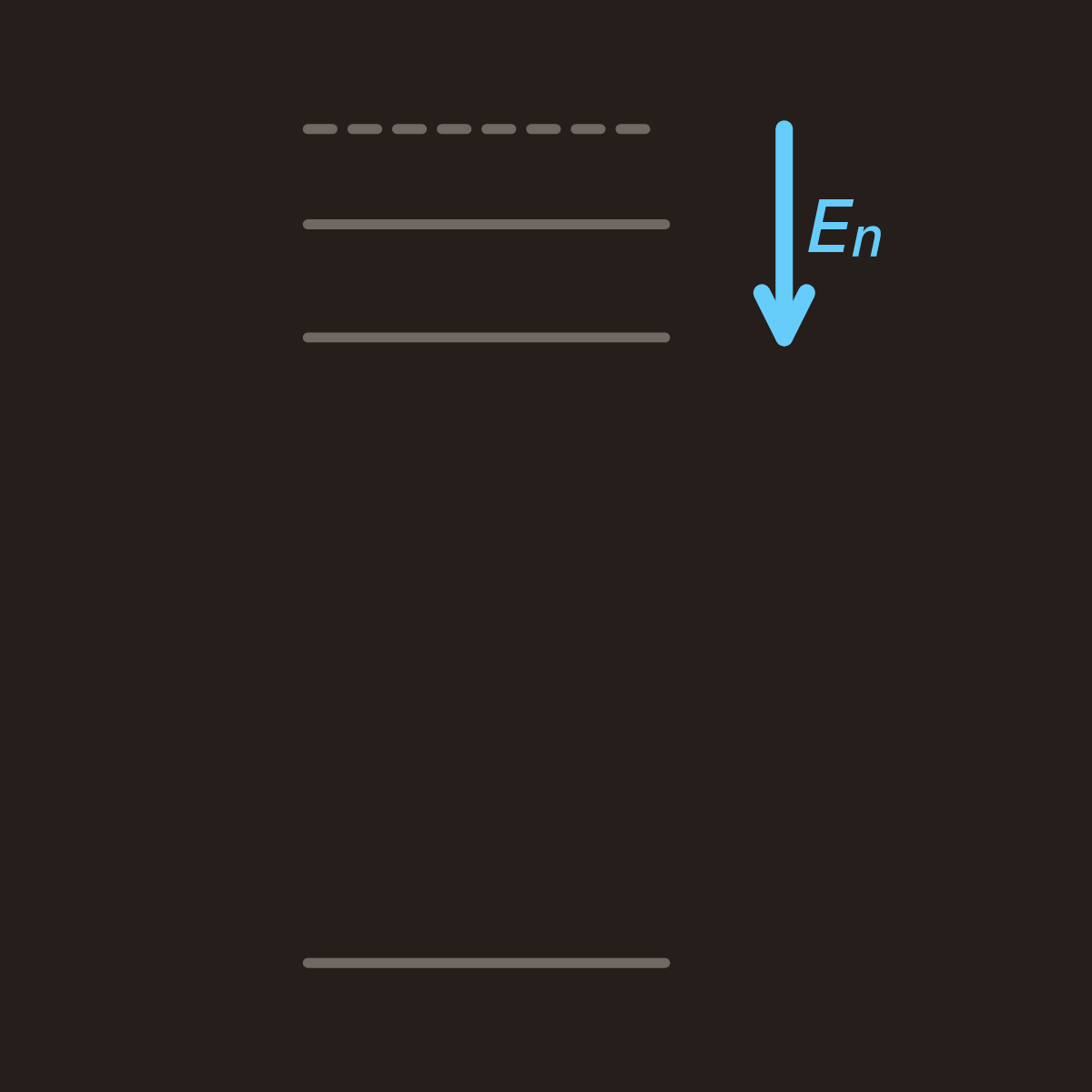
The levels crowd closer together going up and approach zero without reaching it.
Spectral lines
When the electron drops from a higher level, the difference leaves as a
photon:
- E(photon) = E(upper) − E(lower)
The red hydrogen line. From n = 3 to n = 2: −1.51 − (−3.40) = 1.89 eV. The wavelength is
1240 / 1.89 ≈ 656 nm, the red line that colours nebulae pink.
Down to the ground state. From n = 2 to n = 1: 13.6 − 3.40 = 10.2 eV, so 1240 / 10.2 ≈ 122 nm.
Ultraviolet, invisible.
Drops to n = 2 give the Balmer series, whose four visible lines come from n = 3 to 6, with the rest at the
edge of the ultraviolet. Drops to n = 1 give ultraviolet (the Lyman series).
Worked examples
Level 5. E₅ = −13.6 / 25 = −0.544 eV.
Which level? A level has energy −0.378 eV. n² = 13.6 / 0.378 = 36, so n = 6.
Ionising from level 2. It takes 3.40 eV, which corresponds to light shorter than
1240 / 3.40 ≈ 365 nm.
Common mistakes
- Dropping the minus sign. The energy is negative, and the difference between two levels is taken as
upper minus lower so the photon’s energy comes out positive.
- Using it for other atoms. It holds for hydrogen, and for one-electron ions if 13.6 is multiplied by
Z². For atoms with several electrons it does not hold.
- Thinking n can be 0. The lowest level is n = 1.
Frequently asked questions
Is the Bohr model right?
Its energy levels for hydrogen agree very well. Its picture of the electron orbiting the nucleus does
not, and was replaced in the 1920s by quantum mechanics, which gives the same energies with a different
explanation.