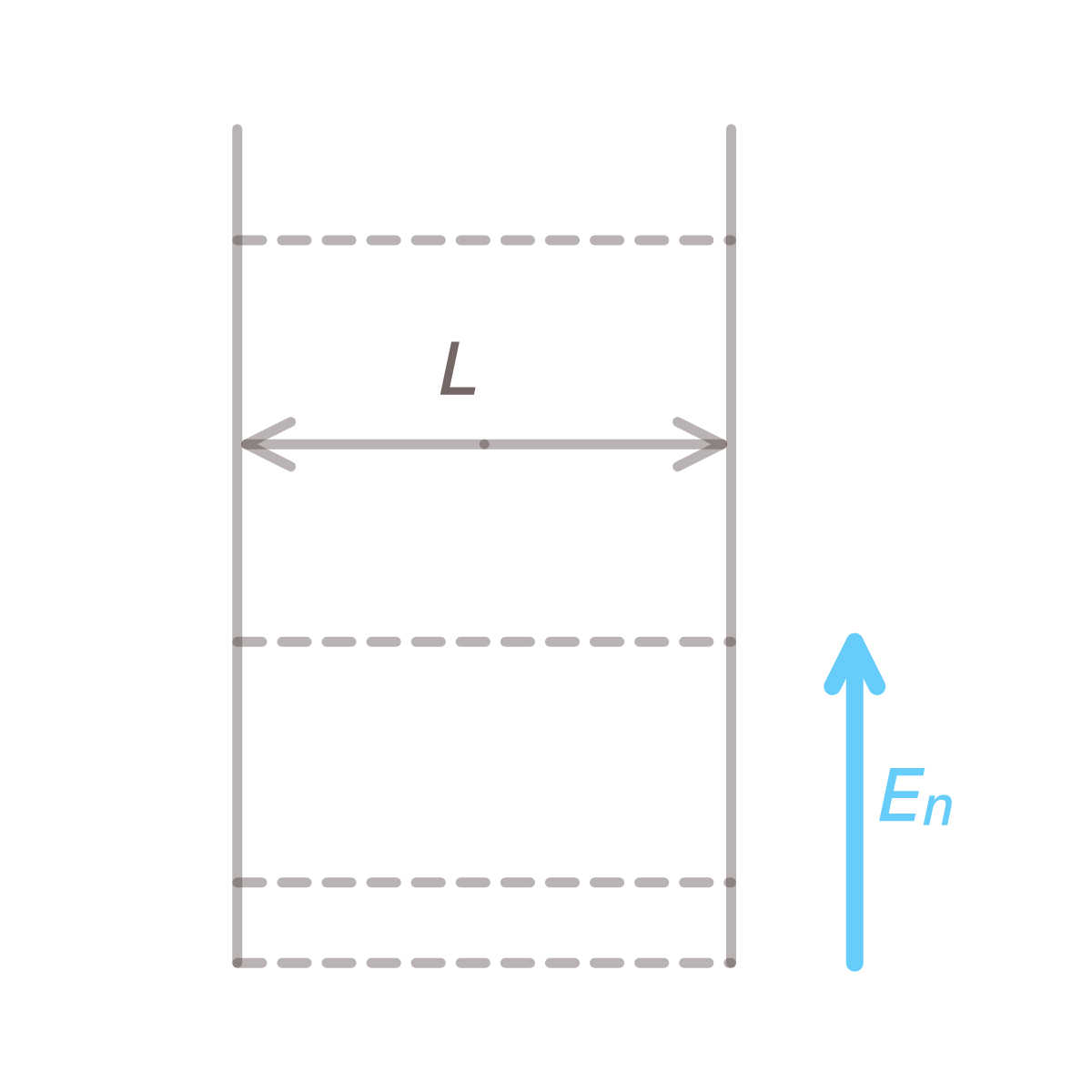
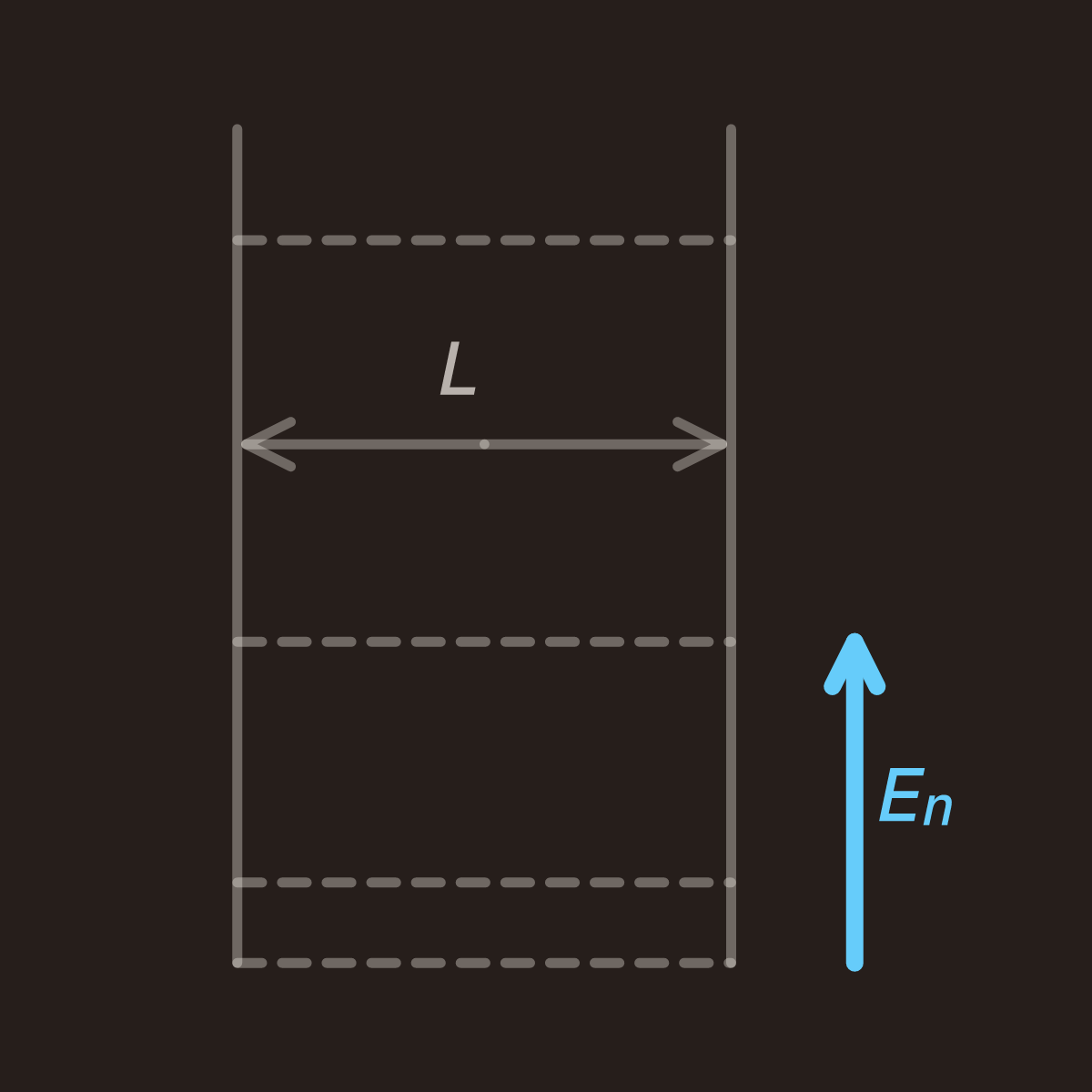
- Eₙ = n² · h² / (8 · m · L²)
n is the quantum number, 1, 2, 3 …, h the Planck constant, 6.626 · 10⁻³⁴ J·s, m the mass of the
particle, L the width of the box, and Eₙ the energy of level n.
Holds for a particle in a one-dimensional box with infinitely high walls.
The particle can never be found outside the box. Inside, only standing waves fit — a whole number of
half-wavelengths across the box, L = n · λ / 2 — and with de Broglie’s
relation each allowed wavelength gives one
allowed energy.
Worked examples
An electron in a 1 nm box. With m = 9.109 · 10⁻³¹ kg and L = 10⁻⁹ m, the lowest level is
E₁ = h² / (8 · m · L²) ≈ 6.02 · 10⁻²⁰ J ≈ 0.376 eV.
The next levels are n² times as large: E₂ ≈ 1.50 eV and E₃ ≈ 3.38 eV.
The light it emits. Falling from n = 2 to n = 1 releases ΔE = 3 · E₁ ≈ 1.13 eV, a photon of
λ = h · c / ΔE ≈ 1,100 nm, in the infrared. Make the box smaller and the light moves toward blue — which
is exactly how the colour of quantum dots is tuned.
- The lowest energy is not zero. n starts at 1, so a confined particle always moves. It is the
uncertainty principle at work: a
known position means an uncertain momentum.
- The levels spread apart. They grow as n², so the gaps between neighbours grow too: 1, 3, 5, 7 … times E₁.
- Size matters a lot. Halving L quadruples every energy. For a ball in a room the levels are so close
together that energy looks continuous.
Common mistakes
- Starting at n = 0. That would mean no wave at all in the box, so no particle. n begins at 1.
- Using ħ. This form uses h. Written with ħ it becomes Eₙ = n² · π² · ħ² / (2 · m · L²), which is the
same value.
- Mixing units. L must be in metres; 1 nm is 10⁻⁹ m. To get electronvolts, divide joules by
1.602 · 10⁻¹⁹.
Questions people ask
Is a real atom a box?
No — the Coulomb attraction is not a pair of hard walls, and the hydrogen levels fall off as 1 / n² instead
of growing as n². But the box gets the size right, and it describes electrons in quantum dots, nanowires and
long dye molecules surprisingly well.
What about a box in three dimensions?
Each direction gets its own quantum number, and the energy is the sum of three terms of the same form.