Hubble's law
The relation
v
Distant galaxies move away from us at a speed proportional to their distance. At 67.4 km/s per megaparsec, a galaxy 100 Mpc away recedes at about 6,700 km/s.
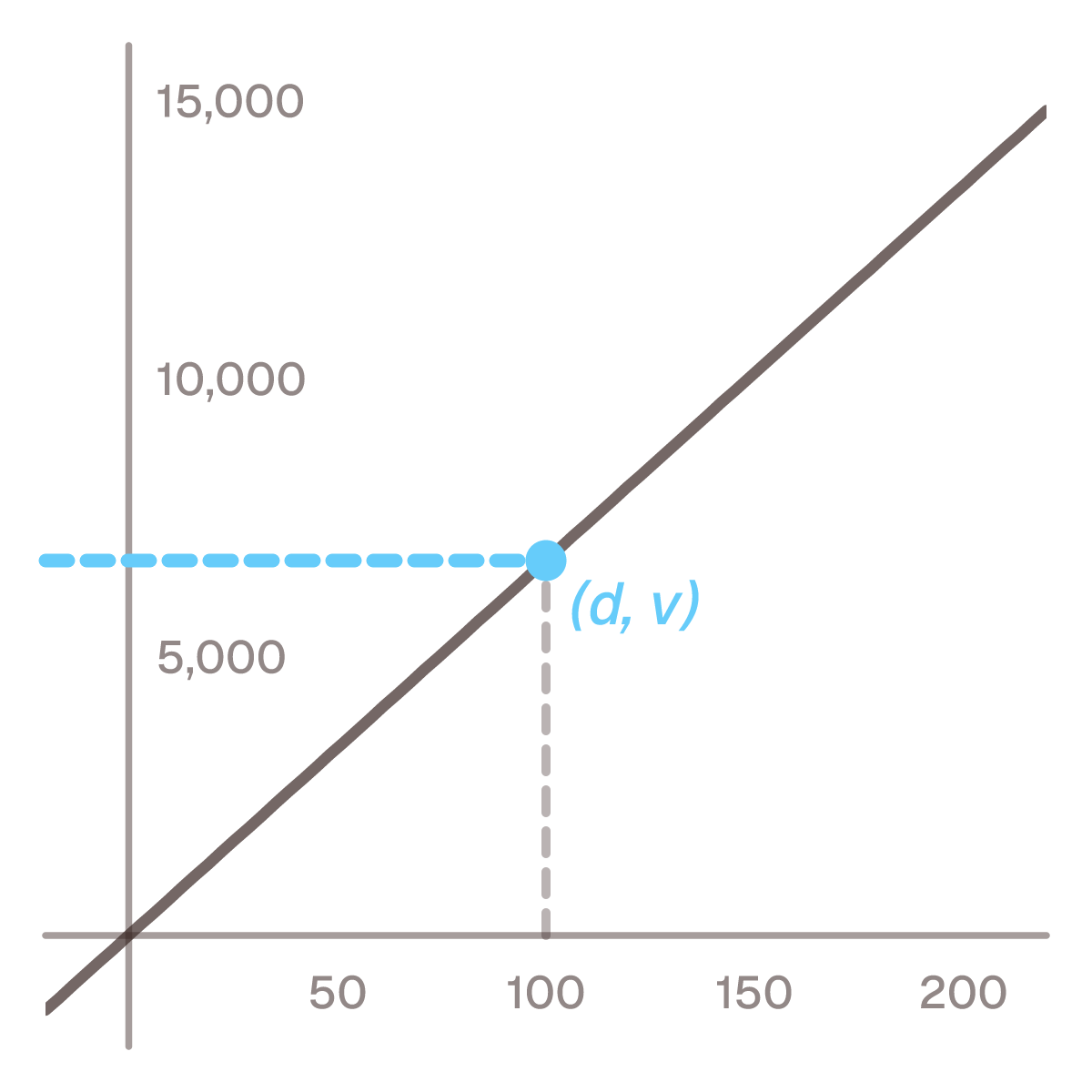
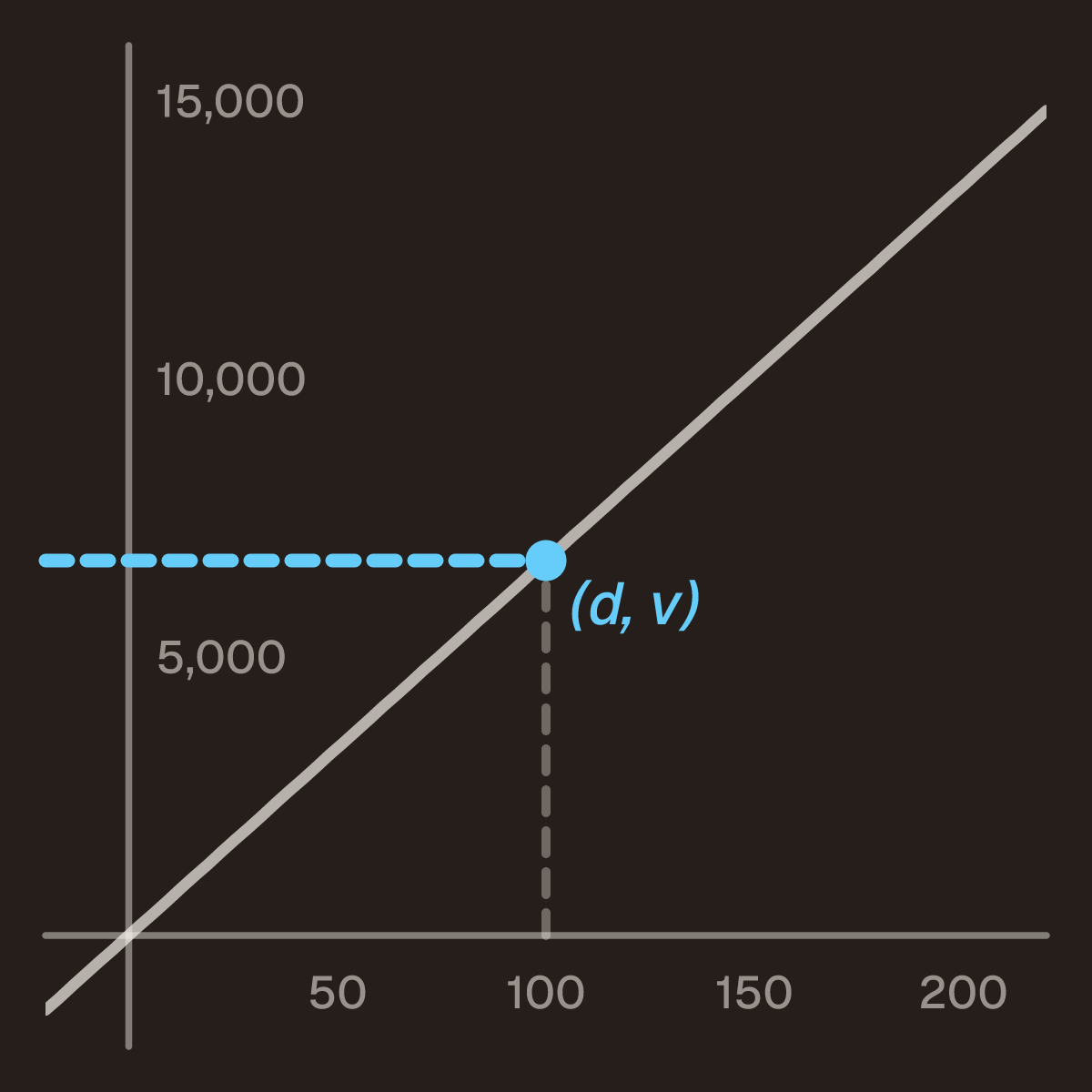
Solve for
v=6,740
v equals 67.4 times 100, equals 6,740
Den här sidan finns på svenska. Byt till svenska
The farther away a galaxy is, the faster it moves away from us. The universe is expanding.
In Swedish: Hubbles lag
v
Distant galaxies move away from us at a speed proportional to their distance. At 67.4 km/s per megaparsec, a galaxy 100 Mpc away recedes at about 6,700 km/s.
v=6,740
v equals 67.4 times 100, equals 6,740
You are given
Source: Hubble E (1929). A relation between distance and radial velocity among extra-galactic nebulae. Proceedings of the National Academy of Sciences 15(3), 168–173. — checked October 7, 2026
d is the galaxy’s distance in megaparsecs (Mpc), H₀ the Hubble constant in km/s per Mpc and v the
speed away from us in km/s. Hubble published the relation in 1929.
H₀ is measured and not settled. The Planck satellite’s measurements of the cosmic microwave background give 67.4 km/s per Mpc (2018); measurements with Cepheids and supernovae give about 73. Many textbooks round to 70. The card opens on 67.4; enter your book’s value if it uses another.
Holds when the galaxy is far enough away for its own motion to be small against the expansion, from a few tens of Mpc, and near enough for v to be well below the speed of light. Farther out a cosmological model is needed.
A galaxy 150 Mpc away. v = 67.4 · 150 = 10,110 km/s.
Distance from speed. A galaxy recedes at 7,000 km/s. d = 7,000 / 67.4 ≈ 104 Mpc. With H₀ = 73 it is 96 Mpc. The choice of H₀ changes the distance by eight per cent.
The distance is the hard part; the speed is easy. It is measured from how far the galaxy’s spectral lines have shifted towards red, with the redshift v = cz. That is why Hubble’s law is mostly used backwards: measure the redshift, and the law gives the distance.
| H₀ (km/s per Mpc) | d for v = 7,000 km/s | 1/H₀ |
|---|---|---|
| 67.4 | 104 Mpc | 14.5 billion years |
| 70 | 100 Mpc | 14.0 billion years |
| 73 | 96 Mpc | 13.4 billion years |
1/H₀, the Hubble time, is a measure of the age of the universe if the expansion had run at a steady rate. A billion years is 10⁹ years, eine Milliarde Jahre in German and en miljard år in Swedish, see long and short scales.
Why are there two values of H₀?
Two independent methods give 67 and 73, and the gap is larger than the measurement errors. It is called
the Hubble tension and is unresolved.
Are we at the centre of the universe?
No. From every galaxy all the others appear to move away in the same way, like raisins in rising dough.
Why is it sometimes called the Hubble–Lemaître law?
Georges Lemaître derived the relation and estimated the constant two years before Hubble. The
International Astronomical Union recommended the name Hubble–Lemaître law in 2018.
| Solve for | Rearranged | With the numbers | Comes to |
|---|---|---|---|
| H₀ | vd | 6,740100 | 67.4 |
| d | vH₀ | 6,74067.4 | 100 |
| v | H₀d | 67.4·100 | 6,740 |
Last reviewed October 7, 2026 ·How pages are reviewed
Copy the code into your page where the formula card should appear. It loads from lovetocalc.com, so it stays current on its own — all we ask is that the credit line comes with it.