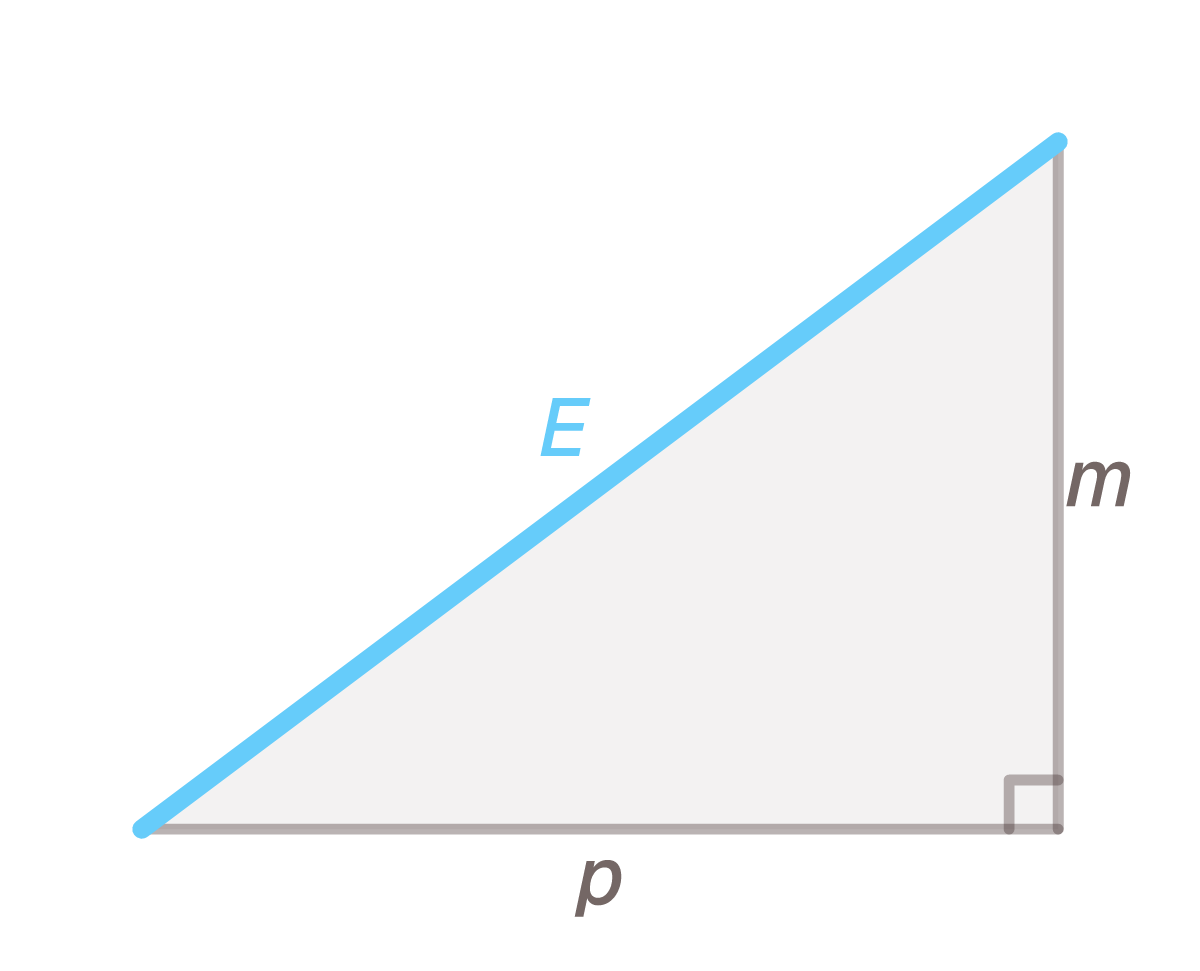
- E² = (p · c)² + (m · c²)²
E is the total energy, p the momentum, m the rest mass and c the speed of light. Two special cases
are written into it: at rest p = 0 and E = mc², as in
mass–energy equivalence; with no mass m = 0
and E = pc.
Holds in special relativity, for a free particle or body, with no potential energy in a field.
Worked examples
An electron with momentum 1.00 MeV/c. Particle physics counts energy in MeV and momentum in MeV/c, so c
drops out of the arithmetic. The electron’s rest energy is 0.511 MeV:
E = √(1.00² + 0.511²) = √1.261 ≈ 1.12 MeV. Its kinetic energy is E − mc² ≈ 0.61 MeV.
A photon. m = 0, so E = pc. A photon with momentum 1.3 · 10⁻²⁷ kg·m/s has energy
1.3 · 10⁻²⁷ · 3.00 · 10⁸ = 3.9 · 10⁻¹⁹ J, about 2.4 eV, green light.
1 kg at 0.6c. Then p = γmv = 1.25 · 0.6c = 0.75c kg, and E = √(0.75² + 1) · c² = 1.25c²
≈ 1.12 · 10¹⁷ J, the same γmc² that
relativistic momentum and γ give.
Why the relation is needed
The formulas with γ divide by √(1 − v²/c²) and say nothing about light, which has v = c. This relation has
no speed in it at all, only energy, momentum and mass, so it works for photons too. It is how a photon is
known to carry momentum p = E/c.
| Case |
The formula becomes |
| At rest, p = 0 |
E = mc² |
| No mass, m = 0 |
E = pc |
| pc much larger than mc² |
E ≈ pc |
| pc much smaller than mc² |
E ≈ mc² + p²/2m |
Common mistakes
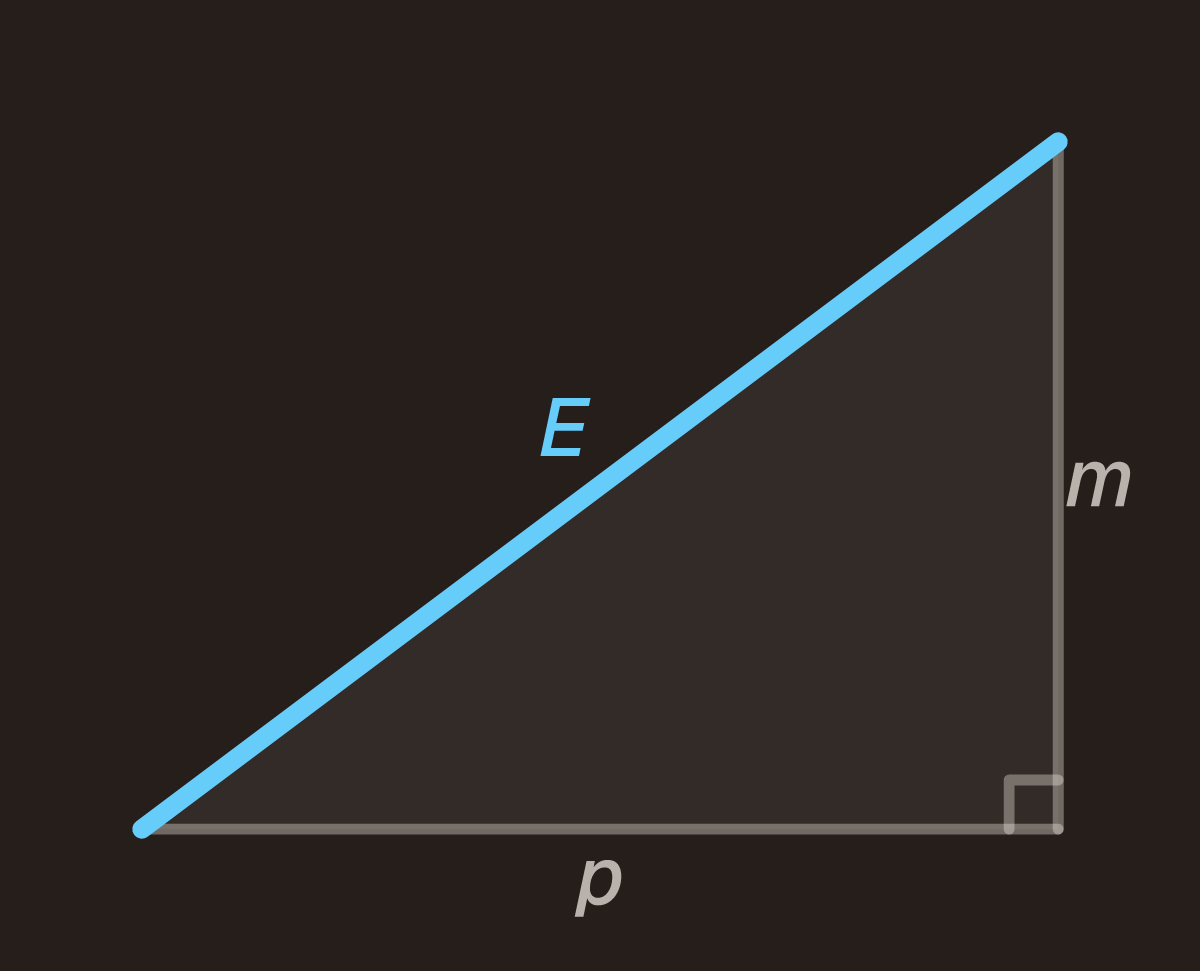
- Adding without the squares. E = pc + mc² is wrong; the terms add like the legs of a right triangle.
- Mixing units. Either SI throughout, or MeV, MeV/c and MeV/c². Not a mixture.
- Taking E for the kinetic energy. E is the total energy. The kinetic energy is E − mc².
Questions people ask
Where does the relation come from?
Square E = γmc² and p = γmv, and use γ² · (1 − v²/c²) = 1. The speed drops out and the relation is left.
Why does it look like Pythagoras’ theorem?
It has the same form: E is the hypotenuse and pc and mc² are the legs. Many textbooks draw it that way.
Does it hold for a body in a gravitational field?
Not as written. The relation is for free particles; in a field there is potential energy on top.