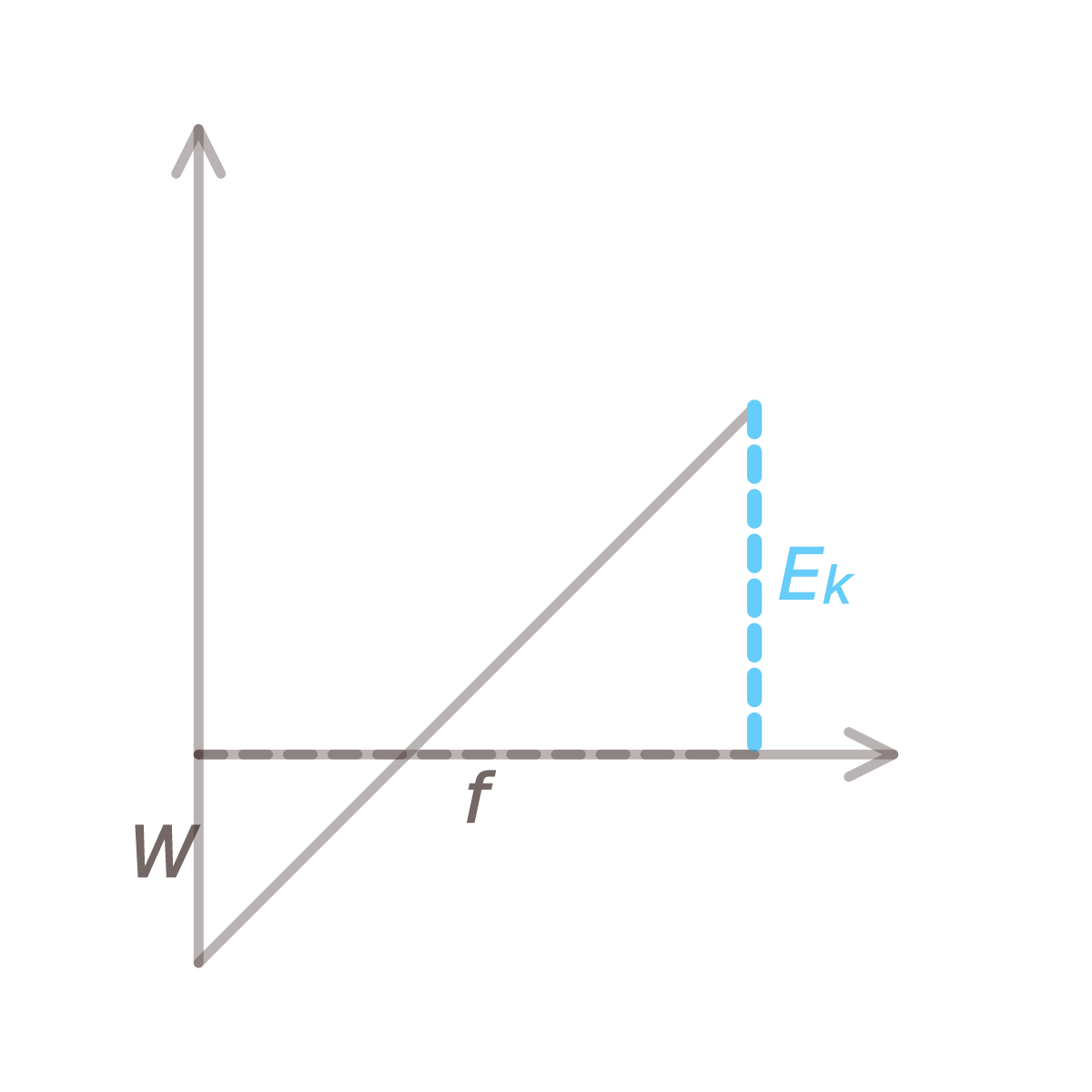
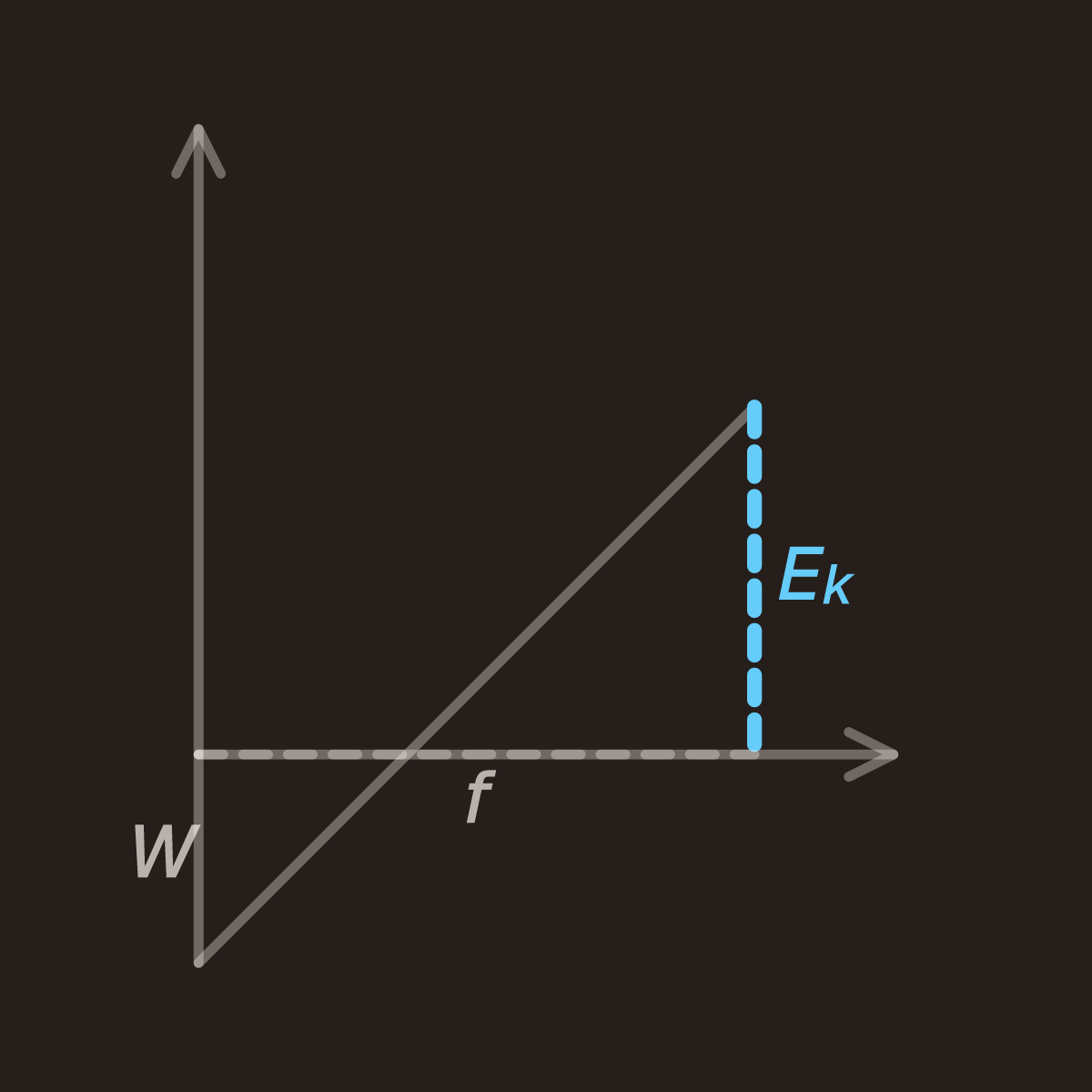
h · f is the photon’s energy, W the metal’s
work function — what it costs to free an electron — and Eₖ the largest kinetic energy the electron can
have once it has left the metal.
Holds when each electron takes in a single photon, as it does at ordinary brightness. Very intense laser
pulses can make two photons act together.
The formula is an energy budget. The photon gives all its energy to one electron. The work function is
paid, and the rest becomes speed.
The threshold frequency
If h · f is smaller than W nothing is left over, and no electron comes out — however bright
ordinary light is, because photons act one at a time. The threshold is
This is what the wave picture of light could not explain. A wave ought eventually to shake the electron
loose if only it were strong enough. But faint blue light frees electrons at once, and bright red light
does not. Einstein explained it in 1905 by light coming in packets.
Work functions
| Metal |
W |
Threshold wavelength |
| Caesium |
2.1 eV |
590 nm (yellow) |
| Sodium |
2.3 eV |
540 nm (green) |
| Zinc |
4.3 eV |
290 nm (UV) |
| Copper |
4.7 eV |
260 nm (UV) |
That is why caesium is used in photocells meant to respond to visible light, while the zinc plate in the
school electroscope experiment only discharges under a UV lamp.
Worked examples
UV on zinc. Light of wavelength 250 nm carries 1240 / 250 = 4.96 eV. Zinc’s work function is 4.3 eV,
so Eₖ = 4.96 − 4.3 = 0.66 eV.
In joules. f = 8 · 10¹⁴ Hz and W = 3 · 10⁻¹⁹ J give
Eₖ = 6.626 · 10⁻³⁴ · 8 · 10¹⁴ − 3 · 10⁻¹⁹ = 5.30 · 10⁻¹⁹ − 3 · 10⁻¹⁹ = 2.3 · 10⁻¹⁹ J.
The threshold for sodium. W = 2.3 eV = 3.68 · 10⁻¹⁹ J, so
f₀ = 3.68 · 10⁻¹⁹ / 6.626 · 10⁻³⁴ ≈ 5.6 · 10¹⁴ Hz.
Common mistakes
- Working with a negative Eₖ. If the answer is negative the photon is too weak. The answer is then
that no electron comes out, not that it has negative energy.
- Mixing eV and J. Tables often give W in eV while hf comes out in J. Convert one before subtracting.
- Thinking brighter light gives faster electrons. Brighter light gives more electrons. How fast they
go is set by the frequency alone.
Frequently asked questions
Why the “largest” kinetic energy?
Electrons deeper in the metal lose some energy on the way out. The formula gives the energy of those
that escape most easily, and that is what a stopping voltage measures.
Where is the effect used?
In solar cells, camera sensors and photomultipliers that count single photons. A solar cell works a
little differently, since the electrons stay in the material, but the principle of an energy threshold
per photon is the same.