μ is the material’s attenuation coefficient and x½ the half-value thickness, in the length unit μ is
the inverse of: μ in cm⁻¹ gives x½ in cm.
Holds under the same conditions as the absorption law:
a narrow beam, one photon energy and no scattered radiation in the detector.
Worked examples
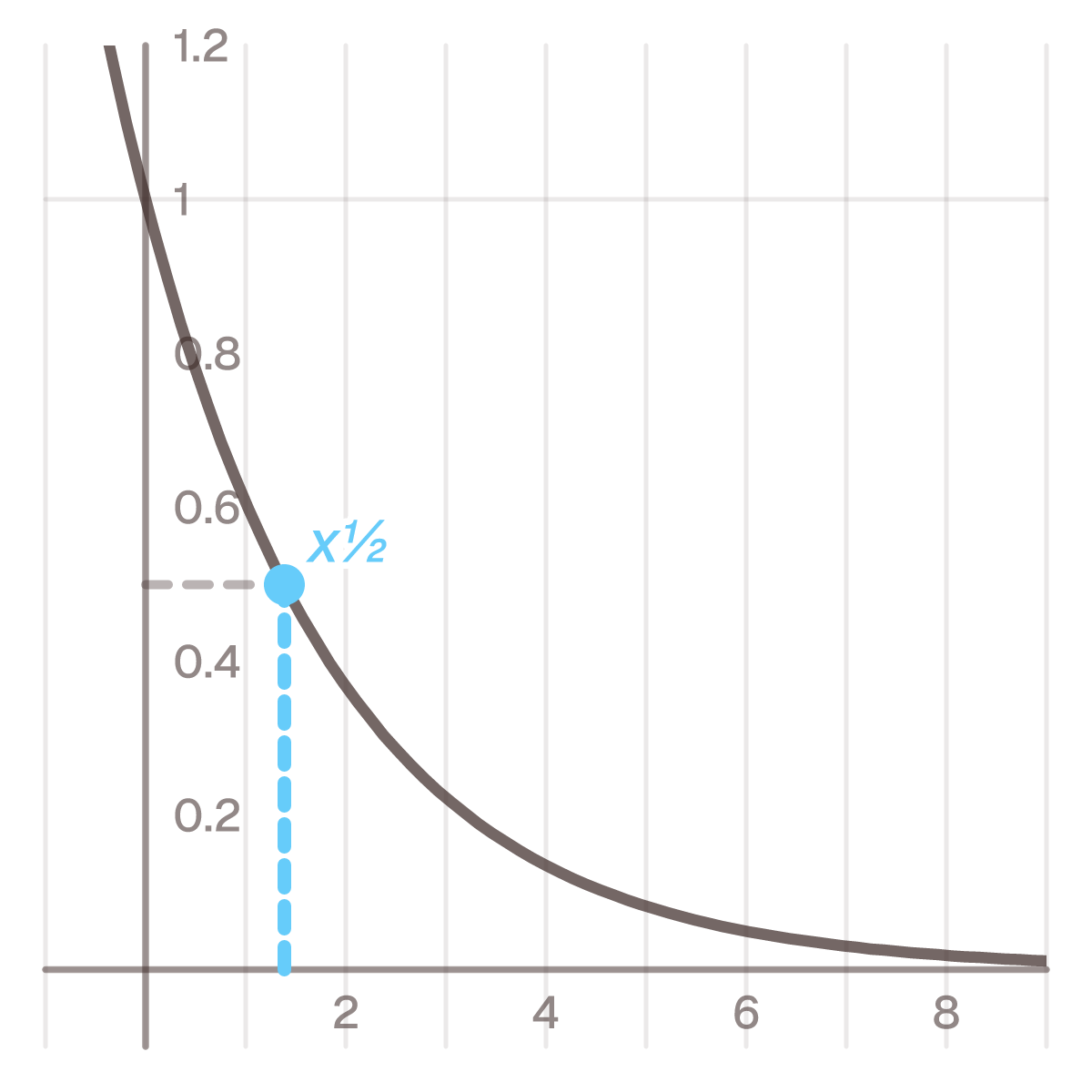
μ = 0.5 cm⁻¹. x½ = 0.693 / 0.5 ≈ 1.39 cm.
The other way round. A table gives a half-value thickness of 1.2 cm. Then μ = 0.693 / 1.2 ≈
0.58 cm⁻¹, and that is the value that goes into the absorption law.
Counting in halvings
With the half-value thickness the arithmetic needs no e: n half-value thicknesses let through (½)ⁿ. 3 cm at
x½ = 1.39 cm is 2.16 halvings, and 0.5^2.16 ≈ 0.22: the same 22% the absorption law gives.
| Half-value thicknesses |
Fraction left |
| 1 |
50% |
| 2 |
25% |
| 3 |
12.5% |
| 10 |
about 0.1% |
It is the same relation as between half-life and decay constant,
with thickness in place of time.
Common mistakes
- Thinking two half-value thicknesses stop everything. Two halvings leave 25%, not 0%.
- Using log instead of ln. ln 2 = 0.693; log 2 = 0.301 gives the wrong answer.
- Using the half-value thickness for another photon energy. It holds only for the energy it was
measured at.
Questions people ask
What is the tenth-value thickness?
The thickness that lets a tenth through: ln 10 / μ, about 3.3 half-value thicknesses. It is used in
shielding calculations.
Why does radiation get harder through a material?
If the radiation has several energies, the lower ones are stopped first. What comes through has a higher
average energy, and the next half-value thickness is longer than the first.
Is half-value thickness the same as range?
No. Range applies to alpha and beta particles, which stop after a certain distance. Photons have no
range, only a fraction that gets through.