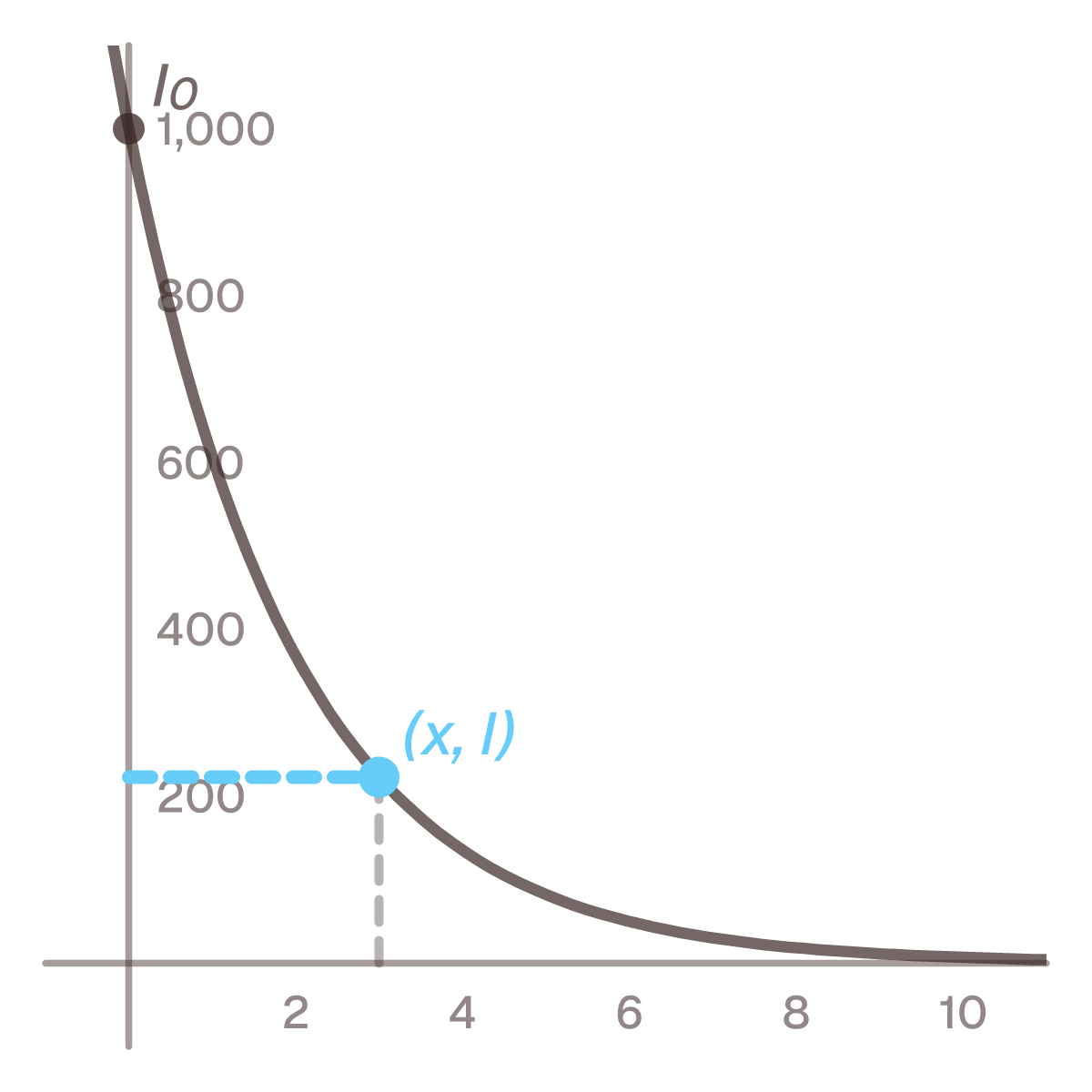
I₀ is the intensity reaching the material, x the material’s thickness, μ the attenuation coefficient
and I the intensity that gets through. The intensity can be in any unit, counts per second on a
Geiger counter for instance, as long as I and I₀ are in the same one. μ and x need units that cancel, such
as cm⁻¹ and cm.
Holds when the beam is narrow, the photons all have one energy and scattered radiation does not reach the
detector. μ depends on both the material and the photon energy, so its value has to be looked up for the
radiation in question.
Worked examples
3 cm of material with μ = 0.5 cm⁻¹. 1,000 counts per second in:
I = 1,000 · e^(−0.5 · 3) = 1,000 · e^(−1.5) ≈ 223 counts per second.
How thick to stop 99%? Then I / I₀ = 0.01. Take logarithms: μx = ln 100, so
x = ln 100 / 0.5 ≈ 9.2 cm. Three times the first example’s thickness, to go from 22% left to 1% left.
Exponential, not linear
Thinking that 3 cm lets 22% through, so 6 cm lets 0% through, treats the radiation as if it ran out. It
does not: 6 cm lets through 22% of 22%, about 5%. No thickness stops everything.
| Thickness |
Left of 1,000 |
| 1 cm |
607 |
| 2 cm |
368 |
| 3 cm |
223 |
| 5 cm |
82 |
The same law with other letters is radioactive decay,
with time in place of thickness. The thickness that halves the radiation is the
half-value thickness.
Common mistakes
- Mixing units. μ in cm⁻¹ with x in mm puts the exponent ten times off.
- Working linearly. Twice the thickness does not halve what gets through; it squares the fraction.
- Using it for alpha and beta radiation. They have a range and stop within a certain distance; the law
is for photons.
Questions people ask
Why is lead used for shielding?
Heavy elements have a large μ for gamma and X-rays, so less thickness gives the same attenuation.
Concrete is used where thickness is acceptable and cost matters.
How does this relate to the Beer–Lambert law?
It is the same exponential attenuation, written for light through a solution in chemistry, with the
concentration built into the coefficient.
How do I get μ from a measurement?
Measure I and I₀ and solve μ = ln(I₀ / I) / x. The card above does it if you pick μ as the unknown.