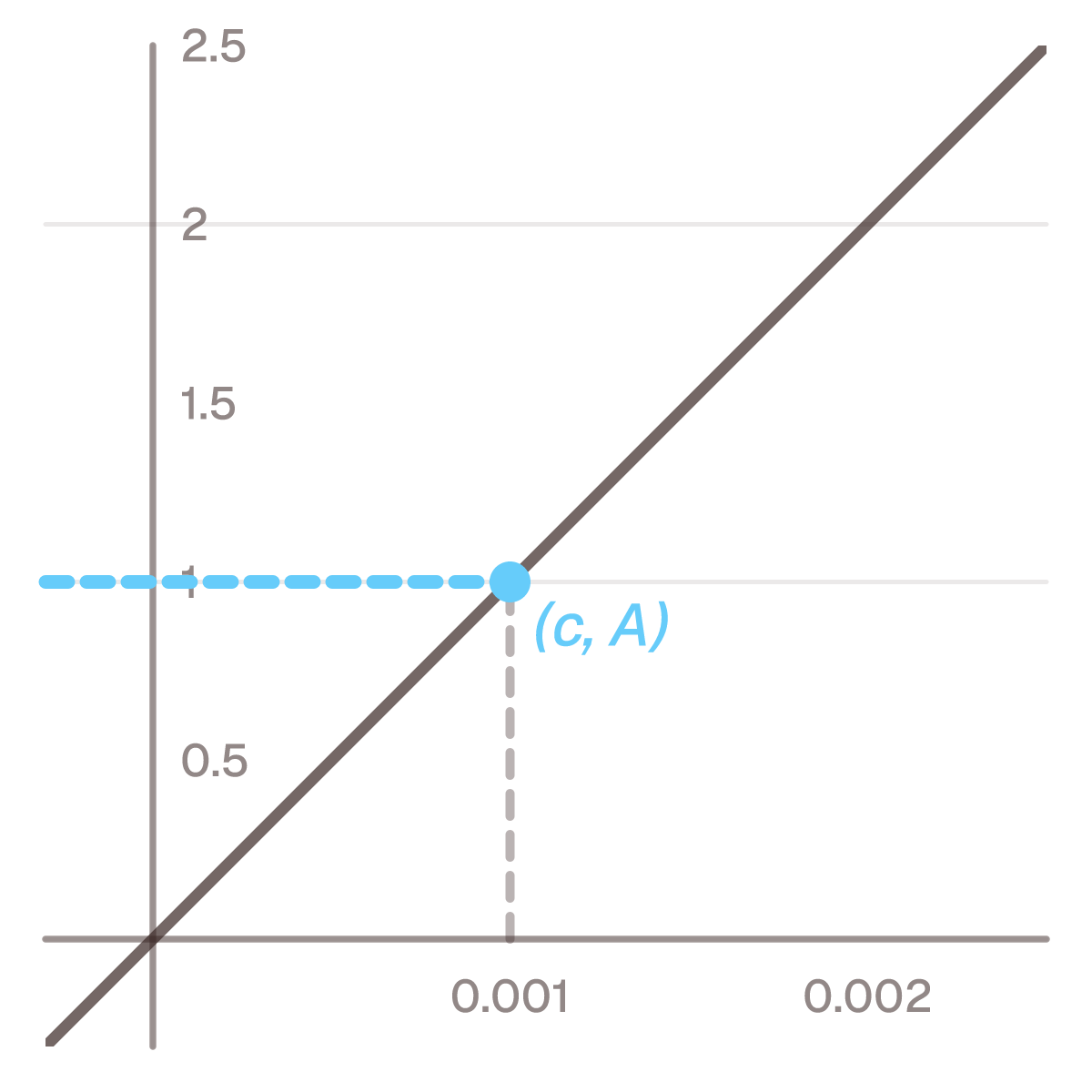
The absorbance of a solution is the molar absorptivity times the path length times the concentration — a straight line a spectrophotometer reading can be turned into a concentration with.
A equals 1,000 times (1 times 0.001), equals 1,000 times 0.001, equals 1
Working3 steps
A
=
1,000·1·0.001
=
1,000·0.001
=
1
Practice questions
You are given
A=1
ε=1000l/(mol·cm)
l=1cm
mol/dm³
The formula
A = ε · l · c
A is the absorbance, a number without a unit. ε is the molar absorptivity in dm³/(mol·cm), a property of
the substance at one wavelength. l is the path length through the sample in cm, usually 1 cm for a
standard cuvette, and c the concentration in mol/dm³.
Holds for dilute solutions and light of one wavelength, as long as the absorbance is not too high, roughly
below 1.
What absorbance is
A spectrophotometer measures how much light gets through: the transmittance T = I / I₀. Absorbance is
A = −log T. An absorbance of 1 lets 10% through, 2 lets 1% through. Because of the logarithm, absorbance
grows in a straight line with the concentration, which makes it the useful number to calculate with.
Worked examples
The defaults. ε = 1,000 dm³/(mol·cm), l = 1 cm and c = 0.001 mol/dm³: A = 1,000 · 1 · 0.001 = 1.
Ten per cent of the light gets through.
Concentration from a reading. The same substance reads A = 0.45 in a 1 cm cuvette:
c = A / (ε · l) = 0.45 / 1,000 = 4.5 · 10⁻⁴ mol/dm³.
A longer cuvette. The same solution in a 2 cm cuvette gives twice the absorbance, 0.90. Path length and
concentration count the same way: both are the number of molecules the light meets.
Common mistakes
Using transmittance instead of absorbance. A reading of 45% is T = 0.45, which is A ≈ 0.35, not 0.45.
Measuring at the wrong wavelength. ε belongs to one wavelength, usually the absorption maximum.
Trusting it at high absorbance. Above roughly A = 1 to 1.5 the line often bends. Dilute the sample
instead.
Frequently asked questions
How is ε found?
From a standard curve: measure A for a few solutions of known concentration and plot A against c. The
slope is ε · l.
Looking for another letter? The formula solved for each one
Copy the code into your page where the formula card should appear. It loads from lovetocalc.com, so it stays current on its own — all we ask is that the credit line comes with it.