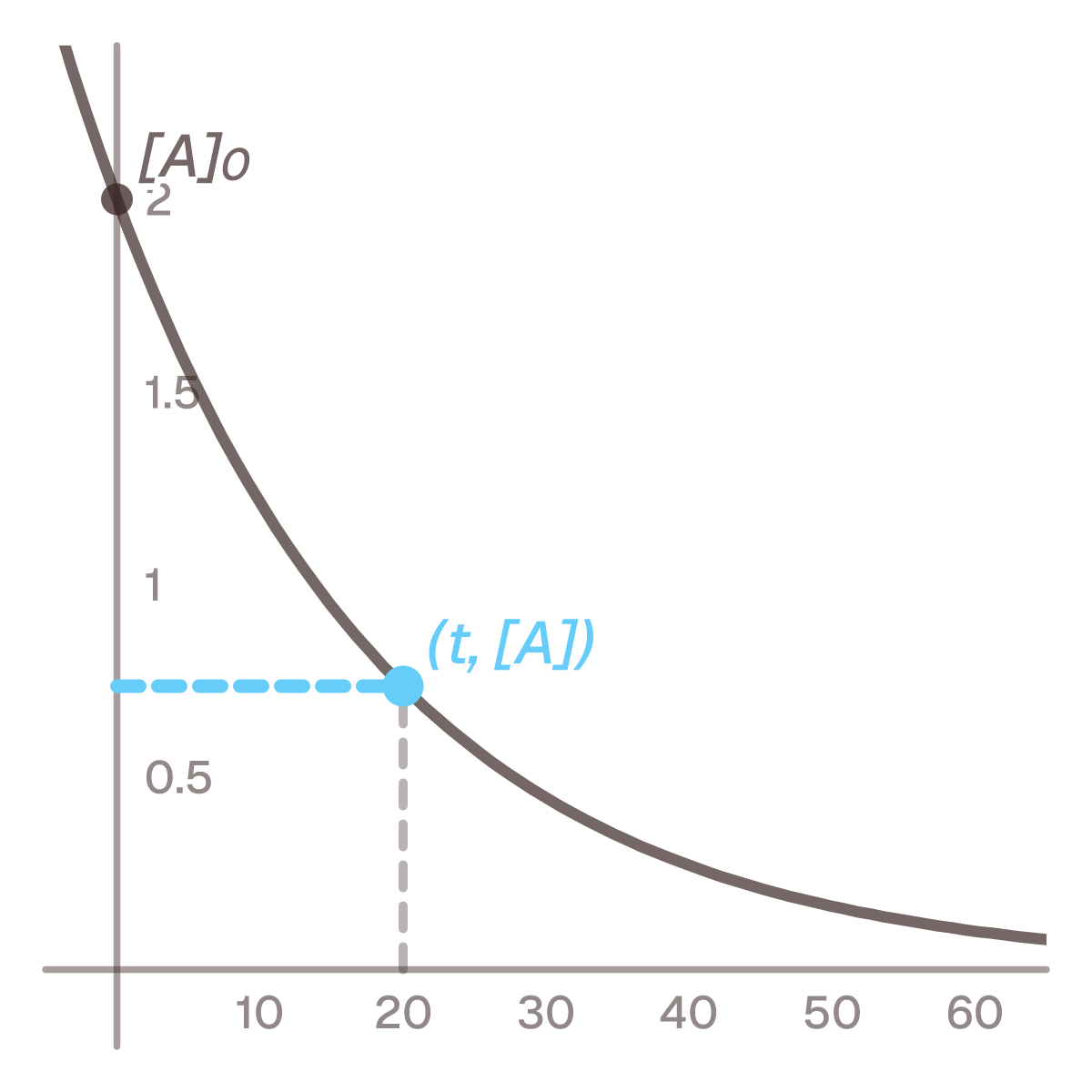
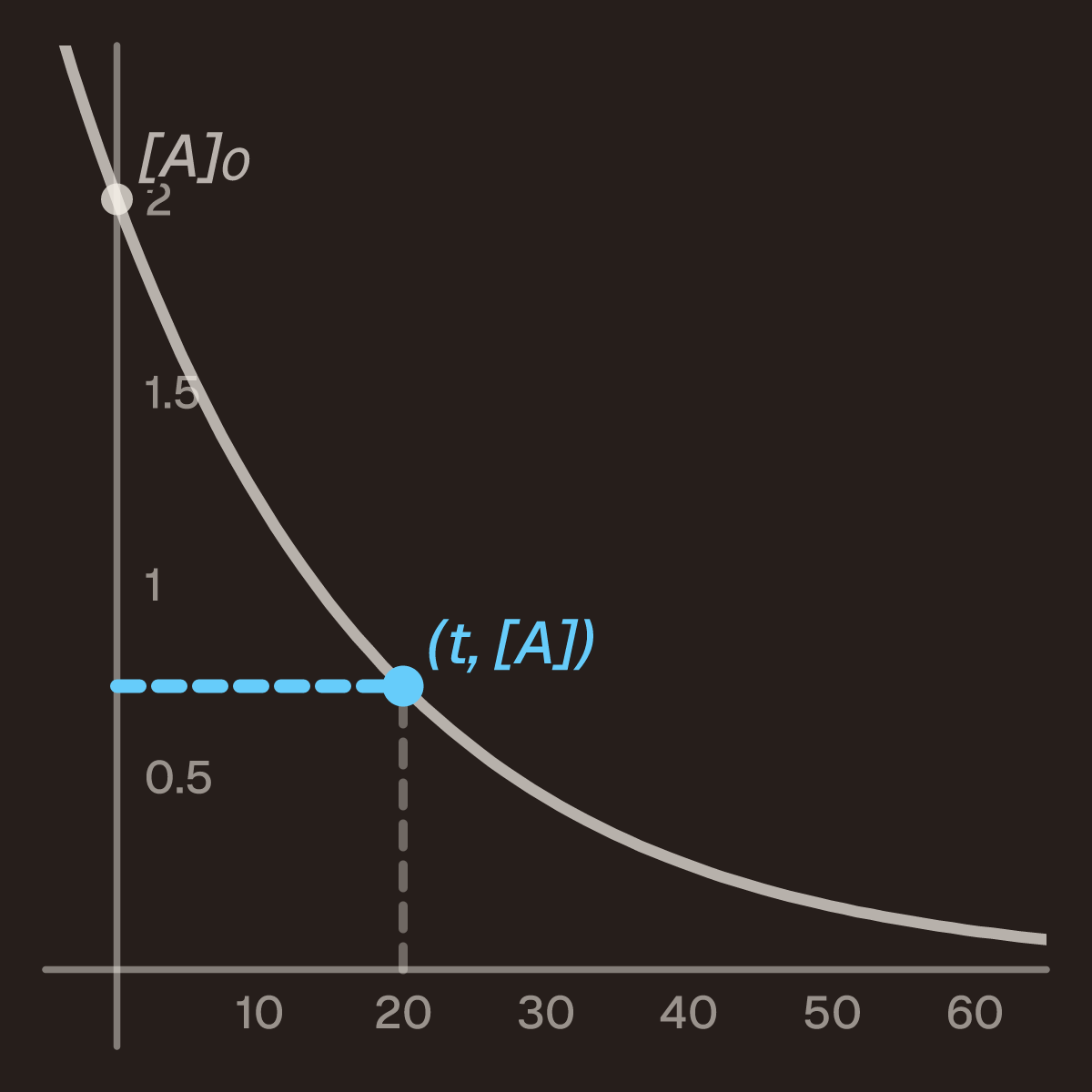
[A] equals 2 times e to the power of (minus (0.05 times 20)), equals 2 times e to the power of (minus 1), equals 2 times e to the power of −1, is approximately 2 times 0.3679, is approximately 0.7358
Working5 steps
[A]
=
2e−0.05·20
=
2e−1
=
2e−1
≈
2·0.3679
≈
0.7358
The formula
ln[A] = ln[A]₀ − k · t
or, with e on both sides: [A] = [A]₀ · e^(−kt)
[A]₀ is the starting concentration, [A] the concentration after the time t, and k the rate constant
in 1/s. The time and k must use the same time unit: if k is per minute, t has to be in minutes.
Holds for a reaction whose rate is proportional to the concentration of one substance, at constant
temperature.
What first order means
A reaction is first order when its rate is proportional to the concentration of a single substance:
v = k·[A]. Half as much left means half as fast. That gives exponential decay, the same mathematics as
radioactive decay, which is why ln[A] is a straight line against time with slope −k.
Worked examples
The defaults. [A]₀ = 2 mol/dm³, k = 0.05 1/s and t = 20 s:
[A] = 2 · e^(−0.05 · 20) = 2 · e^(−1) ≈ 0.74 mol/dm³.
How long does it take? The same reaction, from 2 down to 0.5 mol/dm³:
t = (ln 2 − ln 0.5) / 0.05 = ln 4 / 0.05 ≈ 27.7 s.
The rate constant from a measurement. The concentration falls from 1.0 to 0.6 mol/dm³ in 10 s:
k = (ln 1.0 − ln 0.6) / 10 ≈ 0.051 1/s.
Common mistakes
Using it for a reaction of another order. The formula holds only when the rate is proportional to
one concentration. If ln[A] against t is not a straight line, the reaction is not first order.
Mixing time units. k in 1/min and t in seconds is off by a factor of 60.
Using log₁₀ instead of ln. The formula is built on the natural logarithm.
Frequently asked questions
How does it connect to the half-life?
Set [A] = [A]₀/2. Then ln 2 = k·t, and that time is the
half-life t½ = ln 2 / k. It does not depend
on how much you started with.
Why is it called integrated?
The rate law v = k·[A] says how fast the concentration changes at each moment. Integrating it over time
gives the concentration itself as a function of time, and that is this formula.
Looking for another letter? The formula solved for each one
Copy the code into your page where the formula card should appear. It loads from lovetocalc.com, so it stays current on its own — all we ask is that the credit line comes with it.