Retention factor
The relation
Rf
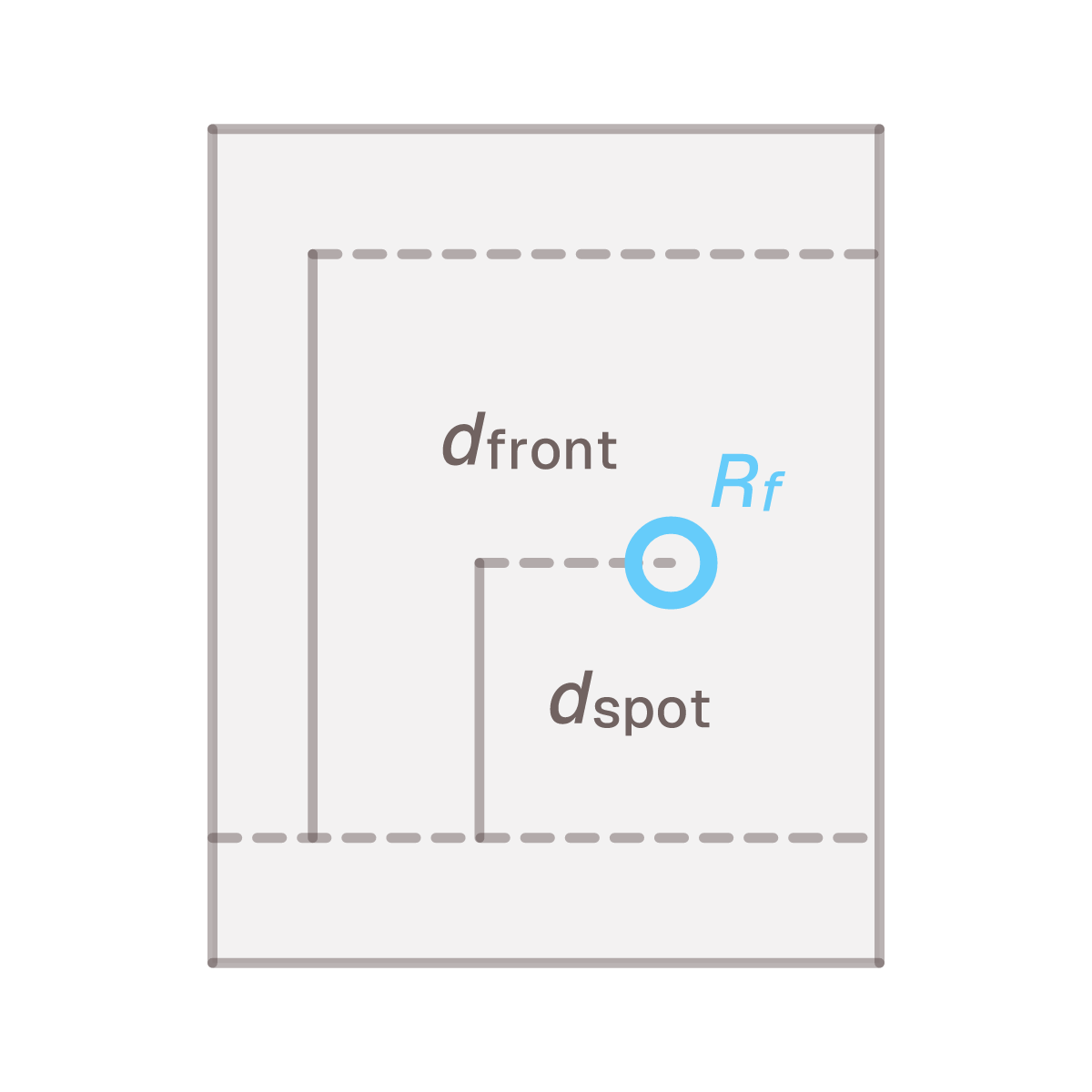
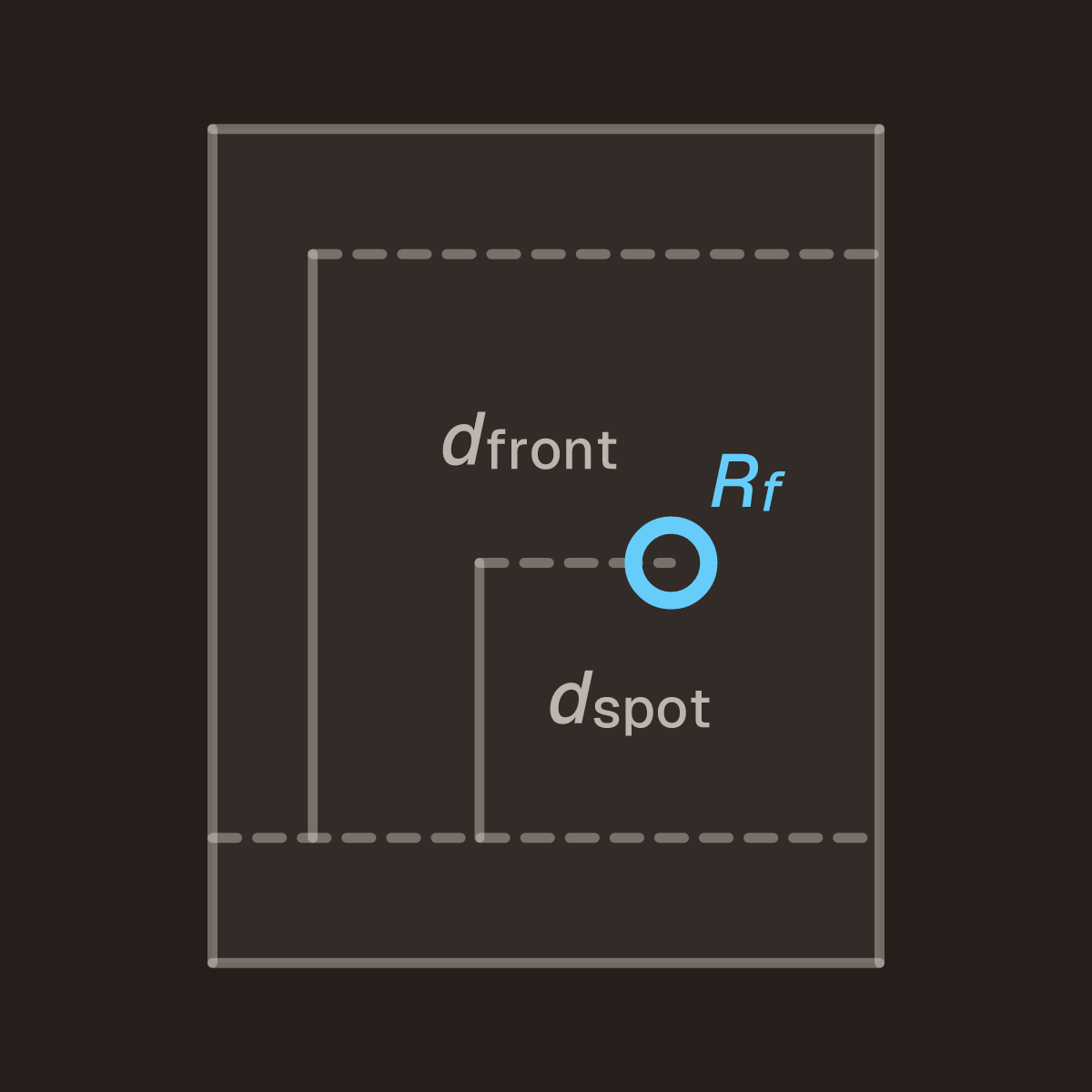
How far a spot has moved up a chromatography plate, as a fraction of how far the solvent front moved — both measured from the start line.
Solve for
Rf=0.6
R f equals 3.6 divided by 6, equals 0.6
Den här sidan finns på svenska. Byt till svenska
Definition — what does that mean?
How far a spot has travelled up the plate, as a fraction of how far the solvent got.
In Swedish: Rf-värde
Rf
How far a spot has moved up a chromatography plate, as a fraction of how far the solvent front moved — both measured from the start line.
Rf=0.6
R f equals 3.6 divided by 6, equals 0.6
You are given
d_spot is the distance from the start line to the centre of the spot and d_front the distance from the start line
to the solvent front. Both are in the same unit, so R_f has no unit and lies between 0 and 1.
The spot moved 3.6 cm and the front 6.0 cm. R_f = 3.6 / 6.0 = 0.6.
It is used in thin-layer chromatography (TLC) and paper chromatography.
Both distances start at the line where the sample was spotted, not at the edge of the plate and not at the surface of the solvent in the beaker. Mark the front in pencil as soon as the plate comes out, before the solvent dries and the front can no longer be seen.
The same plate, with the start line 1.0 cm above the edge:
| Calculation | R_f |
|---|---|
| Wrong: from the edge, 4.6 / 7.0 | 0.66 |
| Right: from the start line, 3.6 / 6.0 | 0.6 |
Measured from the wrong line the value comes out too high, and if only the spot is measured from the edge it can pass 1. An R_f above 1 would mean the spot travelled further than the solvent carrying it, which cannot happen.
Two reference substances and an unknown sample are run on the same plate. The front reaches 6.0 cm.
| Spot | Distance | R_f |
|---|---|---|
| Reference A | 1.5 cm | 0.25 |
| Reference B | 4.2 cm | 0.7 |
| Unknown | 4.2 cm | 0.7 |
The unknown has the same R_f as B under the same conditions, which suggests it is B. An R_f depends on the plate, the solvent and the temperature, so the comparison means most when the references are run on the same plate.
A spot with R_f = 0.3 has moved 2.4 cm. The front has then moved d_front = 2.4 / 0.3 = 8 cm.
Why can R_f not be greater than 1?
The substance is carried up by the solvent and cannot get further than it. A spot at the front has an R_f close to 1.
What does a high R_f mean?
That the substance prefers moving with the solvent to sticking to the plate. On an ordinary silica plate, which is
polar, less polar substances travel further and have higher R_f values. It is a
partition between two phases, read off as a distance.
What unit does Rf have?
None. It is a distance divided by a distance, so the centimetres cancel. It does not matter whether you measure in cm
or mm, as long as both distances are in the same unit. Some books call the ratio the retardation factor.
| Solve for | Rearranged | With the numbers | Comes to |
|---|---|---|---|
| dspot | Rfdfront | 0.6·6 | 3.6 |
| dfront | dspotRf | 3.60.6 | 6 |
| Rf | dspotdfront | 3.66 | 0.6 |
Last reviewed October 7, 2026 ·How pages are reviewed
Solutions and concentrationAll formulas
Copy the code into your page where the formula card should appear. It loads from lovetocalc.com, so it stays current on its own — all we ask is that the credit line comes with it.