[A]₀ is the starting concentration in mol/dm³, [A] the concentration after the time t, and k the rate
constant in mol/(dm³·s). For a zero-order reaction k is itself the reaction rate.
Holds as long as some reactant is left and something other than it, such as a saturated catalyst surface or
an enzyme, sets the pace.
What zero order means
The rate is constant: v = k, whatever the concentration. That happens when something other than the
reactant sets the pace, such as a catalyst surface that is fully covered or an enzyme working at full
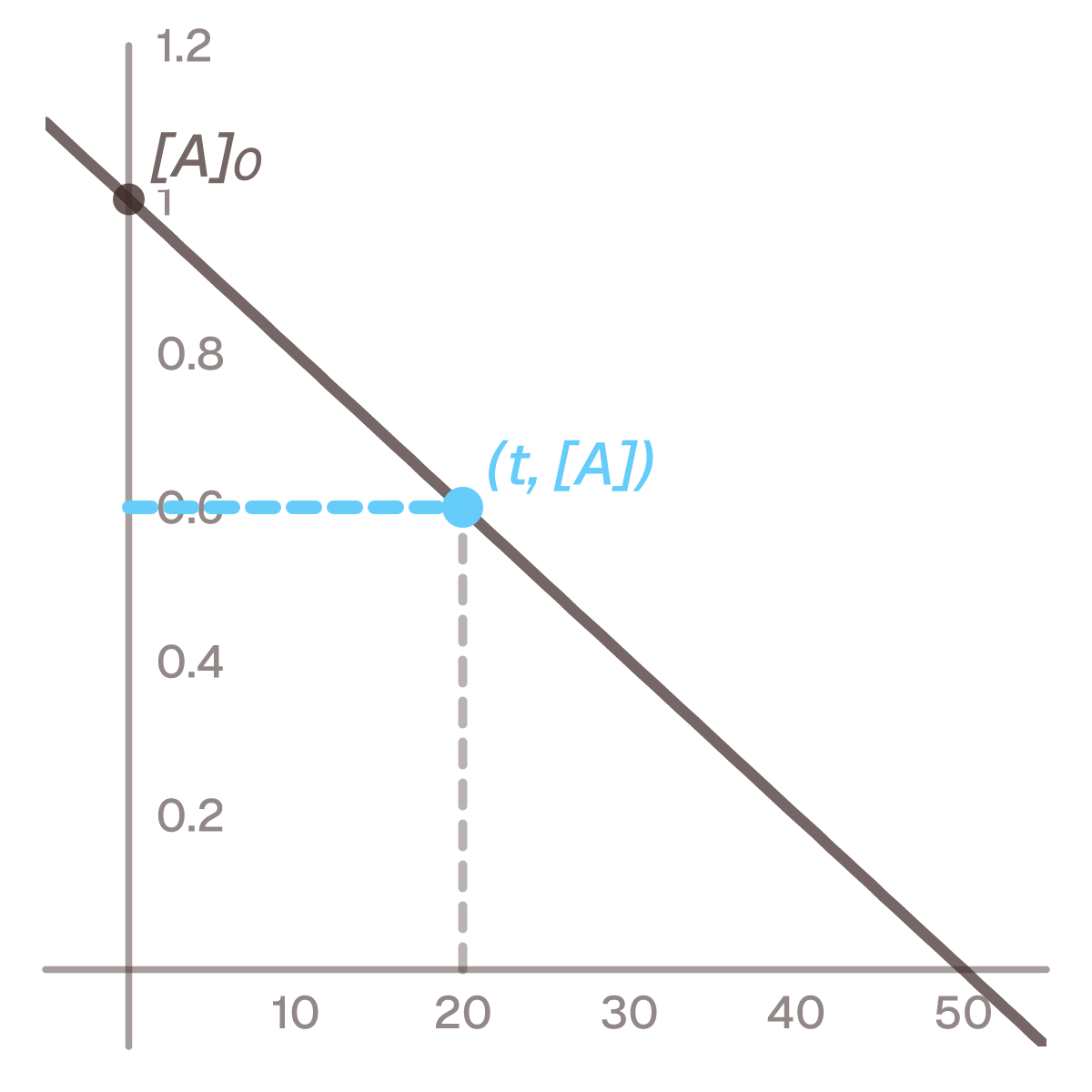
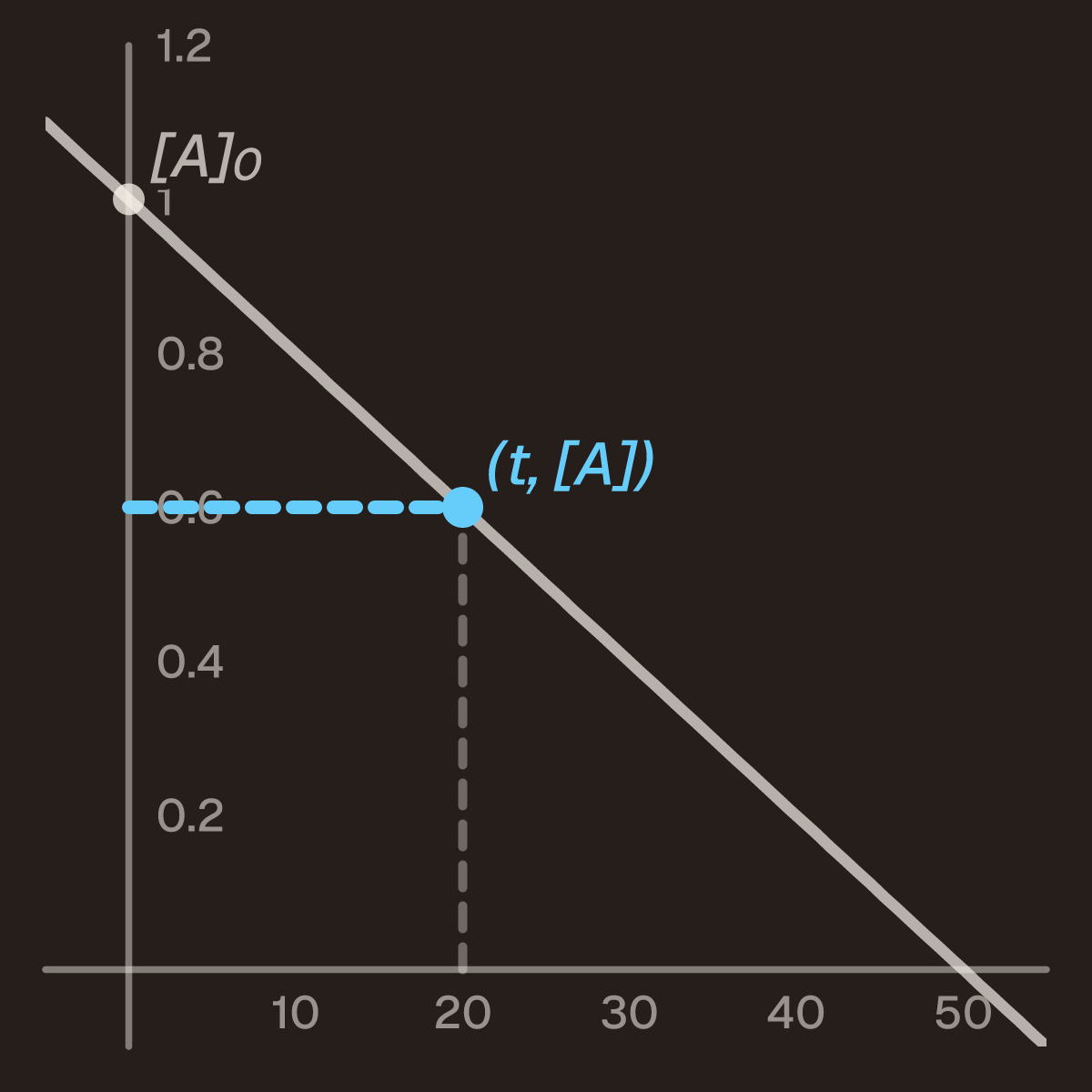
capacity. More reactant then only queues up. Plotted against time, [A] is a straight line with slope −k,
and it reaches zero at t = [A]₀ / k.
Worked examples
The defaults. [A]₀ = 1 mol/dm³, k = 0.02 mol/(dm³·s) and t = 20 s:
[A] = 1 − 0.02 · 20 = 0.6 mol/dm³.
When is it used up? The same reaction runs out at t = 1 / 0.02 = 50 s. After that the formula would
give negative concentrations, and the reaction has simply stopped.
The half-life. Half is gone when k · t = [A]₀ / 2, so t½ = [A]₀ / (2k) = 1 / 0.04 = 25 s. Unlike a
first-order reaction, the half-life depends on how much you start with: start with half as much, and the
half-life halves.
Common mistakes
- Using it for another order. Only if [A] against t is a straight line is the reaction zero order.
- Mixing the units of k. In zero order k is in mol/(dm³·s), not 1/s as in first order.
- Continuing past zero. A negative concentration means the reactant ran out earlier.
Frequently asked questions
How does it compare with first and second order?
In first order, ln[A] is the straight line and
the half-life is constant. In second order,
1/[A] is the straight line and the half-life grows as the reaction goes on. Plotting all three is the usual
way to find the order.
Where is a zero-order reaction found?
Alcohol broken down in the liver is the textbook case: the enzyme works at full speed, so the level in the
blood falls by roughly the same amount every hour.