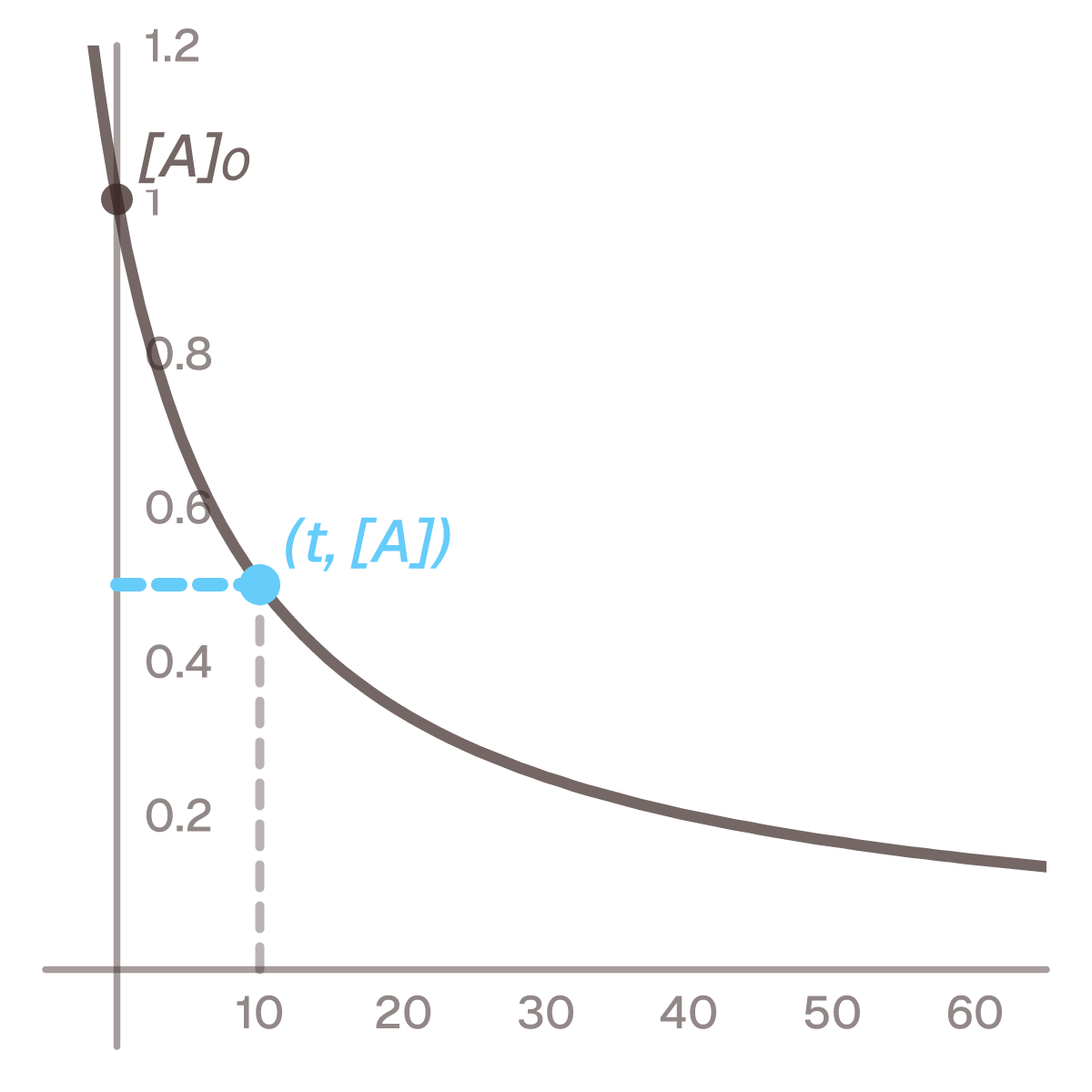
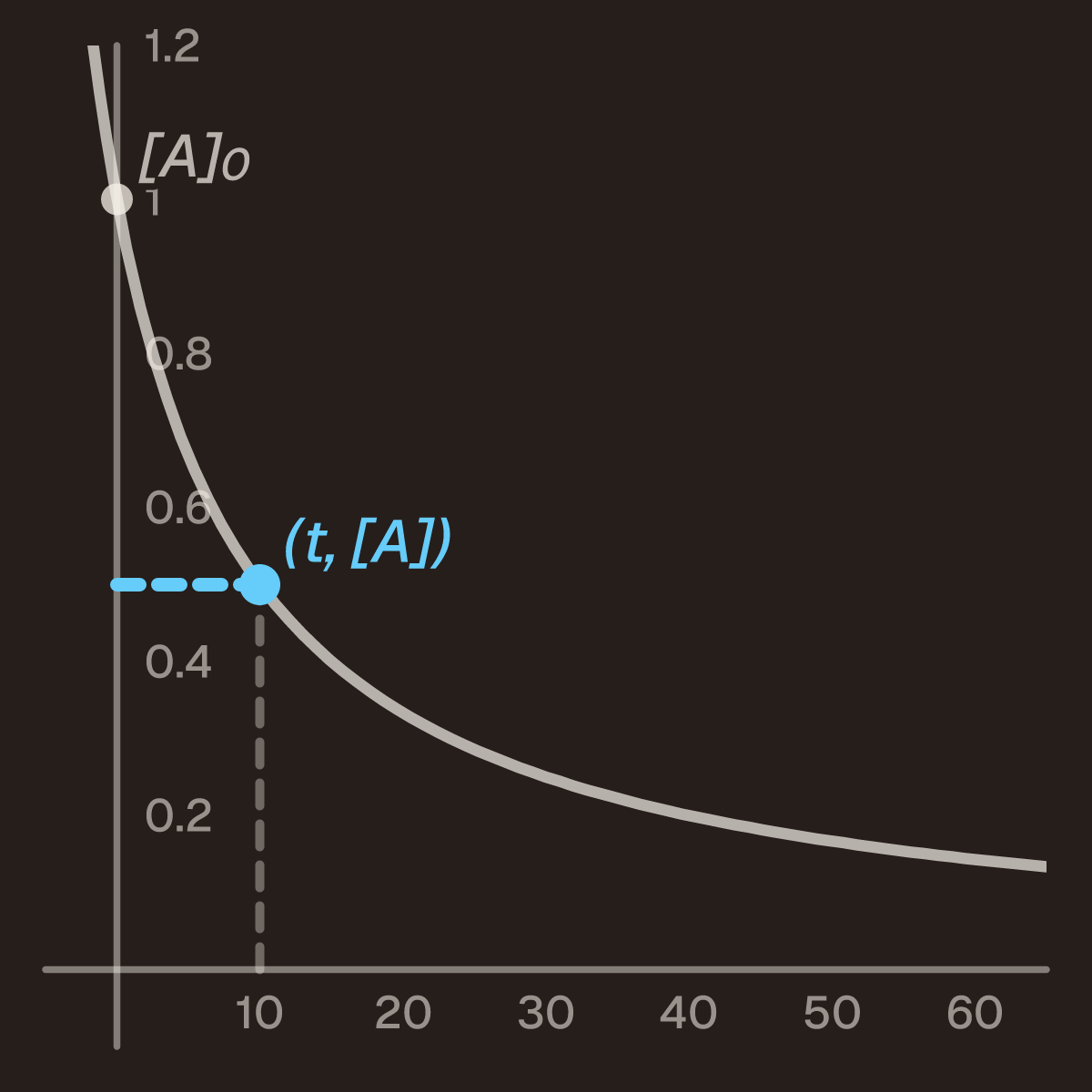
[A] equals 1 divided by ((1 divided by 1) plus (0.1 times 10)), equals 1 divided by (1 plus 1), equals 1 divided by 2, equals 0.5
Working4 steps
[A]
=
111+0.1·10
=
11+1
=
12
=
0.5
Practice questions
You are given
[A]₀=1
k=0.9
t=10
The formula
1/[A] = 1/[A]₀ + k · t
[A]₀ is the starting concentration in mol/dm³, [A] the concentration after the time t, and k the rate
constant in dm³/(mol·s). Solved for the concentration: [A] = [A]₀ / (1 + k · [A]₀ · t).
Holds for a reaction whose rate is k · [A]², at constant temperature.
What second order means
The rate is v = k · [A]²: two molecules of A have to meet. Half as much left means a quarter of the rate, so
the reaction drags on longer than a first-order one. Plotted against time, 1/[A] is a straight line with
slope k.
Worked examples
The defaults. [A]₀ = 1 mol/dm³, k = 0.1 dm³/(mol·s) and t = 10 s:
1/[A] = 1/1 + 0.1 · 10 = 2, so [A] = 0.5 mol/dm³.
The half-life. Setting [A] = [A]₀ / 2 gives t½ = 1 / (k · [A]₀) = 1 / (0.1 · 1) = 10 s, which is why
the defaults land on half. The next half, from 0.5 down to 0.25, takes 1 / (0.1 · 0.5) = 20 s. Each
half-life is twice the one before.
Another start. [A]₀ = 0.5 mol/dm³, k = 0.1 dm³/(mol·s) and t = 30 s:
1/[A] = 2 + 3 = 5, so [A] = 0.2 mol/dm³.
Common mistakes
Taking the reciprocal at the wrong point. Work out 1/[A] first, then invert the sum. 1/2 + 1/3 is
not 1/5.
Mixing the units of k. In second order k is in dm³/(mol·s).
Using it when two different substances react. The formula is for 2A → products, or A + B with equal
starting amounts. Unequal A and B need a different expression.
Frequently asked questions
How does it compare with first and zero order?
In first order, ln[A] is the straight line and
the half-life is constant. In zero order, [A]
itself is the line and the half-life shrinks. Here, the half-life grows.
Looking for another letter? The formula solved for each one
Copy the code into your page where the formula card should appear. It loads from lovetocalc.com, so it stays current on its own — all we ask is that the credit line comes with it.