Lateral area of a pyramid
The relation
A
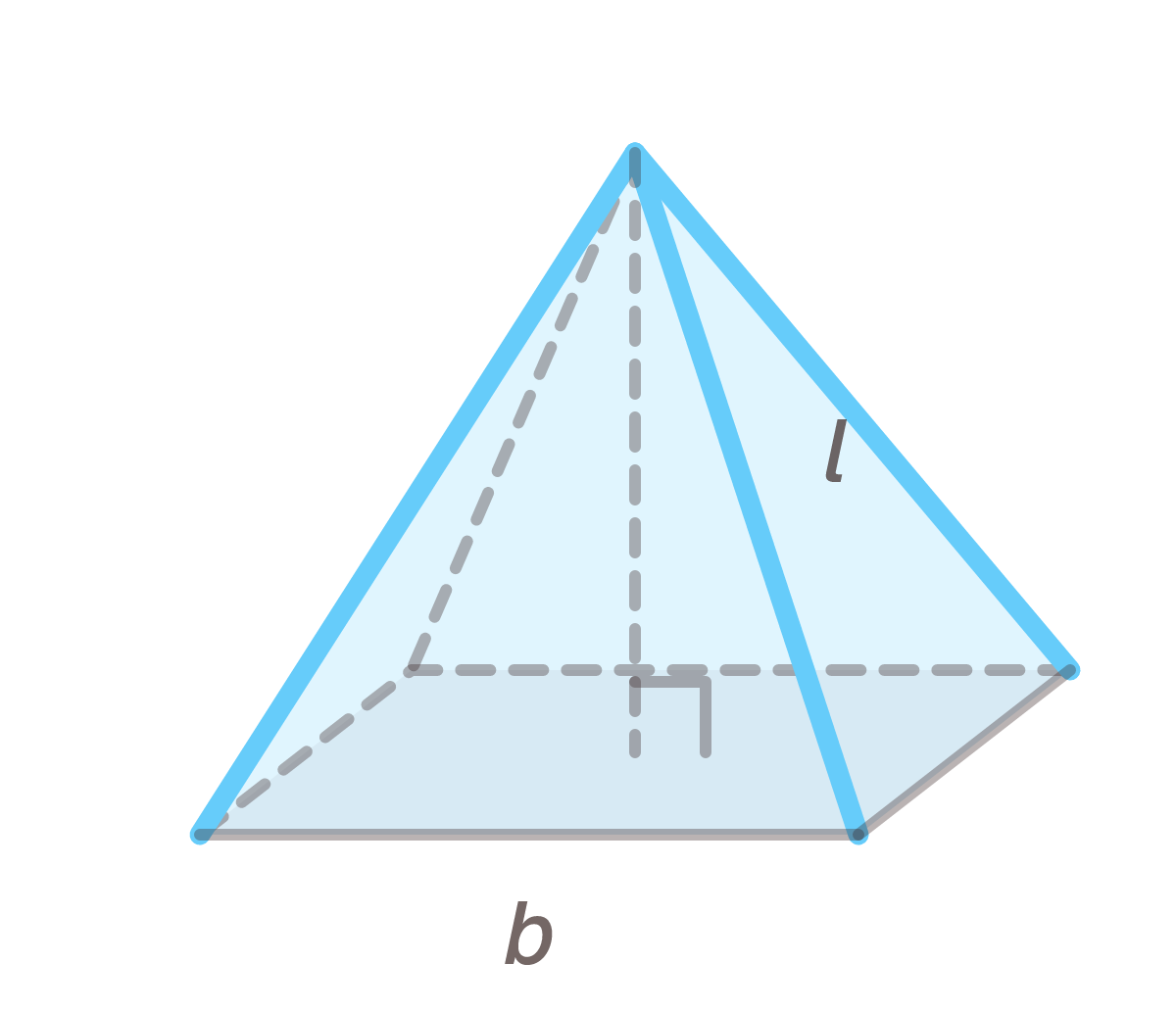
The four leaning triangles, without the base: four times b·l/2.
Solve for
A=60cm²
A equals 2 times (6 times 5), equals 2 times 30, equals 60 cm²
Den här sidan finns på svenska. Byt till svenska
Definition — what does that mean?
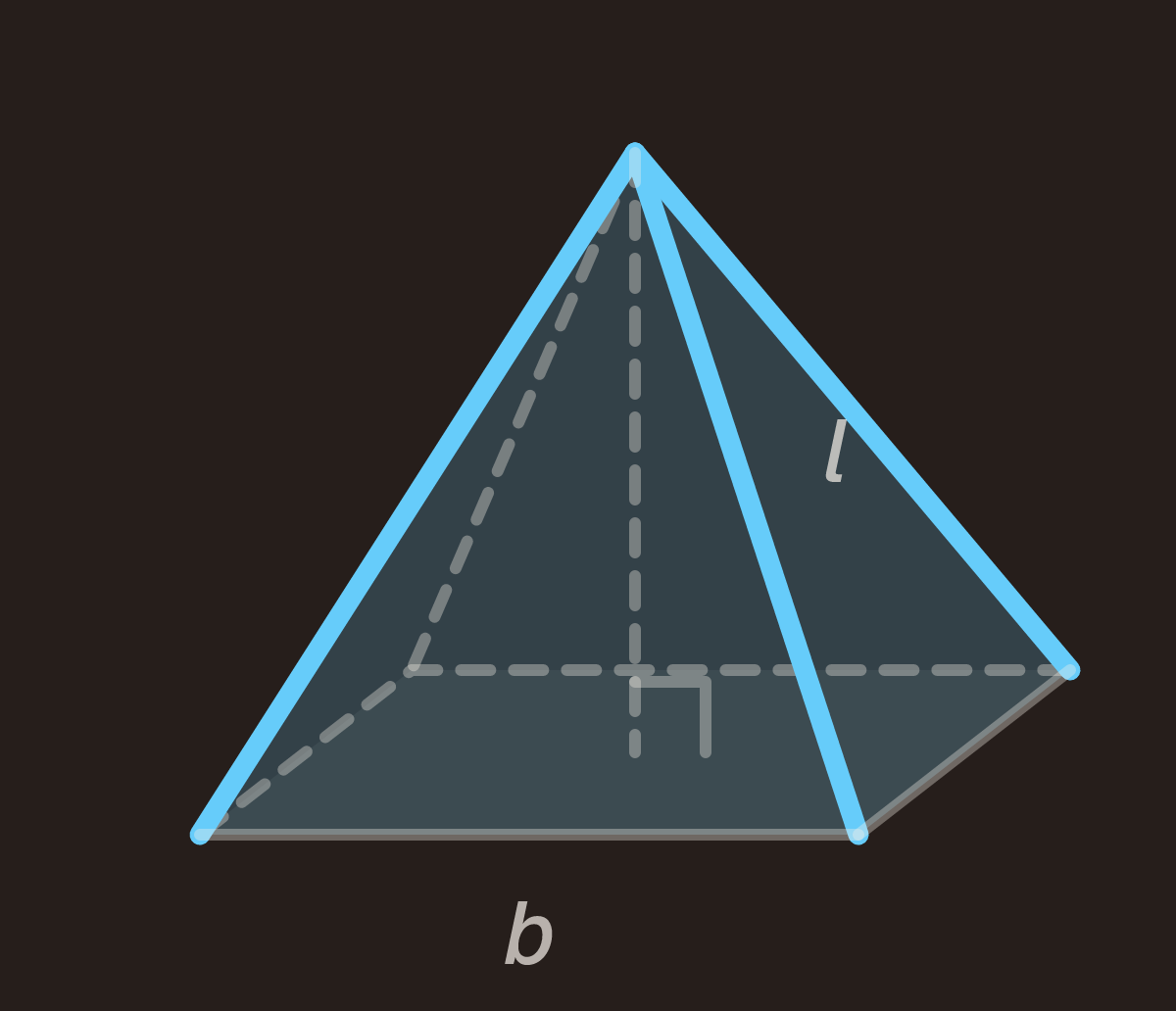
The four leaning triangles, without the base — four times b · l / 2.
In Swedish: Pyramidens mantelarea
A
The four leaning triangles, without the base: four times b·l/2.
A=60cm²
A equals 2 times (6 times 5), equals 2 times 30, equals 60 cm²
You are given
A = 320 cm²
Pick the unit your lengths are in. Areas are then labelled in square units and volumes in cubic units; nothing is converted.
A right pyramid on a square base has four side faces, and all four are identical triangles. Each has the base edge b for its base and the slant height l for its height, so its area is b · l / 2. Four of them:
Swedish calls the slant height sidohöjd and the height straight up höjd.
4 · (b · l) / 2 = 2 · b · l
The base is not counted. It belongs to the surface area, which is this formula plus b².
A pyramid has two measurements that everyday language calls the height:
The slant height is always the longer of the two, because it leans. They are connected by Pythagoras’ theorem: the height h and half the base edge b/2 are the legs of a right-angled triangle whose hypotenuse is the slant height.
l² = h² + (b / 2)²
So a question that gives you the height needs that step taken first. Put h into 2 · b · l and the answer comes out too small, which is a common mistake on this formula.
A pyramid with a base edge of 6 cm and a slant height of 5 cm. The lateral area is 2 · 6 · 5 = 60 cm². Each face is therefore 15 cm², which checks out: (6 · 5) / 2 = 15.
Given the height instead. A pyramid has a base edge of 10 cm and a height of 12 cm. Half the base edge is 5, so the slant height is √(12² + 5²) = √169 = 13 cm. The lateral area is 2 · 10 · 13 = 260 cm².
Working backwards. The lateral area is 60 cm² and the slant height is 5 cm. The base edge is 60 / (2 · 5) = 6 cm.
A pyramid roof on a square tower 8 m across, with a slant height of 5 m. The roof area to be covered is 2 · 8 · 5 = 80 m².
Does the formula hold for a pyramid on a triangular base?
Not in this form. The idea holds — the lateral area is the sum of the faces’ triangles — but with three
sides it is 3 · (b · l) / 2, and if the base’s sides differ each triangle has to be worked out on its
own.
Why is the slant height always longer than the height?
Because it is the hypotenuse of the triangle the height is a leg of. A hypotenuse is always longer than
either leg.
How do I find the height from the slant height?
The same relation backwards: h = √(l² − (b / 2)²).
| Solve for | Rearranged | With the numbers | Comes to |
|---|---|---|---|
| b | A2l | 602·5 | 6 cm |
| l | A2b | 602·6 | 5 cm |
| A | 2bl | 2·6·5 | 60 cm² |
Last reviewed October 6, 2026 ·How pages are reviewed
The same drawing, measured in the other ways it can be measured.
Copy the code into your page where the formula card should appear. It loads from lovetocalc.com, so it stays current on its own — all we ask is that the credit line comes with it.