Concrete needed
The relation
V
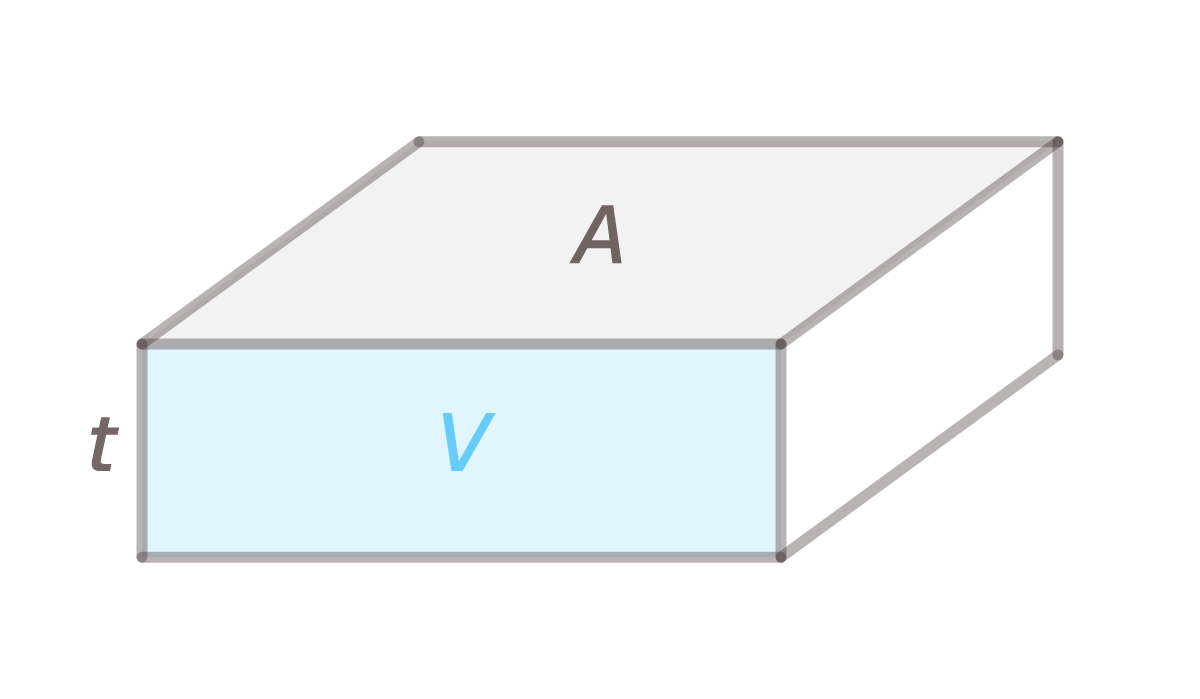
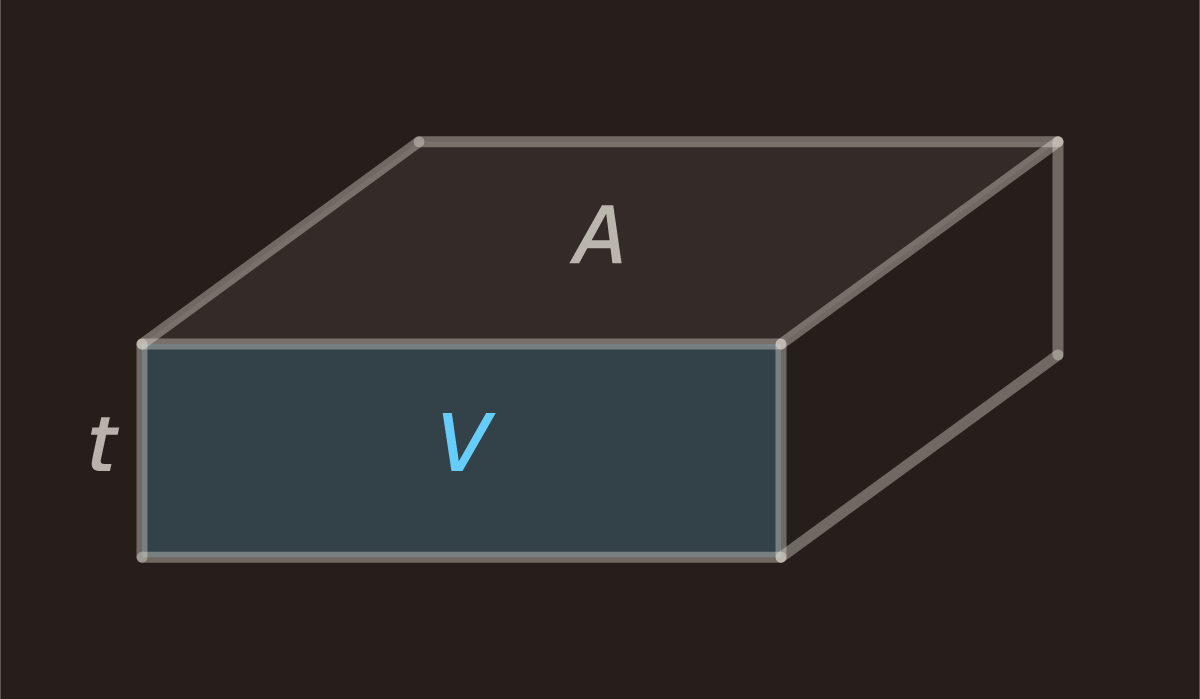
A slab is a very flat box: the area it covers, times how thick it is poured.
Solve for
V=1.2cm³
V equals 12 times 0.1, equals 1.2 cm³
Den här sidan finns på svenska. Byt till svenska
Theorem — what does that mean?
A slab is a very flat box — the area it covers, times how thick it is poured.
In Swedish: Betongåtgång
V
A slab is a very flat box: the area it covers, times how thick it is poured.
V=1.2cm³
V equals 12 times 0.1, equals 1.2 cm³
You are given
Round to 2 decimals.
Pick the unit your lengths are in. Areas are then labelled in square units and volumes in cubic units; nothing is converted.
A poured slab is a box that is far wider than it is thick. Its volume is the area times the thickness, as for any other box.
A slab of 12 m² poured 10 cm thick holds 12 · 0.10 = 1.2 m³ of concrete.
Keep the units together: if the area is in square metres the thickness belongs in metres. Ten centimetres is 0.10 metres, not 10.
Concrete is sold either ready-mixed by the cubic metre or as a dry mix in bags. The bag states how many litres of finished concrete it yields — fewer litres than the bag weighs in kilos, because concrete weighs a little over two kilos per litre.
The number of bags is the volume divided by what one bag yields:
| Volume | Bag yields 12.5 l | Bag yields 20 l |
|---|---|---|
| 0.1 m³ = 100 l | 8 bags | 5 bags |
| 0.5 m³ = 500 l | 40 bags | 25 bags |
| 1.0 m³ = 1,000 l | 80 bags | 50 bags |
If the bag only states a weight, read the product sheet — that is where the yield in litres is.
The thickness is not a free choice. A slab under a garden room is poured thinner than a garage slab that has to carry a car, and the demands on the base and the reinforcement change with the load.
The formula works out volume, not strength. What the slab has to withstand is a question for the engineer or the build spec; this page only says how much goes into the form.
Slab on ground. 5 × 4 m at 12 cm: 20 · 0.12 = 2.4 m³.
Path. 10 m long and 0.8 m wide, 8 cm: 8 · 0.08 = 0.64 m³.
Backwards. 1.5 m³ over 15 m² is 1.5 / 15 = 0.10 m, that is 10 cm.
Footings. Six footings of area 0.09 m² and depth 0.6 m: 6 · 0.09 · 0.6 = 0.32 m³.
How much is a cubic metre of concrete?
A thousand litres. It is the unit ready-mixed concrete is sold in, and the one to compare bag yields
against.
Do I need to allow for waste?
Yes, a few per cent. Ground is uneven and a form is rarely filled exactly to the edge.
Does the formula work for footings and post holes?
Yes — there A is the cross-section of the hole and t its depth. Same calculation, different words.
| Solve for | Rearranged | With the numbers | Comes to |
|---|---|---|---|
| A | Vt | 1.20.1 | 12 cm² |
| t | VA | 1.212 | 0.1 cm |
| V | At | 12·0.1 | 1.2 cm³ |
Last reviewed October 6, 2026 ·How pages are reviewed
Copy the code into your page where the formula card should appear. It loads from lovetocalc.com, so it stays current on its own — all we ask is that the credit line comes with it.