Exterior angle theorem
The relation
δ
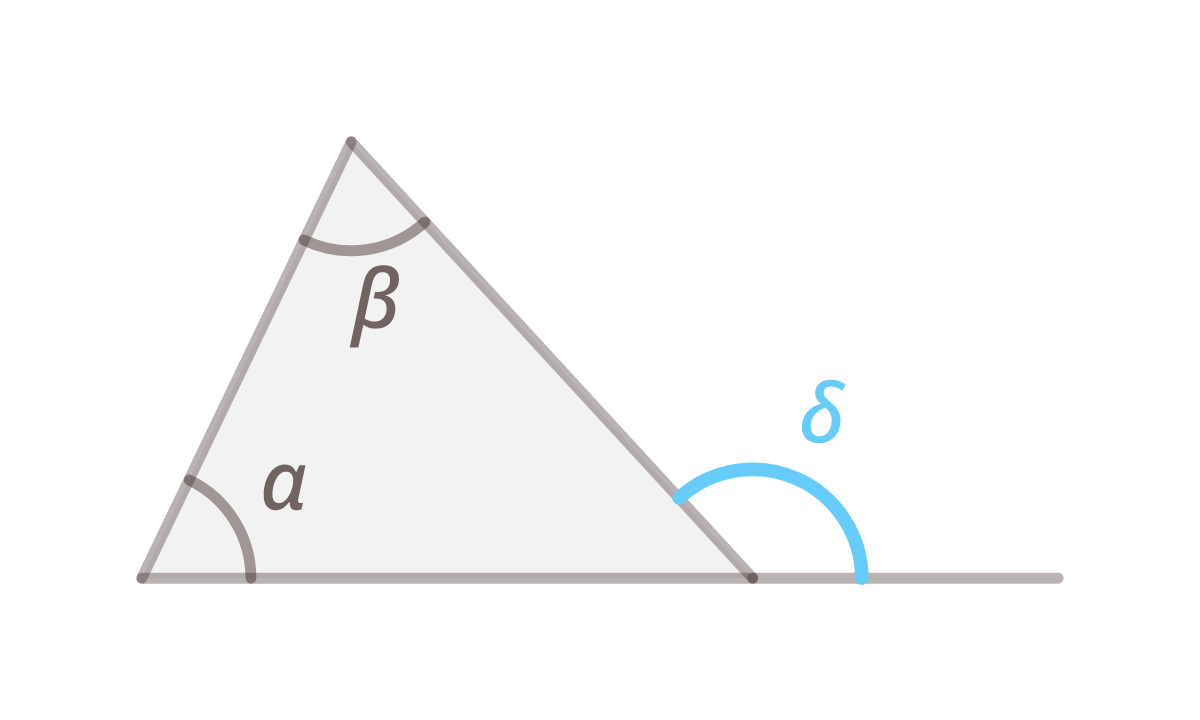
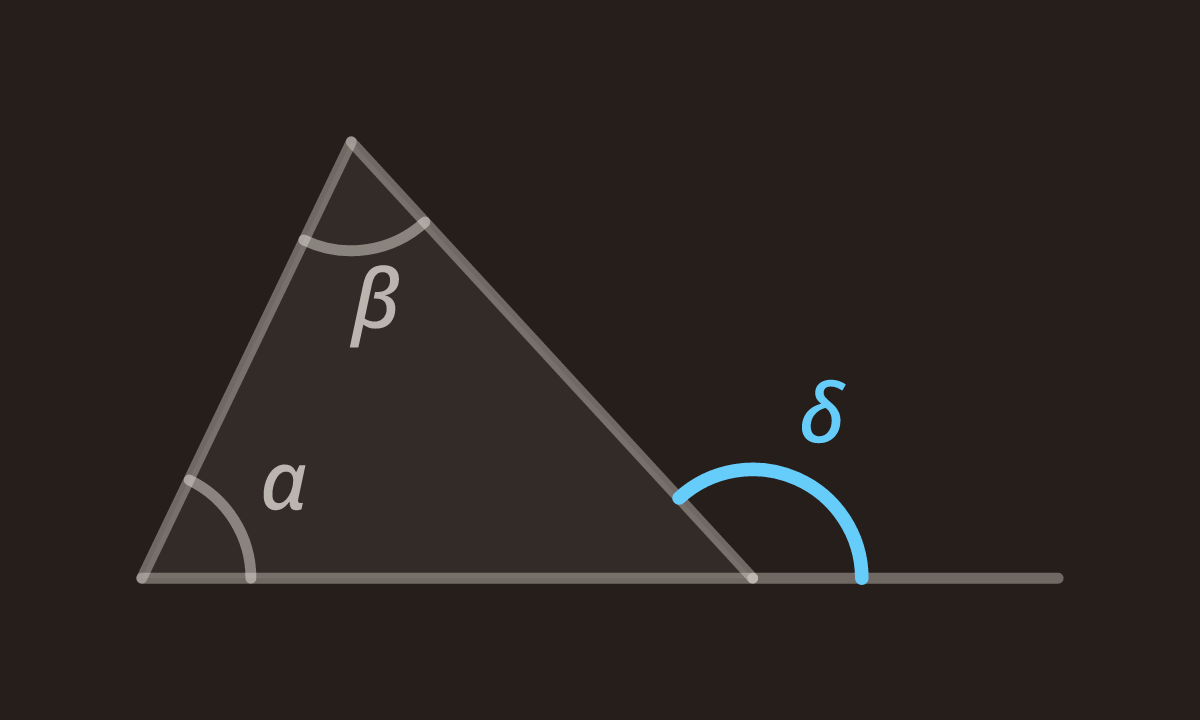
The angle outside one corner of a triangle equals the two inside angles at the other two corners, added together.
Solve for
δ=120
δ equals 50 degrees plus 70 degrees, equals 120 degrees
Den här sidan finns på svenska. Byt till svenska
Theorem — what does that mean?
The angle outside one corner of a triangle equals the two inside angles at the other two corners, added together.
In Swedish: Yttervinkelsatsen
δ
The angle outside one corner of a triangle equals the two inside angles at the other two corners, added together.
δ=120
δ equals 50 degrees plus 70 degrees, equals 120 degrees
You are given
Extend one side of a triangle past a corner. The angle between the extension and the other side at that corner is an exterior angle, δ. The theorem says it equals the sum of the two interior angles α and β at the other two corners — the remote interior angles.
If the two remote angles are 50° and 70°, the exterior angle is 50° + 70° = 120°.
A mistake that is easy to miss is including the angle at the same corner as the exterior angle. That angle sits next to the exterior one on a straight line, and the two make 180°. In the triangle above it is 60°:
| Working | δ |
|---|---|
| 50° + 70° (the two remote angles, right) | 120° |
| 50° + 60° (one remote and the adjacent one, wrong) | 110° |
Both answers look like reasonable angles. The check is that the exterior angle and the adjacent interior angle make 180°: 120° + 60° = 180°, but 110° + 60° = 170°.
Call the interior angle at the exterior angle’s corner γ. The exterior angle and γ lie on one straight line, so δ + γ = 180°. The angle sum of the triangle gives α + β + γ = 180°. Both sums are 180°, so δ + γ = α + β + γ, and taking γ from both sides leaves δ = α + β.
An unknown remote angle. The exterior angle is 130° and one remote angle is 55°. The other is 130° − 55° = 75°.
An obtuse remote angle. Remote angles of 20° and 110° give an exterior angle of 130°. The exterior angle is always larger than either remote angle, the obtuse one included.
Does each corner have two exterior angles?
Yes, one on each side depending on which side is extended. They are vertically opposite and therefore
equal, so the theorem gives the same answer.
Where is it used?
Among other places in the proof of the
inscribed angle theorem, where a radius
splits the figure into isosceles triangles and the exterior angle gives the doubling.
| Solve for | Rearranged | With the numbers | Comes to |
|---|---|---|---|
| α | δ | 120° | 50 |
| β | δ | 120° | 70 |
| δ | α | 50° | 120 |
Last reviewed October 6, 2026 ·How pages are reviewed
Copy the code into your page where the formula card should appear. It loads from lovetocalc.com, so it stays current on its own — all we ask is that the credit line comes with it.