Lateral area of a prism
The relation
A
The wall around it, unrolled: the way round the base times the height.
Solve for
A=60cm²
A equals 12 times 5, equals 60 cm²
Den här sidan finns på svenska. Byt till svenska
Definition — what does that mean?
The wall around it, unrolled — the way round the base times the height.
In Swedish: Prismats mantelarea
A
The wall around it, unrolled: the way round the base times the height.
A=60cm²
A equals 12 times 5, equals 60 cm²
You are given
A = 156 cm²
Pick the unit your lengths are in. Areas are then labelled in square units and volumes in cubic units; nothing is converted.
A prism is two identical end faces with straight walls between them. The lateral area is those walls — everything except the two ends.
Swedish calls it mantelarea, and the surface area including the ends begränsningsarea, a separate word rather than a qualifier.
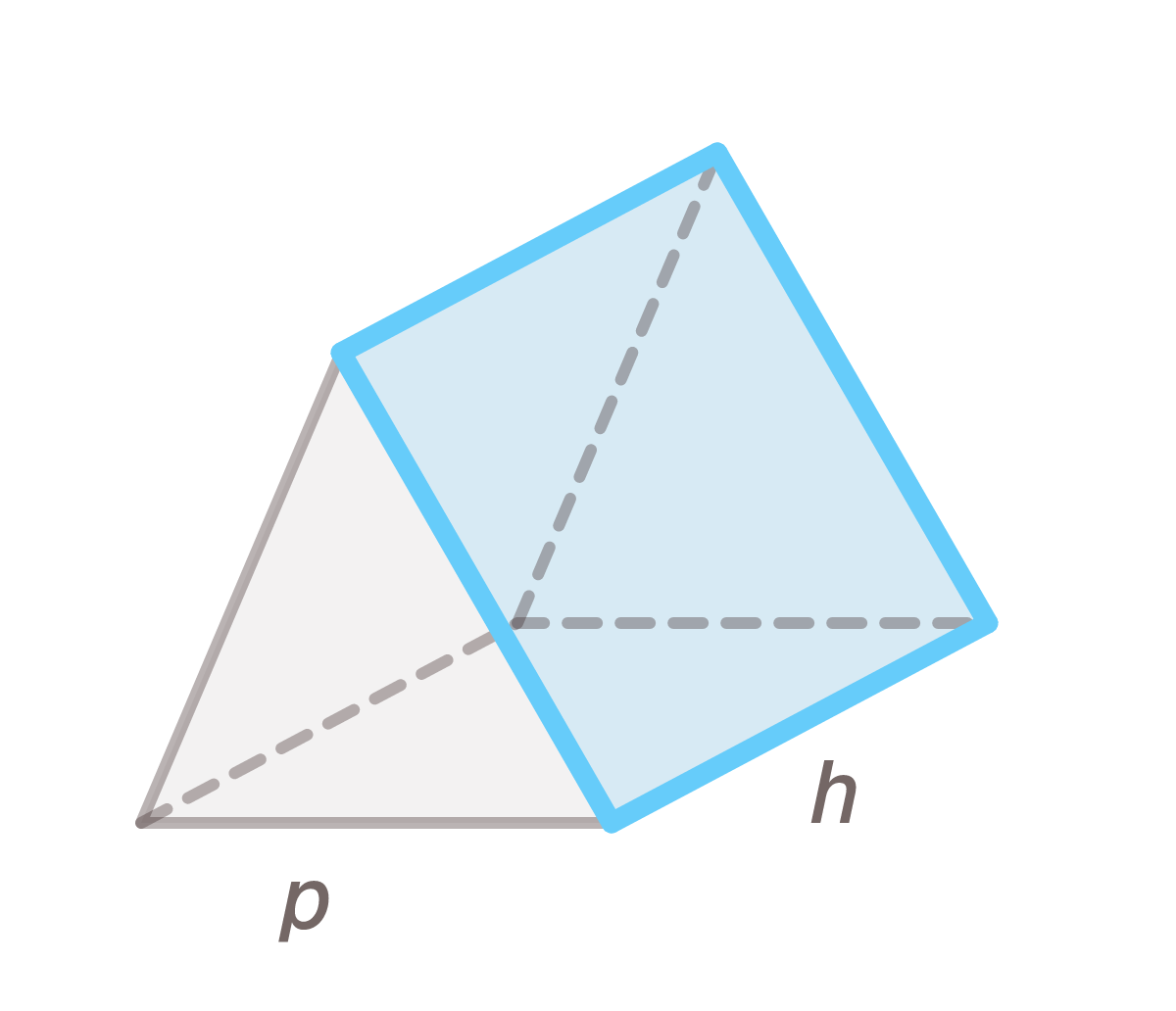
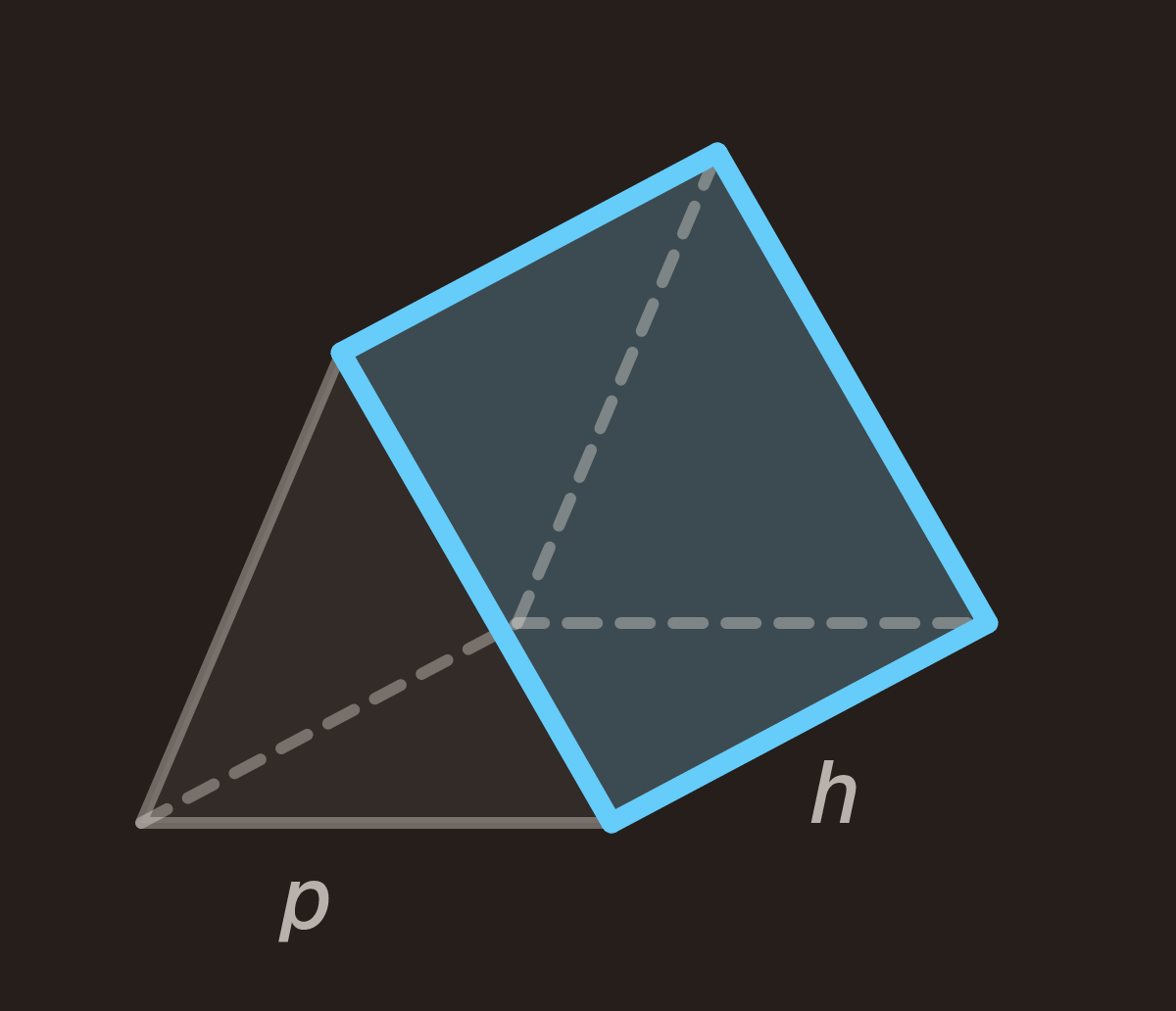
Cut along one of the upright edges and unroll the wall flat. It becomes a single rectangle. Its height is the prism’s height h, and its width is the way round the base, which is the base perimeter p. The area of a rectangle is its width times its height, so:
A = p · h
That the wall is made of three or five or eight flat pieces makes no difference. Laid edge to edge they are together as wide as the perimeter and as tall as the prism.
The surface area is the lateral area plus the two ends: A = 2B + p · h. The difference is 2B, and which of the two you want is decided by what the solid is:
| Situation | What to work out | Formula |
|---|---|---|
| The label around a package | Lateral area | p · h |
| Paint on a closed box | Surface area | 2B + p · h |
| Paint on a pipe, open at both ends | Lateral area | p · h |
| Sheet metal for a box with no lid | Lateral area plus one end | p · h + B |
The last row shows that a real problem often needs something in between, and then the lateral area is the part you start from.
A triangular prism whose base is a triangle with sides 3, 4 and 5 cm, and which is 10 cm long. The base perimeter is 3 + 4 + 5 = 12 cm, so the lateral area is 12 · 10 = 120 cm².
Working backwards. A prism has a lateral area of 180 cm² and a base perimeter of 12 cm. The height is 180 / 12 = 15 cm.
A hexagonal column with a 2 dm side and a height of 25 dm. The perimeter is 6 · 2 = 12 dm, so the area to be painted around it is 12 · 25 = 300 dm² = 3 m².
Does the formula hold for every prism?
For every right prism, however many corners the base has. In an oblique prism the walls are not
perpendicular to the base, and p · h is no longer right.
A cuboid is a prism — does the formula work on it?
Yes. The base is a rectangle of perimeter 2(l + w), so the lateral area is 2(l + w) · h, which is the
four side walls in the
surface area of a cuboid.
And for a cylinder?
The same idea. The base perimeter is 2πr, so the
lateral area of a cylinder is
2πr · h — p · h with a round p.
| Solve for | Rearranged | With the numbers | Comes to |
|---|---|---|---|
| p | Ah | 605 | 12 cm |
| h | Ap | 6012 | 5 cm |
| A | ph | 12·5 | 60 cm² |
Last reviewed October 6, 2026 ·How pages are reviewed
The same drawing, measured in the other ways it can be measured.
Copy the code into your page where the formula card should appear. It loads from lovetocalc.com, so it stays current on its own — all we ask is that the credit line comes with it.