Surface area of a prism
The relation
A
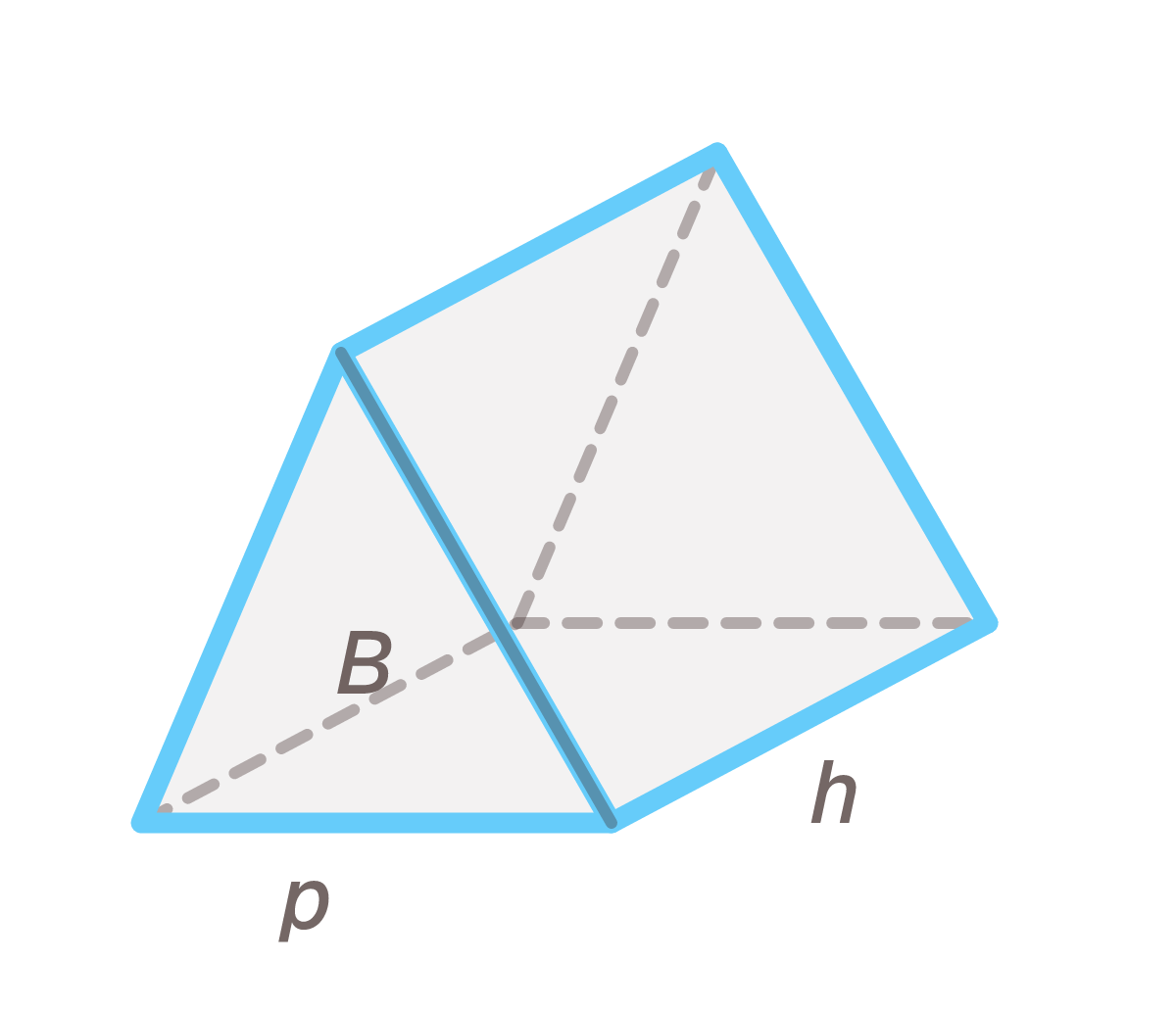
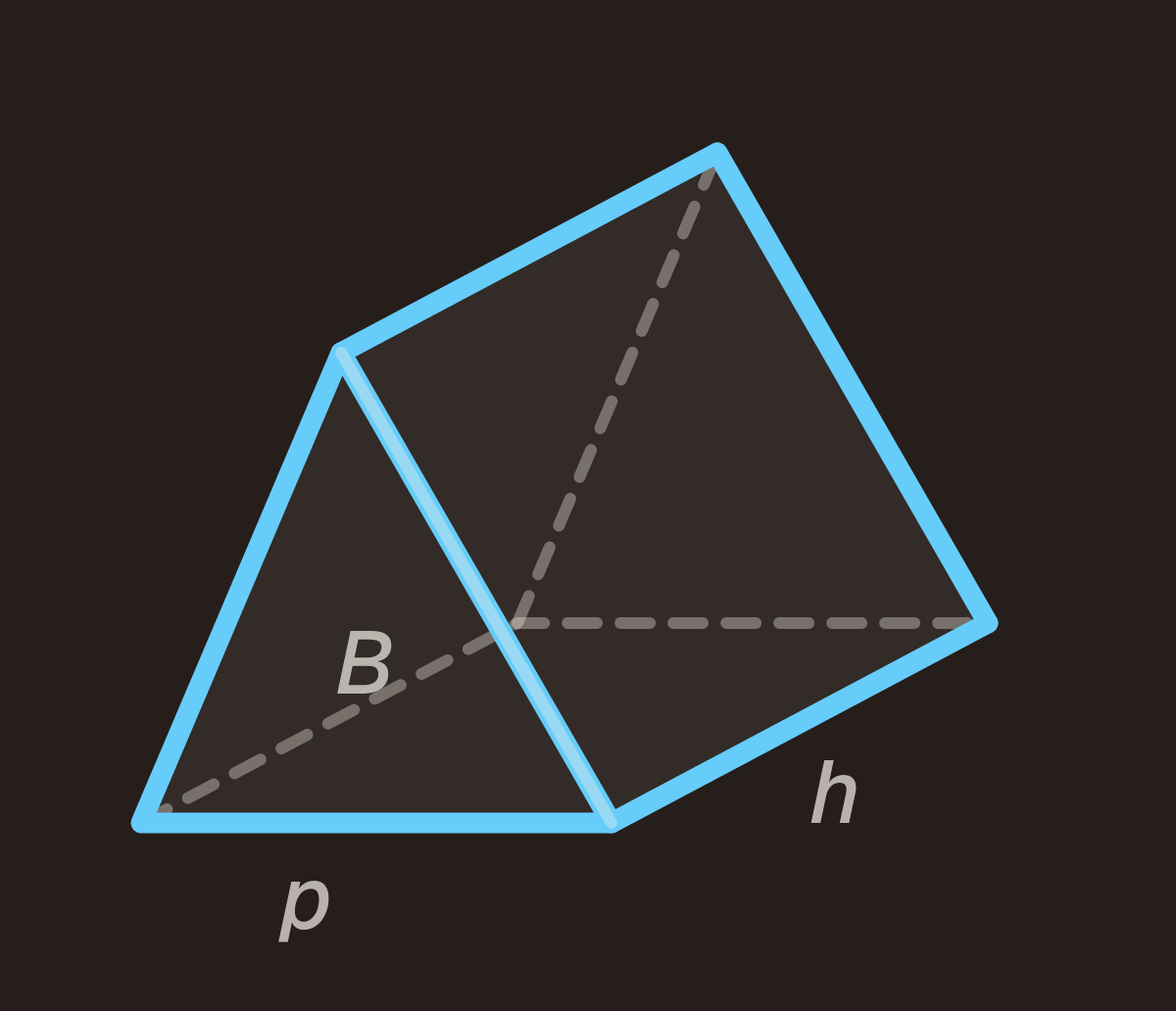
The wall around it plus the two ends.
Solve for
A=72cm²
A equals (2 times 6) plus (12 times 5), equals 12 plus 60, equals 72 cm²
Den här sidan finns på svenska. Byt till svenska
Definition — what does that mean?
The wall around it plus the two end faces.
In Swedish: Prismats begränsningsarea
A
The wall around it plus the two ends.
A=72cm²
A equals (2 times 6) plus (12 times 5), equals 12 plus 60, equals 72 cm²
You are given
A = 396 cm²
Pick the unit your lengths are in. Areas are then labelled in square units and volumes in cubic units; nothing is converted.
A prism has two kinds of surface, and the formula names them both:
Put together:
A = 2B + p · h
Each term matches a part of the solid, so there is no need to work out each face separately.
The formula takes two facts about the base: its area B and its perimeter p. They are measured in different units, and neither can be found from the other without knowing the base’s shape.
| Base | Perimeter p | Area B |
|---|---|---|
| 3-4-5 triangle | 12 | 6 |
| 6-8-10 triangle | 24 | 24 |
| 5-12-13 triangle | 30 | 30 |
| Square of side 6 | 24 | 36 |
Rows two and three look like coincidences, and they are: the same number in two columns that measure different things. If a question gives you only the base’s sides, you work both out yourself — the perimeter by adding the sides, the area with the area of a triangle or whichever formula the base’s shape belongs to.
A triangular prism with a 3-4-5 triangle for its base and a height of 5 cm. The base area is (3 · 4) / 2 = 6 cm² and the perimeter is 12 cm. The surface area is 2 · 6 + 12 · 5 = 12 + 60 = 72 cm².
Working backwards. A prism has a surface area of 72 cm², a base area of 6 cm² and a base perimeter of 12 cm. The wall is 72 − 2 · 6 = 60 cm², so the height is 60 / 12 = 5 cm.
A tent with a triangular gable: the base is an isosceles triangle with a 2 m bottom side and two 2.5 m sides, 2.29 m tall, and the tent is 3 m long. The gable’s area is (2 · 2.29) / 2 ≈ 2.29 m² and its perimeter is 2 + 2.5 + 2.5 = 7 m. The whole outside, gables included, is 2 · 2.29 + 7 · 3 ≈ 25.6 m².
Is the cuboid’s formula a special case of this one?
Yes. With a rectangular base, B = l · w and p = 2(l + w), so 2B + p · h becomes 2lw + 2lh + 2wh — exactly
the surface area of a cuboid.
What if the base is a polygon with many sides?
Nothing changes in the formula. p is the way round the base however many corners it has, and B is its
area. For a regular base, the more sides it has, the more
the result resembles the cylinder’s.
Can I find the base area from the surface area, the perimeter and the height?
Yes. Subtract the wall p · h from the surface area and halve what is left.
| Solve for | Rearranged | With the numbers | Comes to |
|---|---|---|---|
| B | A | 72 | 6 cm² |
| p | A | 72 | 12 cm |
| h | A | 72 | 5 cm |
| A | 2B | 2·6 | 72 cm² |
Last reviewed October 6, 2026 ·How pages are reviewed
Sheets that ask this formula, with their answer keys. Open one to see the questions or print it.
Sixteen questions on the surface area of cubes, cuboids and prisms.
The same drawing, measured in the other ways it can be measured.
Copy the code into your page where the formula card should appear. It loads from lovetocalc.com, so it stays current on its own — all we ask is that the credit line comes with it.