Volume scale factor
The relation
kV
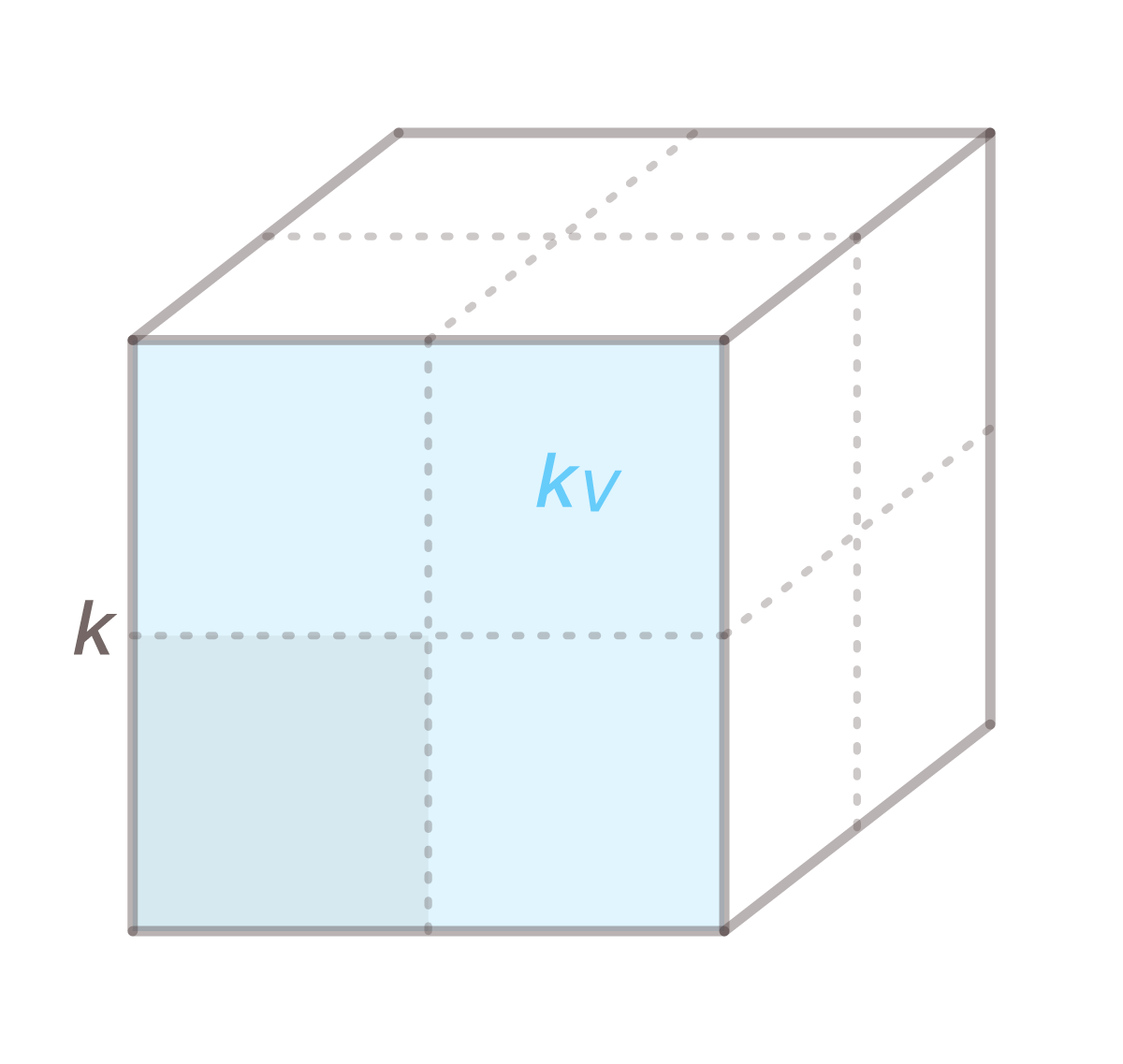
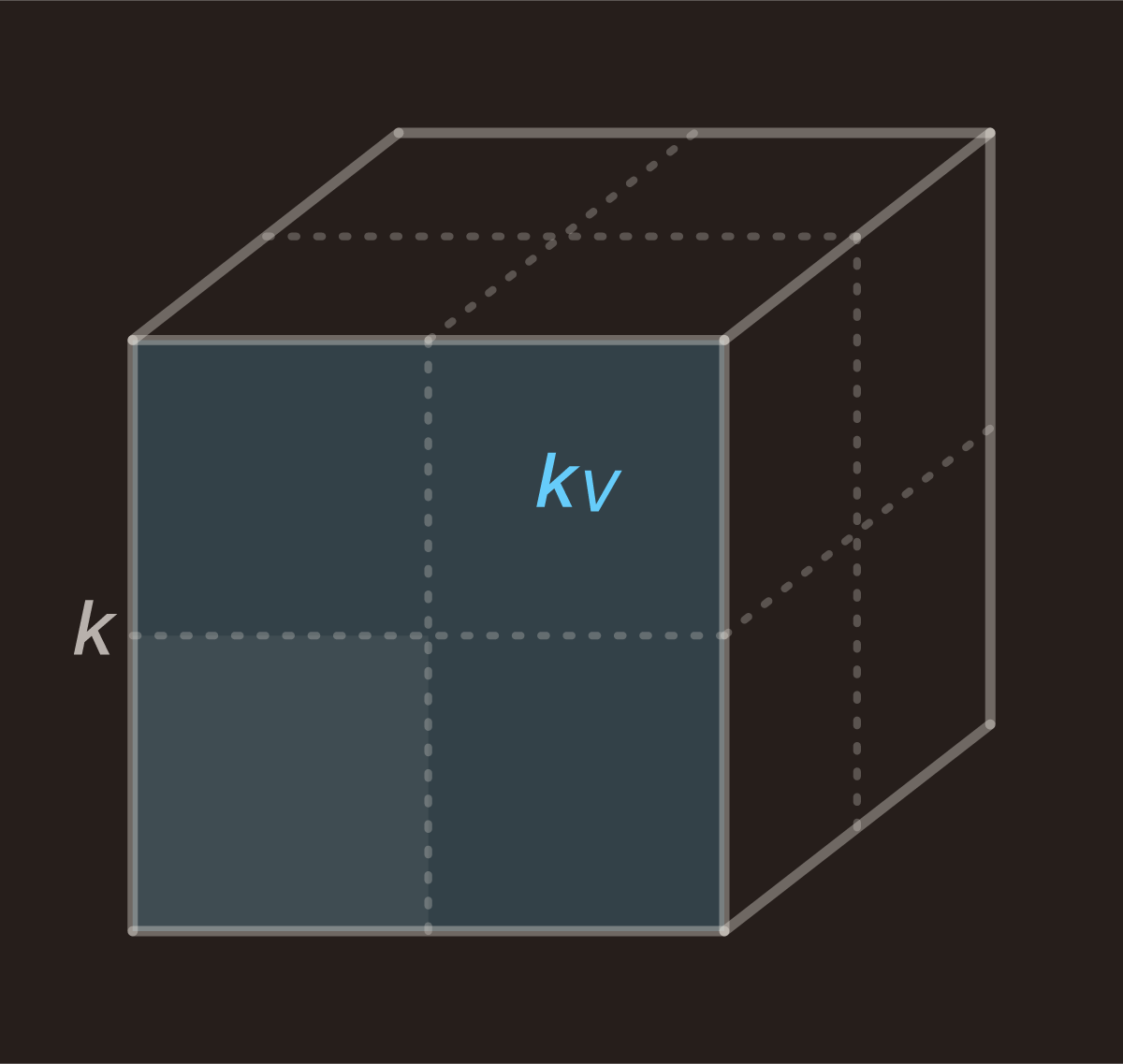
Enlarge a body by a factor k and its volume grows by k³ — three directions, three factors. Twice as tall is eight times as much.
Solve for
kV=27
k V equals 3 cubed, equals 27
Den här sidan finns på svenska. Byt till svenska
Theorem — what does that mean?
Enlarge a solid by a factor of k and its volume grows by k³ — three directions, three factors.
In Swedish: Volymskala
kV
Enlarge a body by a factor k and its volume grows by k³ — three directions, three factors. Twice as tall is eight times as much.
kV=27
k V equals 3 cubed, equals 27
You are given
A volume is a length times a length times a length. Enlarge the solid by a factor of k and all three lengths become k times as long, so the product becomes k³ times as large.
A cuboid shows it at once: a box of 2 × 3 × 4 holds 24. Double every edge to 4 × 6 × 8 and it holds 192 — eight times as much.
It holds for every solid. The volume of a sphere is 4π r³ / 3, and swapping r for k · r gives k³ times as much. The three in the exponent comes from the three directions, not from the formula.
The same enlargement gives three different numbers, and that is where it usually goes wrong:
A model at 1:10 is therefore a tenth as long, has a hundredth of the surface and holds a thousandth.
A model. A model car at 1:18 holds (1/18)³ ≈ 1/5,800 of the real car. Made of the same material throughout, it would weigh less than two ten-thousandths as much, not an eighteenth.
A box. A moving box with sides 20% longer holds 1.2³ = 1.728, that is 73% more — not 20%.
Backwards. One solid holds 27 times as much as another of the same shape. The length scale is ∛27 = 3. Pick the length scale as the unknown in the card above.
Why does an elephant need such thick legs?
The answer follows from this formula. Double an animal’s length and its volume, and so its weight, is
eight times as large, while the cross-section of its legs is only four times as large. Large animals
therefore have disproportionately thick bones.
Does it hold for weight as well?
Yes, if the density is the same. Weight is density times volume, and density does not change because
something is enlarged.
How does it relate to the area scale factor?
The same argument with one more direction. Area grows by
k² and volume by k³, so the volume scale is the
area scale times the length scale.
| Solve for | Rearranged | With the numbers | Comes to |
|---|---|---|---|
| k | 3 | 3 | 3 |
| kV | k³ | 3³ | 27 |
Last reviewed October 6, 2026 ·How pages are reviewed
Sheets that ask this formula, with their answer keys. Open one to see the questions or print it.
Six questions on similar triangles and ten on how area and volume change when the lengths change.
Copy the code into your page where the formula card should appear. It loads from lovetocalc.com, so it stays current on its own — all we ask is that the credit line comes with it.