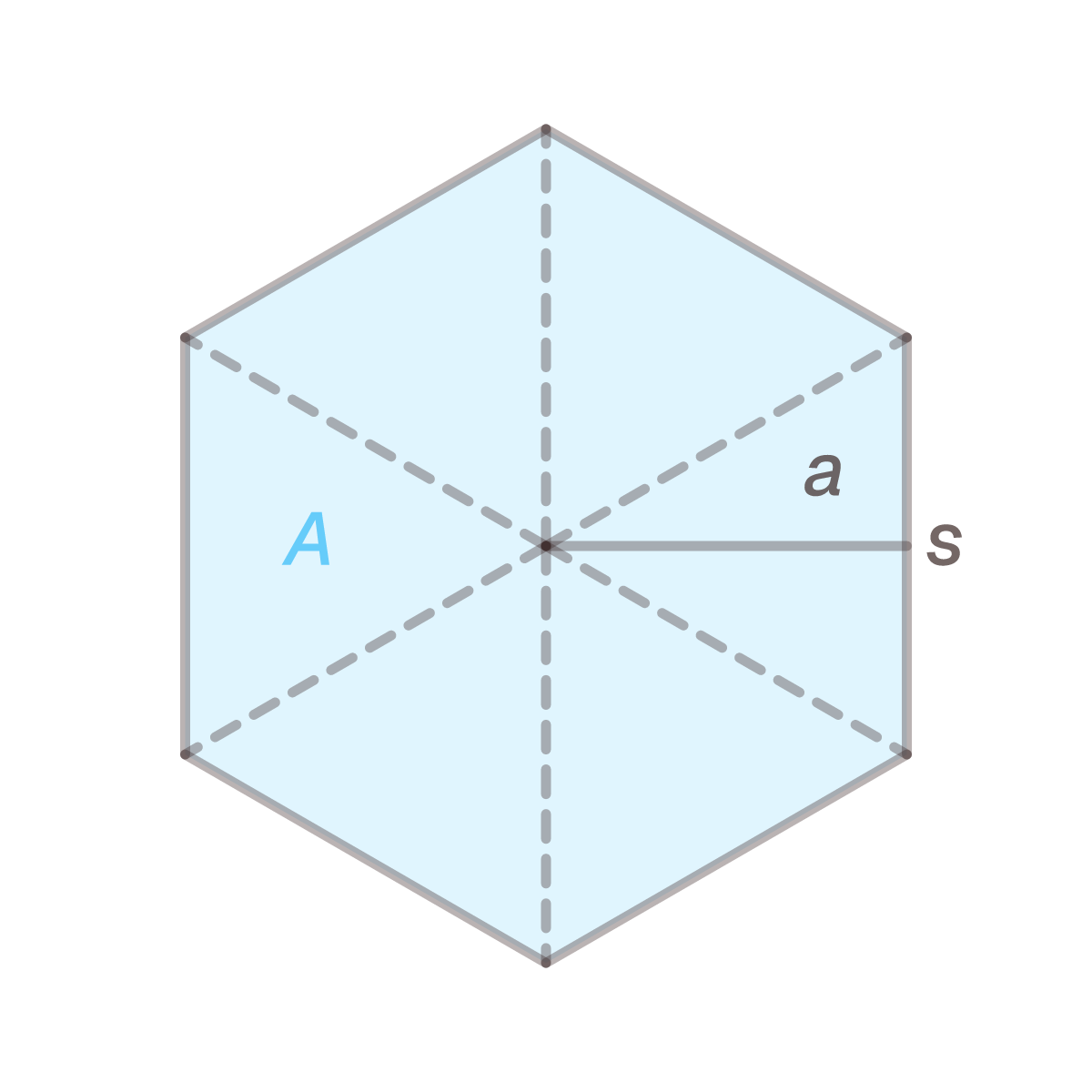
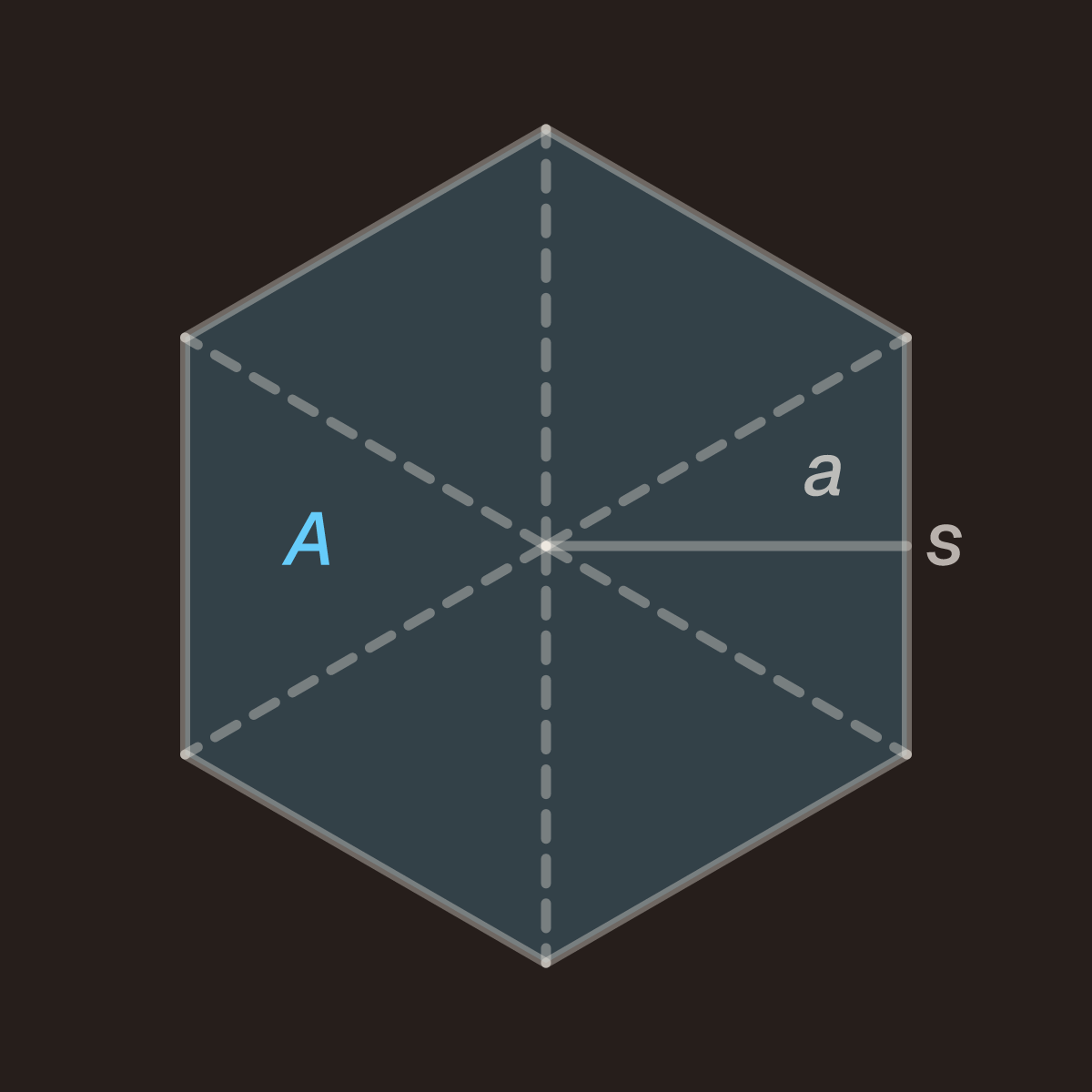
n is the number of sides, s the length of a side and a the apothem — the distance from the centre
straight out to the middle of a side, measured at a right angle. A regular hexagon with a side of 4 cm and
an apothem of 3.5 cm has an area of 6 · 4 · 3.5 / 2 = 42 cm².
Since n · s is the perimeter, the
formula is often written A = P · a / 2: the perimeter times the apothem, halved.
Why it becomes triangles
Draw a line from the centre to every corner. The figure splits into n triangles, all identical, because
the polygon is regular.
Each triangle has a side of the polygon as its base — the length s — and the apothem as its height, since
the apothem is exactly the distance from the centre down to that side. The area of a
triangle is s · a / 2, and n of those make
n · s · a / 2.
The apothem is not the radius
Two distances from the centre are easy to confuse:
- The apothem a runs to the middle of a side. It is the shortest way to the edge.
- The circumradius R runs to a corner. It is the longest.
The formula takes the apothem. If you have R instead, the Pythagorean
theorem on one of the half-triangles gives it:
a² + (s/2)² = R².
Worked examples
A pentagon. Side 6 cm, apothem 4.1 cm: 5 · 6 · 4.1 / 2 = 61.5 cm².
A square as a check. A square is a regular quadrilateral. A side of 6 cm gives an apothem of 3 cm —
half the side — and the formula gives 4 · 6 · 3 / 2 = 36 cm², which is 6².
Backwards. A regular octagon has an area of 120 cm² and a side of 5 cm. The apothem is
2 · 120 / (8 · 5) = 6 cm.
Common mistakes
- Using the distance to a corner instead of the apothem. The answer comes out too large, most of all
for a figure with few sides; the more sides, the closer the two distances get.
- Forgetting to halve. n · s · a is the sum of n parallelograms, not n triangles.
- Using the formula on an irregular figure. The triangles are only identical when the sides and the
angles are.
Common questions
What does apothem mean?
From the Greek apothema, “something put away”. Today it means the perpendicular distance from the centre
of a polygon out to one of its sides — that is, the radius of the inscribed circle.
How do I work out the apothem from the side alone?
With trigonometry: a = s / (2 · tan(180°/n)). For a hexagon with a side of 4 that is
4 / (2 · tan 30°) ≈ 3.46 cm.
What happens when the number of sides gets very large?
The perimeter n · s approaches 2πr and the apothem approaches r, so the formula approaches
2πr · r / 2 = πr² — the area of a circle.