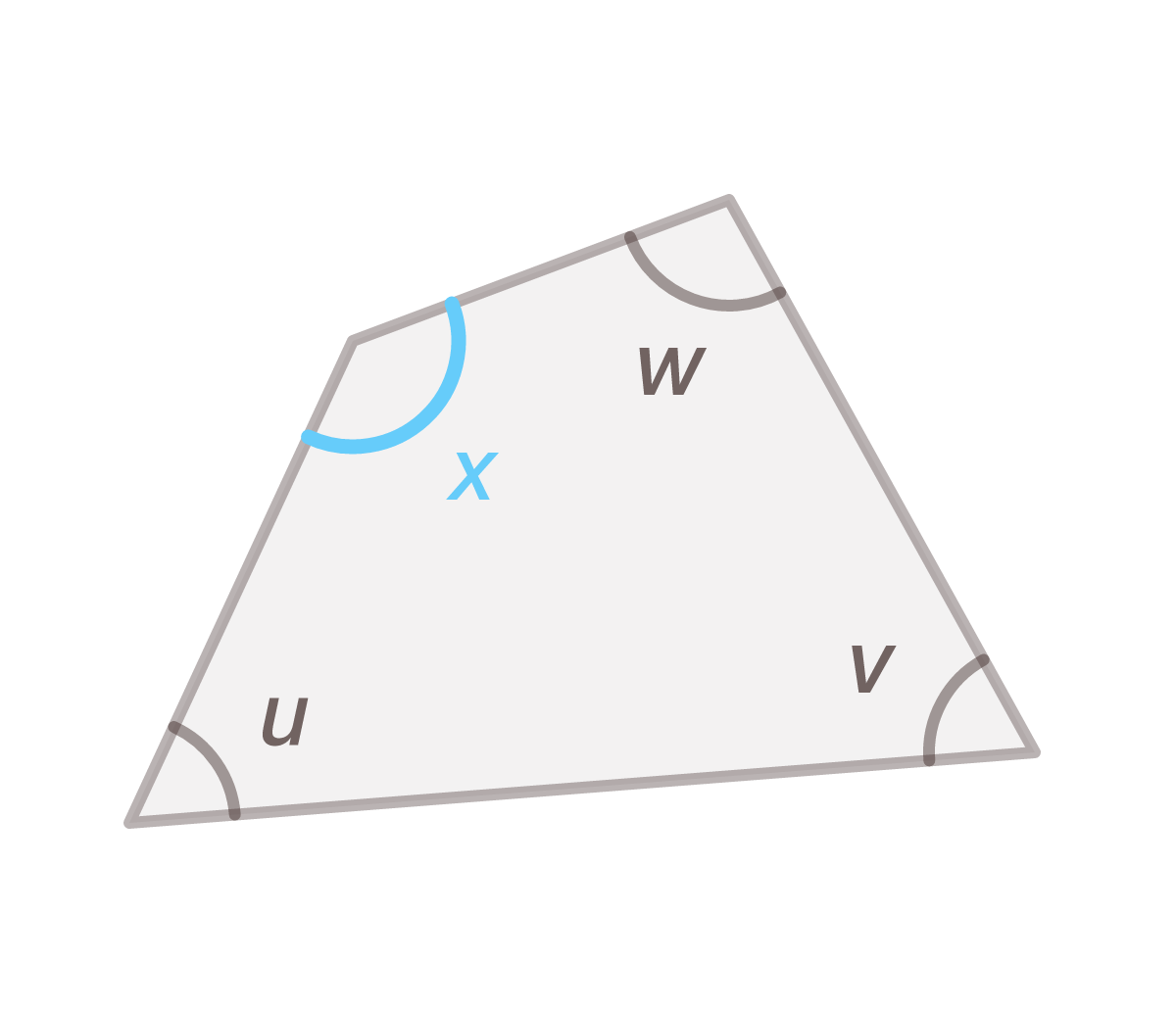
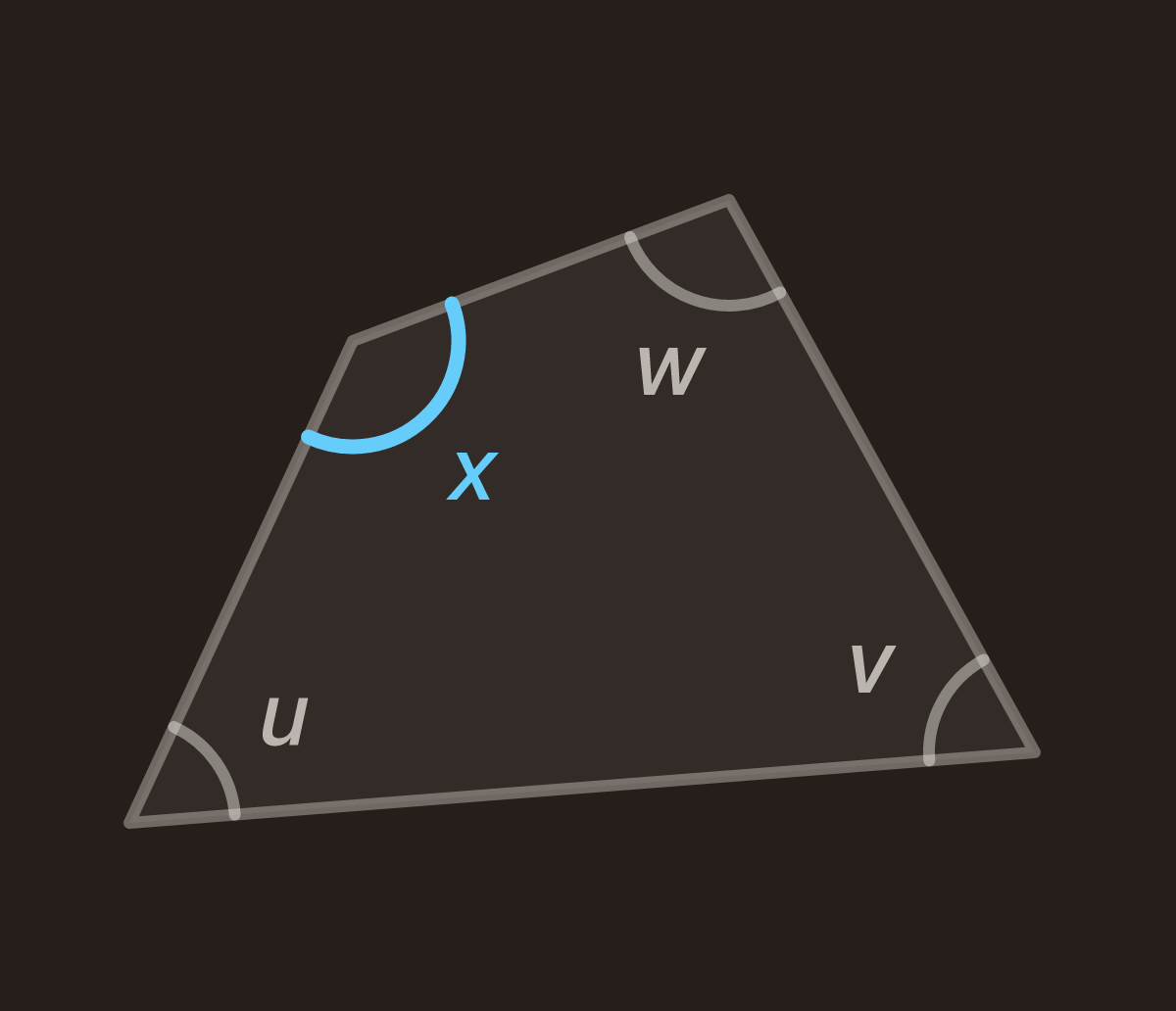
What the theorem says
Every quadrilateral in the plane — square, rectangle, rhombus, trapezoid or a completely irregular figure —
has an angle sum of 360°. Given three of the angles you get the fourth by subtracting them from 360°.
If three angles are 90°, 90° and 60°, the fourth is 360 − 90 − 90 − 60 = 120°.
The proof is one diagonal
Draw a line between two opposite corners. The quadrilateral splits into two triangles, and each triangle’s
angles land entirely inside the quadrilateral’s angles — nothing is left over and nothing is counted
twice.
Since every triangle has an angle sum of
180°, the quadrilateral’s is 2 · 180 = 360°.
It is the same argument that gives the angle sum of a
polygon: an n-gon splits into n − 2 triangles.
- In a rectangle all four angles are 90°, and 4 · 90 = 360.
- In a parallelogram opposite angles are equal, and two adjacent ones add up to 180°.
- In a trapezoid the two angles on the same leg add up to 180°, because they sit between parallel
sides.
- In a cyclic quadrilateral — one that can be drawn inside a circle — opposite angles add up to 180°.
Worked examples
The fourth angle. Three angles are 85°, 95° and 85°. The fourth is 360 − 265 = 95°.
A parallelogram. One angle is 110°. The adjacent one is then 70°, and the four make
110 + 70 + 110 + 70 = 360°.
A kite. Two opposite angles are 60° and 120°, and the other two are equal. Each of them is
(360 − 180) / 2 = 90°.
Common mistakes
- Using 180°. That is the triangle’s sum. A quadrilateral has one more corner, so one more triangle.
- Getting a concave quadrilateral wrong. A figure with an inward-pointing corner still sums to 360° —
but the interior angle at that corner is greater than 180°, and it is easy to write down the smaller one
out of habit.
- Confusing interior and exterior angles. The exterior angles of a convex polygon always add up to
360°, however many corners it has. That is a different theorem.
Common questions
Does it hold for a concave quadrilateral?
Yes. The diagonal proof works as long as you pick the diagonal that lies inside the figure, and in a
concave quadrilateral there is always exactly one.
Why are the exterior angles also 360°?
Because you turn through one full turn walking around the figure. That holds for every convex polygon,
with three corners as much as with twenty — a quite different statement from the interior sum.
What is a cyclic quadrilateral?
One whose four corners all lie on the same circle. Then — and only then — opposite angles add up to
180°, which follows from the inscribed angle theorem.