Volume of a cube
The relation
V
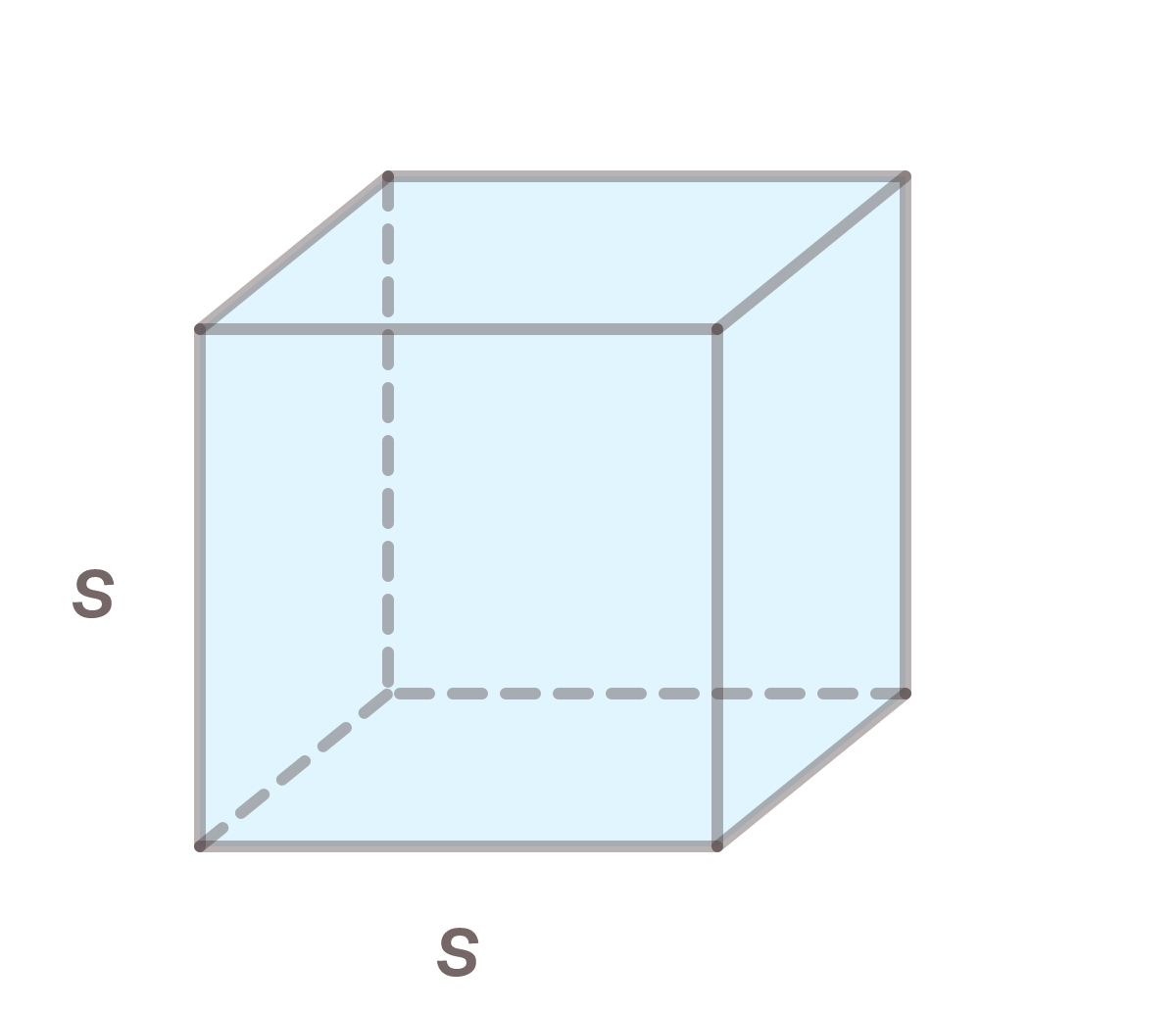
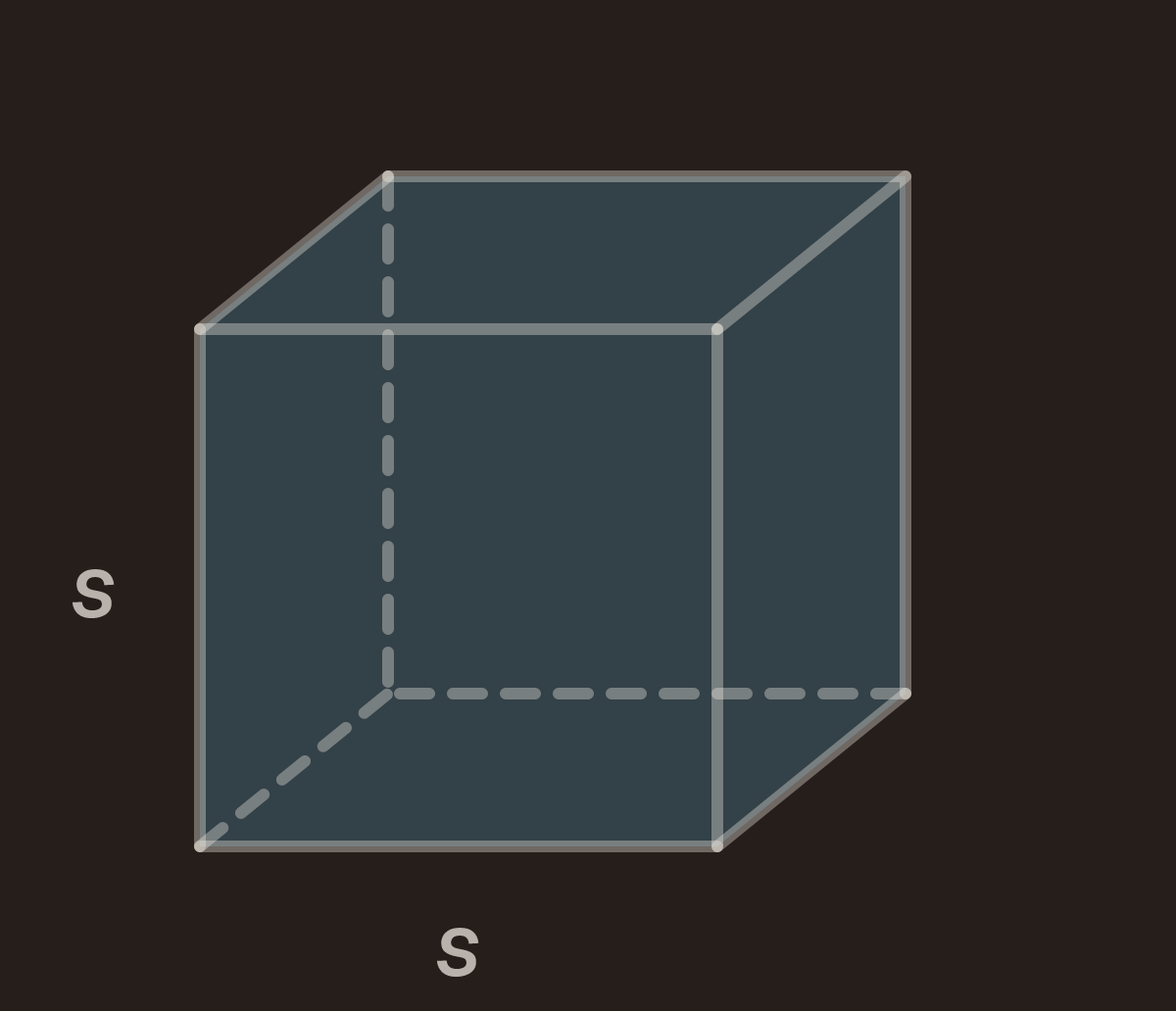
The side cubed — the cuboid’s volume with all three measurements the same.
Solve for
V=64cm³
V equals 4 cubed, equals 64 cm³
Den här sidan finns på svenska. Byt till svenska
Theorem — what does that mean?
The side cubed — and backwards, it is the cube root of the volume.
In Swedish: Kubens volym
V
The side cubed — the cuboid’s volume with all three measurements the same.
V=64cm³
V equals 4 cubed, equals 64 cm³
You are given
V = ?
Pick the unit your lengths are in. Areas are then labelled in square units and volumes in cubic units; nothing is converted.
A cube is a cuboid with all three measurements the same. So the formula is the volume of a cuboid, l · w · h, with the same number in all three places: s · s · s.
Think in unit cubes. A cube 4 cm on a side holds 4 cubes along its length, 4 across its width and 4 layers high — 4 · 4 · 4 = 64 cubic centimetres.
Take the cube root. This is the calculation that makes the cube practical: you know how much something has to hold and want to know how big the box must be.
| Volume | Side |
|---|---|
| 8 dm³ | 2 dm |
| 27 dm³ | 3 dm |
| 1,000 cm³ | 10 cm |
| 100 dm³ | ≈ 4.64 dm |
The metric system is built so that 1 dm³ = 1 litre, as for the cuboid:
A die 16 mm on a side has a volume of 16³ = 4,096 mm³, a little over 4 cubic centimetres.
Backwards. A cubic water tank has to hold 512 litres. The side is the cube root of 512 dm³ = 8 dm, and the surface area is 6 · 64 = 384 dm².
What is the difference between a cube and a cuboid?
A cube is a cuboid with all three measurements equal. The cuboid’s formula works on a cube, but not the
other way round.
How do I find the side if I know the volume?
Take the cube root of the volume. 125 cm³ belongs to a cube with a side of 5 cm.
How much bigger is the volume if the side grows by 10%?
A little over 33%. Volume grows with the cube of the change, and 1.1³ ≈ 1.331.
| Solve for | Rearranged | With the numbers | Comes to |
|---|---|---|---|
| s | 3 | 3 | 4 cm |
| V | s³ | 4³ | 64 cm³ |
Table
| n | n² | n³ | √n |
|---|---|---|---|
| 1 | 1 | 1 | 1.000 |
| 2 | 4 | 8 | 1.414 |
| 3 | 9 | 27 | 1.732 |
| 4 | 16 | 64 | 2.000 |
| 5 | 25 | 125 | 2.236 |
| 6 | 36 | 216 | 2.449 |
| 7 | 49 | 343 | 2.646 |
| 8 | 64 | 512 | 2.828 |
| 9 | 81 | 729 | 3.000 |
| 10 | 100 | 1,000 | 3.162 |
| 11 | 121 | 1,331 | 3.317 |
| 12 | 144 | 1,728 | 3.464 |
| 13 | 169 | 2,197 | 3.606 |
| 14 | 196 | 2,744 | 3.742 |
| 15 | 225 | 3,375 | 3.873 |
| 16 | 256 | 4,096 | 4.000 |
| 17 | 289 | 4,913 | 4.123 |
| 18 | 324 | 5,832 | 4.243 |
| 19 | 361 | 6,859 | 4.359 |
| 20 | 400 | 8,000 | 4.472 |
Last reviewed October 6, 2026 ·How pages are reviewed
Sheets that ask this formula, with their answer keys. Open one to see the questions or print it.
Twenty questions on four solids. The volume is asked for in most; in some the volume is given and an edge or the height is asked for instead.
Eight questions on the volume of a pyramid, four on a sphere and four on a cube. Sometimes the height or the radius is asked for.
The same drawing, measured in the other ways it can be measured.
Copy the code into your page where the formula card should appear. It loads from lovetocalc.com, so it stays current on its own — all we ask is that the credit line comes with it.