Area of a trapezoid
The relation
A
The two parallel sides averaged, times the distance between them.
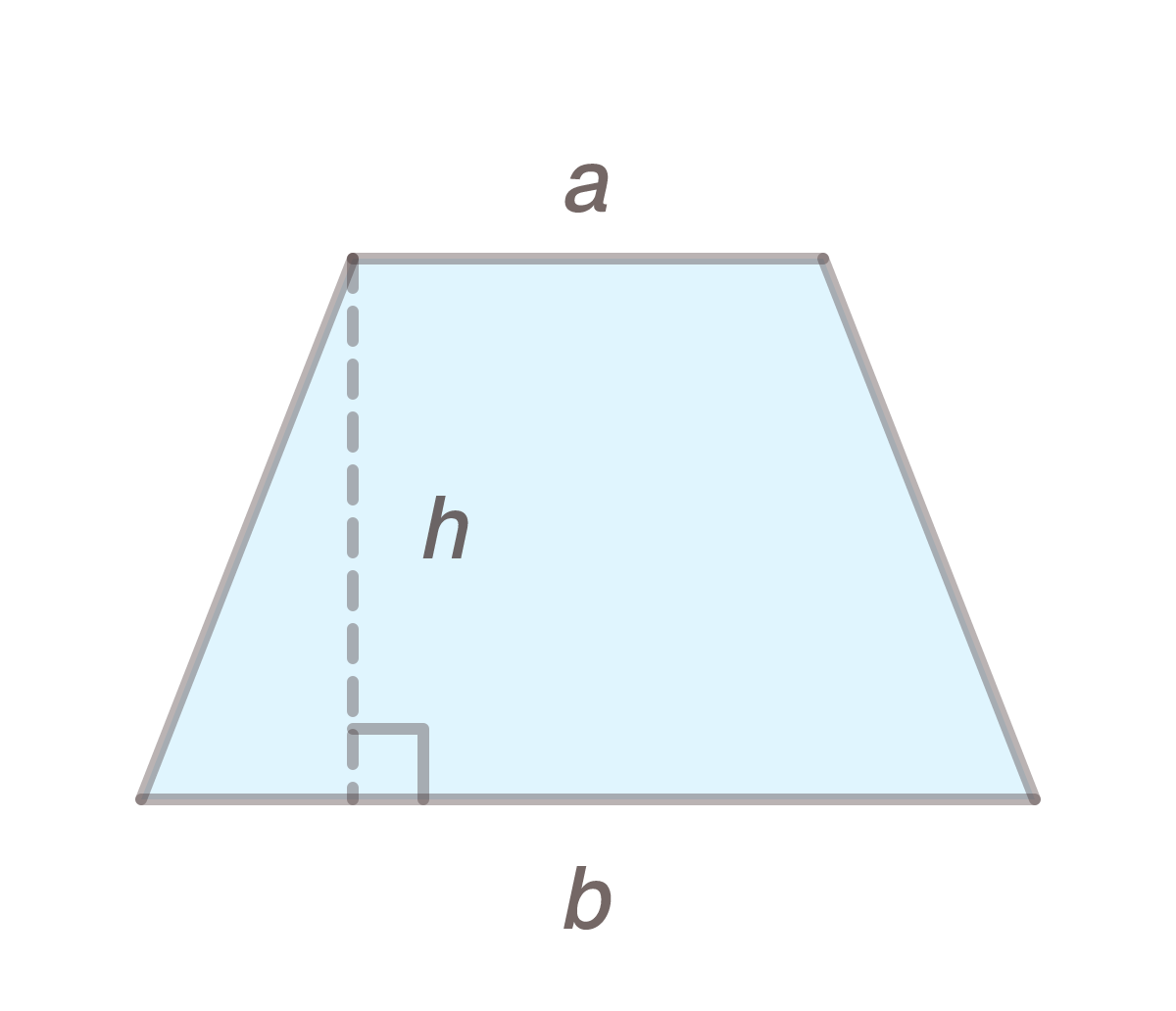
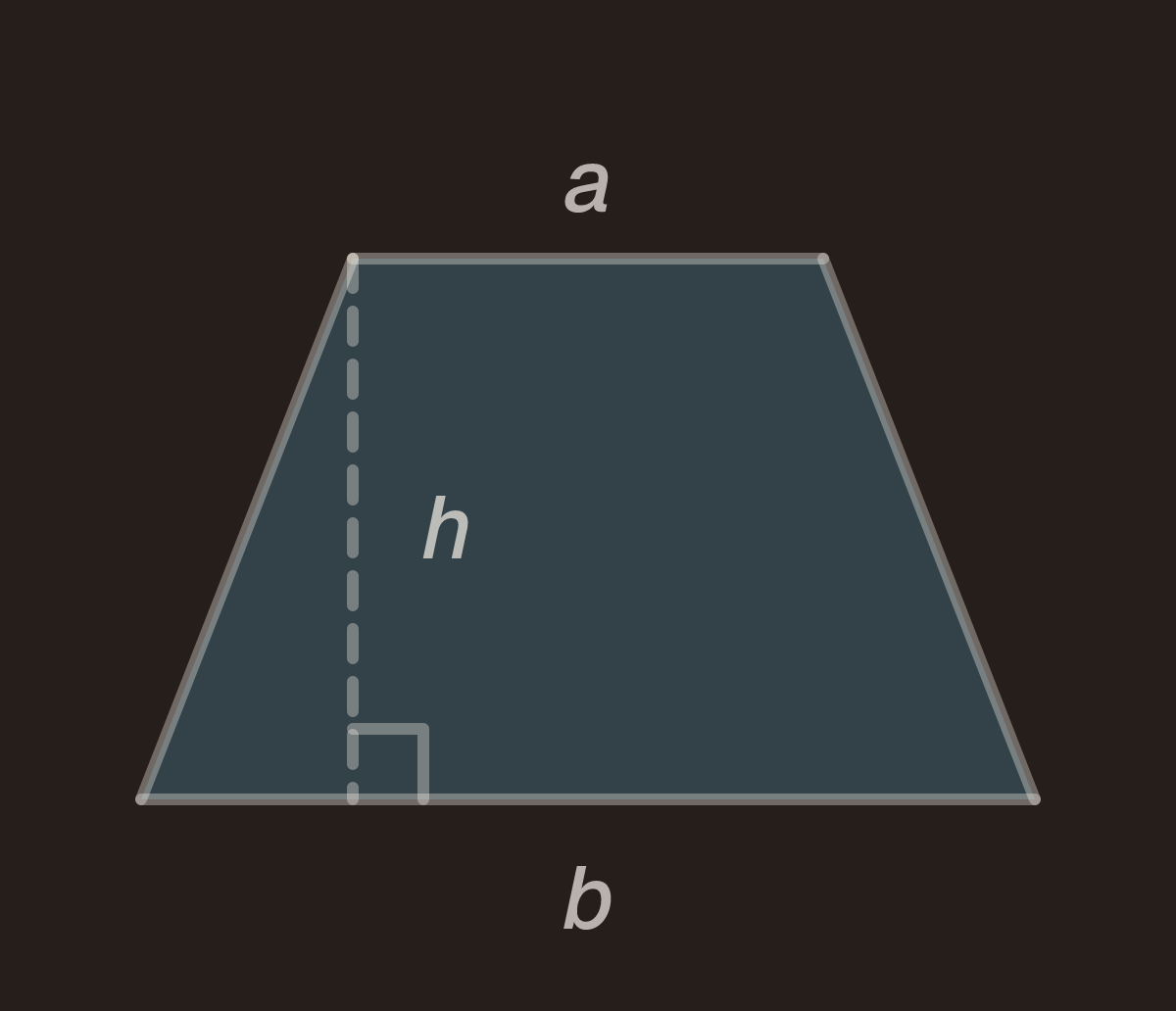
Solve for
A=30cm²
A equals ((4 plus 8) times 5) divided by 2, equals (12 times 5) divided by 2, equals 60 divided by 2, equals 30 cm²
Den här sidan finns på svenska. Byt till svenska
Theorem — what does that mean?
Add the two parallel sides, halve them and multiply by the height — the figure behaves like a rectangle of that average width.
In Swedish: Parallelltrapetsens area
A
The two parallel sides averaged, times the distance between them.
A=30cm²
A equals ((4 plus 8) times 5) divided by 2, equals (12 times 5) divided by 2, equals 60 divided by 2, equals 30 cm²
You are given
A = 52 cm²
Pick the unit your lengths are in. Areas are then labelled in square units and volumes in cubic units; nothing is converted.
Put two identical trapezoids against each other, one of them upside down. Together they form a parallelogram with a base of a + b and the same height h. That parallelogram has an area of (a + b) · h, and your figure is half of it.
That is where the two in the denominator comes from: (a + b) / 2 is the width the figure would have had if it were the same width all the way up. At the bottom it is b, at the top a, and halfway up exactly the average.
A plot of land. The parallel sides are 4 m and 10 m, the height 6 m. The average is (4 + 10) / 2 = 7 m, and the area 7 · 6 = 42 m².
A dormer. A dormer is 3 m wide at the top, 5 m at the bottom and 2 m tall: (3 + 5) / 2 · 2 = 8 m².
Backwards. The area is 42 m², the height 6 m and one side 4 m. The average is 42 / 6 = 7 m, so a + b = 14 and the other side is 14 − 4 = 10 m. Pick the side as the unknown in the card above and every step is written out.
Trapezoid or trapezium?
A quadrilateral with a pair of parallel sides is called a trapezoid in the United States and a
trapezium in the United Kingdom. Some books require exactly one pair, which leaves the parallelogram
out, but the formula still gives its area. Confusingly, the two words mean the opposite thing in the other
country’s older usage; the formula on this page is for the figure drawn above.
What if the parallel sides are equal?
Then the average is that same number, and the formula becomes base times height — the
parallelogram’s.
And if one side is zero?
The figure has collapsed into a
triangle, and the formula gives b / 2 · h, which
is exactly the triangle’s area.
| Solve for | Rearranged | With the numbers | Comes to |
|---|---|---|---|
| a | 2Ah | 2·305 | 4 cm |
| b | 2Ah | 2·305 | 8 cm |
| h | 2Aa | 2·304 | 5 cm |
| A | (a | (4 | 30 cm² |
Last reviewed October 6, 2026 ·How pages are reviewed
Sheets that ask this formula, with their answer keys. Open one to see the questions or print it.
Eighteen questions on four figures. Sometimes the area is asked for, sometimes a side or the height when the area is given. Quantities carry name and letter.
Copy the code into your page where the formula card should appear. It loads from lovetocalc.com, so it stays current on its own — all we ask is that the credit line comes with it.