Area of a kite
The relation
A
Half the product of the two diagonals — the short one and the axis it hangs from.
Solve for
A=30cm²
A equals (6 times 10) divided by 2, equals 60 divided by 2, equals 30 cm²
Den här sidan finns på svenska. Byt till svenska
Theorem — what does that mean?
Multiply the axis of symmetry by the other diagonal and halve it. The same line as the rhombus, for the same reason.
In Swedish: Drakens area
A
Half the product of the two diagonals — the short one and the axis it hangs from.
A=30cm²
A equals (6 times 10) divided by 2, equals 60 divided by 2, equals 30 cm²
You are given
A = ?
Pick the unit your lengths are in. Areas are then labelled in square units and volumes in cubic units; nothing is converted.
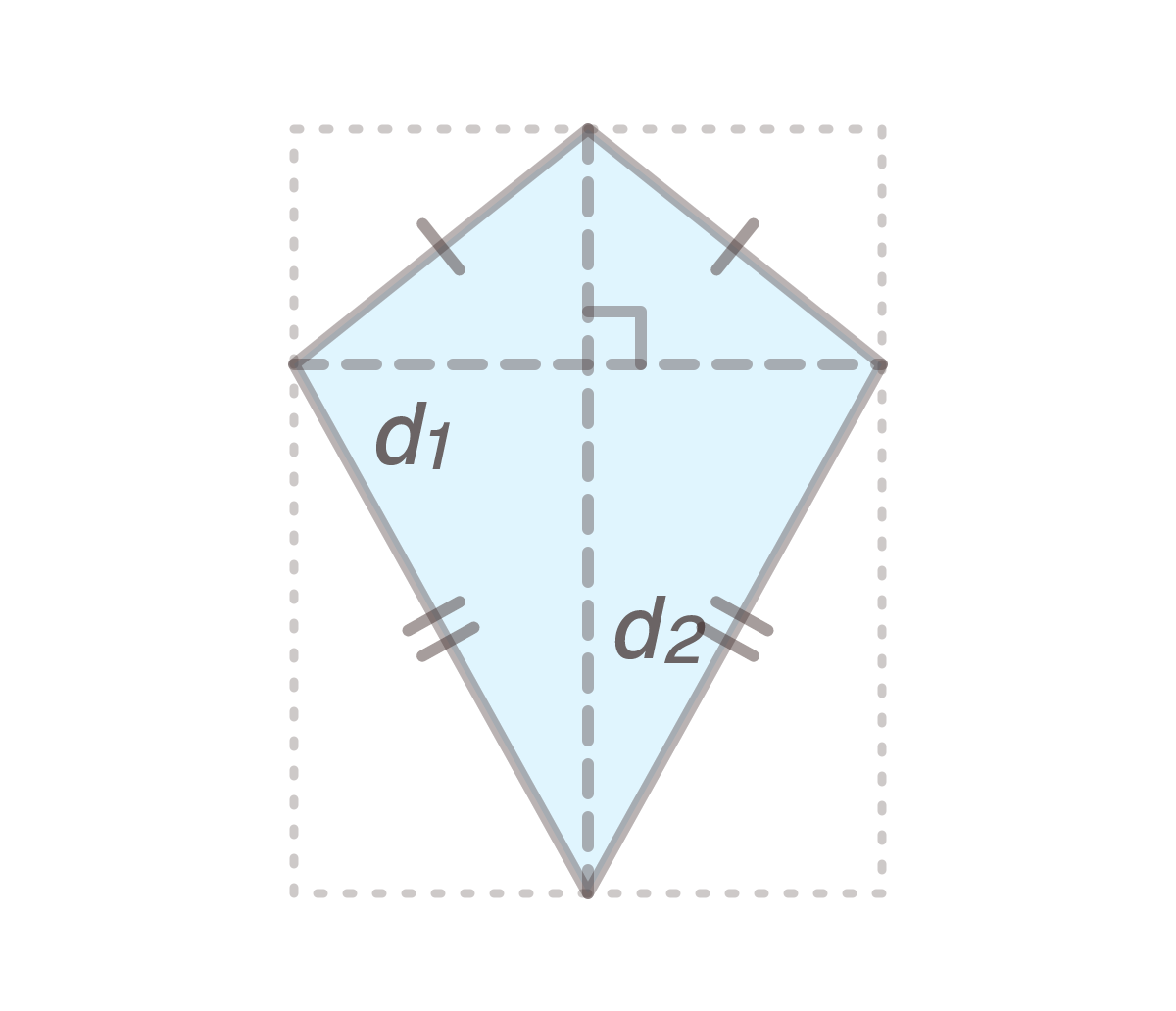
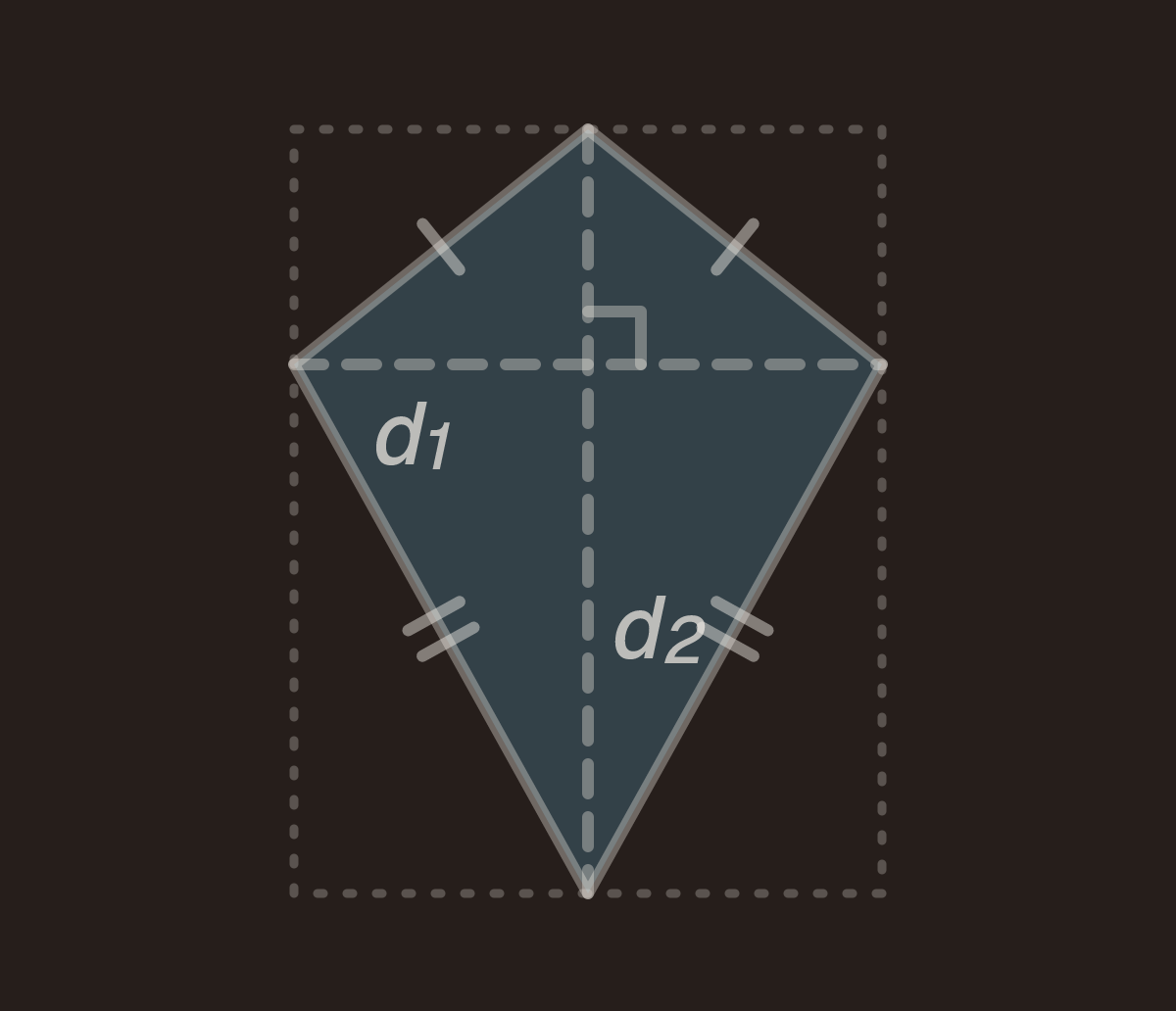
A kite is a quadrilateral with two pairs of equal sides, and the pairs sit next to each other rather than opposite. One diagonal — the axis of symmetry — cuts the figure into two mirror images, and the other crosses it at a right angle.
A kite with diagonals of 6 cm and 10 cm has an area of 6 · 10 / 2 = 30 cm².
The axis d₂ splits the kite into two triangles. Both have d₂ as their base, and between them they have a height of d₁ — the other diagonal is cut by the axis into two pieces, one on each side.
So the area is d₂ · (left piece) / 2 + d₂ · (right piece) / 2, and since the pieces add up to d₁ this lands on d₁ · d₂ / 2. That the axis cuts d₁ exactly in half is not needed for the arithmetic — only that the two pieces make up the whole diagonal.
A rhombus is the kite where both pairs are the same length, that is, where all four sides are equal. The formula is the same, and that is no accident: all it takes is for the diagonals to meet at a right angle, which they do in both figures.
The difference shows up as soon as you want something other than the area. In a rhombus the diagonals cut each other in half; in a kite only the axis of symmetry does.
Forwards. A paper kite is 40 cm across and 70 cm from nose to tail: 40 · 70 / 2 = 1,400 cm², or 0.14 m².
Forwards. Diagonals of 8 cm and 9 cm give 8 · 9 / 2 = 36 cm².
Backwards. The area is 36 cm² and the axis is 12 cm. The other diagonal is 2 · 36 / 12 = 6 cm.
Does the formula work for a dart?
A dart is a concave kite: one corner points inwards, so the diagonals cross outside the figure. Measure
the diagonals along the same lines and the arithmetic still works, but it is safer to split it into two
triangles and add.
Are the diagonals always perpendicular?
In a kite, yes — it follows from the two pairs of equal sides. Take a quadrilateral whose diagonals meet at some other
angle and this formula no longer applies; you need the sine of that angle.
How do I get the area if I only know the sides?
The sides are not enough: a kite can be folded without its side lengths changing. If you know the sides
and one angle, split the figure into two triangles and use the area with a
sine.
| Solve for | Rearranged | With the numbers | Comes to |
|---|---|---|---|
| d₁ | 2Ad₂ | 2·3010 | 6 cm |
| d₂ | 2Ad₁ | 2·306 | 10 cm |
| A | d₁d₂2 | 6·102 | 30 cm² |
Last reviewed October 6, 2026 ·How pages are reviewed
Copy the code into your page where the formula card should appear. It loads from lovetocalc.com, so it stays current on its own — all we ask is that the credit line comes with it.