Pick the unit your lengths are in. Areas are then labelled in square units and volumes in cubic units; nothing is converted.
What the rule says
In any triangle,
T = (a · b · sin C) / 2
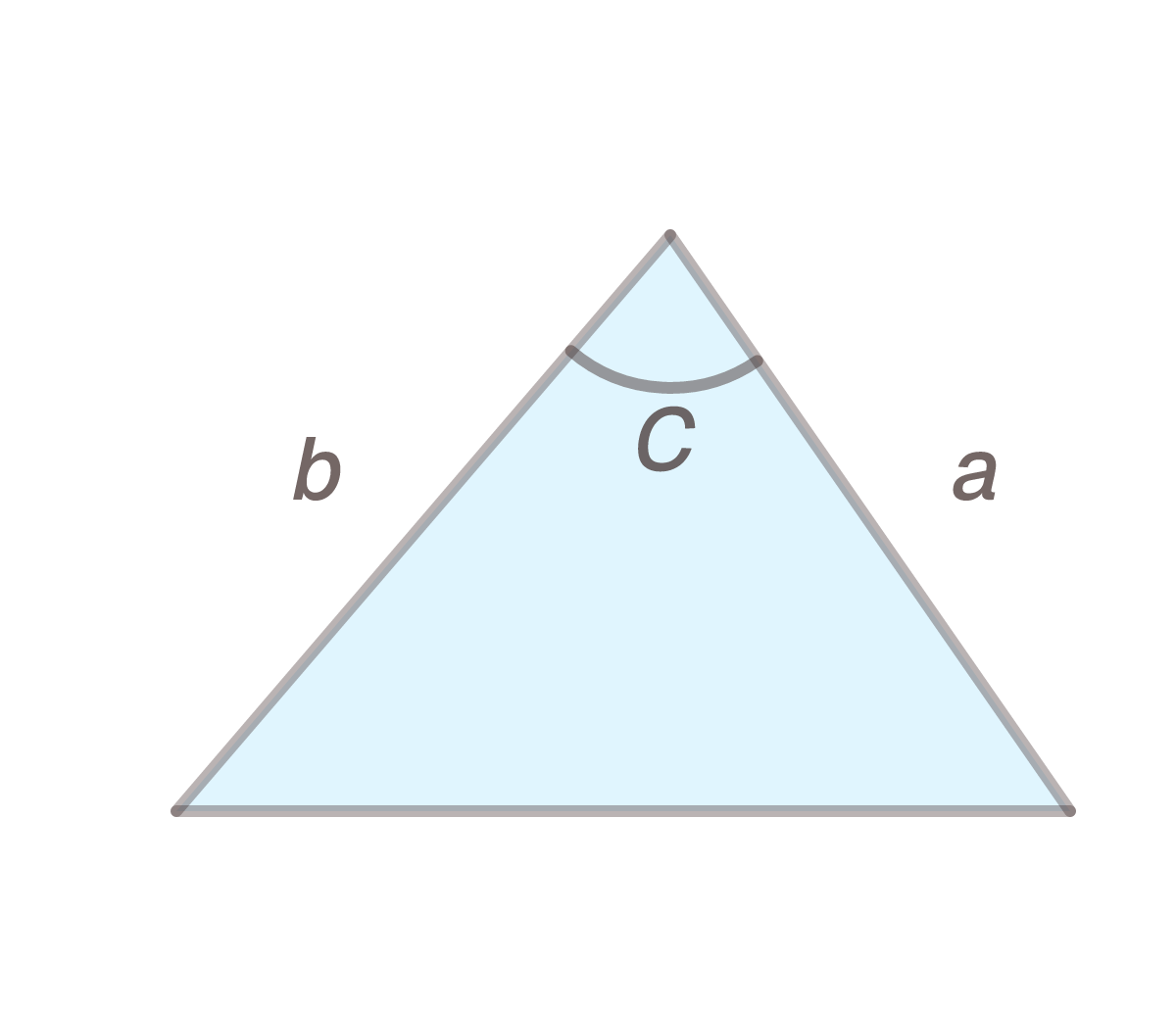
where C is the angle between sides a and b.
This is not a new area formula. It is the area of a triangle,
T = b·h/2, with the height swapped for something you actually know.
Where it comes from
Drop the height from the corner between a and c onto side b. That height is a leg of a right-angled
triangle in which a is the hypotenuse and C is the angle, so the
definition of sine gives it immediately:
h = a · sin C
Substitute that into T = b·h/2 and the rule is there. The proof is one substitution, and it trades the
length that is hardest to measure for an angle that is easy to measure.
That it still holds for an obtuse C is worth a thought. The foot of the height then falls outside side
b, but sin C stays positive all the way from 0° to 180° — the sine curve is symmetric about 90° — so
the formula is unchanged. The same symmetry produces the ambiguity further down.
Worked examples
The area directly. Two sides are 8 cm and 5 cm with a 30° angle between them.
- T = (8 · 5 · sin 30°) / 2
- T = (40 · 0.5) / 2 = 20 / 2 = 10 cm²
A triangular plot. Two sides measure 42 m and 35 m, with 118° between them.
- T = (42 · 35 · sin 118°) / 2
- T = (1,470 · 0.8829) / 2 = 1,297.9 / 2 = 649 m²
The obtuse angle causes no trouble. sin 118° is the same number as sin 62°, and it is
positive.
The angle from the area — and two answers. Two sides are 9 cm and 6 cm and the area is 20 cm². What is
the angle?
- sin C = 2T / (a · b) = 40 / 54 = 0.7407
- C = arcsin 0.7407 = 47.8°
But sin 132.2° is also 0.7407, so C = 132.2° gives the same area. Two different
triangles — one acute, one obtuse — on the same two sides with the same surface. There is no side to
compare that settles it, as there is with the law of sines; the area alone
cannot tell them apart. The card above prints both.
There is a ceiling. The area is largest when the sides meet at a right angle, so here 9 · 6 / 2 = 27 cm².
Ask for more than that and there is no angle at all — you have asked for a sine greater than 1.
Common mistakes
- Using a side that does not touch the angle.
a and b have to be the two sides that meet at C.
Take the third side and you get a number that is not the area.
- Putting the height in as one of the sides. That counts the sine twice. The rule takes the sides, not
the height.
- Forgetting to halve.
a · b · sin C is the area of the parallelogram the two sides span. The
triangle is half of it.
- Working in radians.
sin 30 in radian mode is −0.988, and the area comes out negative. Check the
mode if the answer looks strange.
- Answering with the acute angle only. Solving for
C gives two answers, and both are real
triangles — except when the area is the largest possible and C = 90°.
Frequently asked questions
When do I use this instead of base times height?
When you have two sides and the angle between them, which is common outside a
textbook — an angle can be measured with a protractor or a phone, while the height of a slanted triangle
is a line that is not drawn anywhere. If you have the base and the height,
T = b·h/2 is of course simpler.
What if I only know the three sides?
Find an angle first with the law of cosines, then use this rule. Two
steps, and both are cards here. (Heron’s formula does it in one step, but it is not on every syllabus.)
Does it work for a right triangle?
Yes, and it collapses into something you already know. sin 90° = 1, so T = a·b/2 — the two legs
multiplied, halved. The right-angled triangle is also the case where the area is largest for two given
sides, which is why the ambiguity disappears exactly there.