The definition
cos v = x
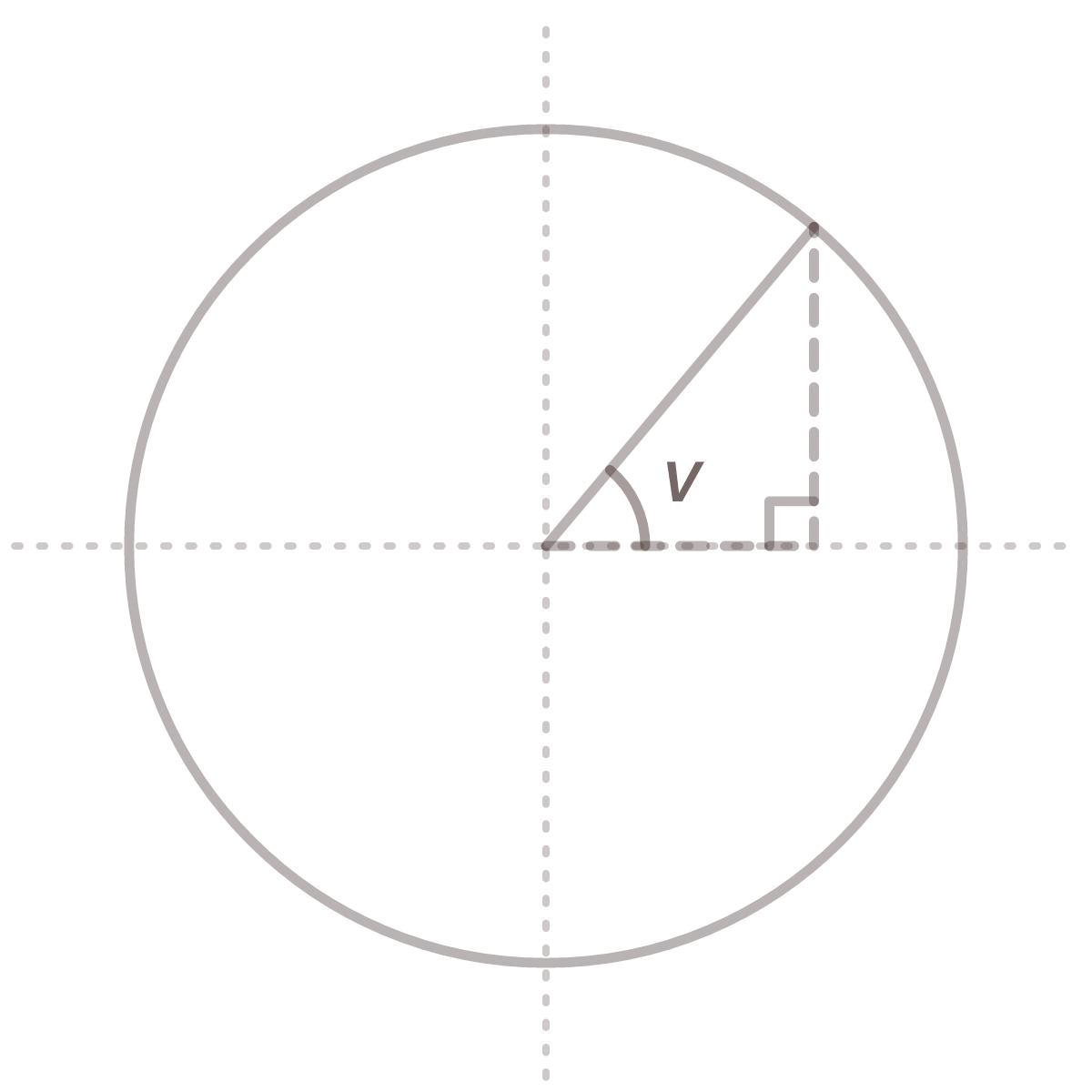
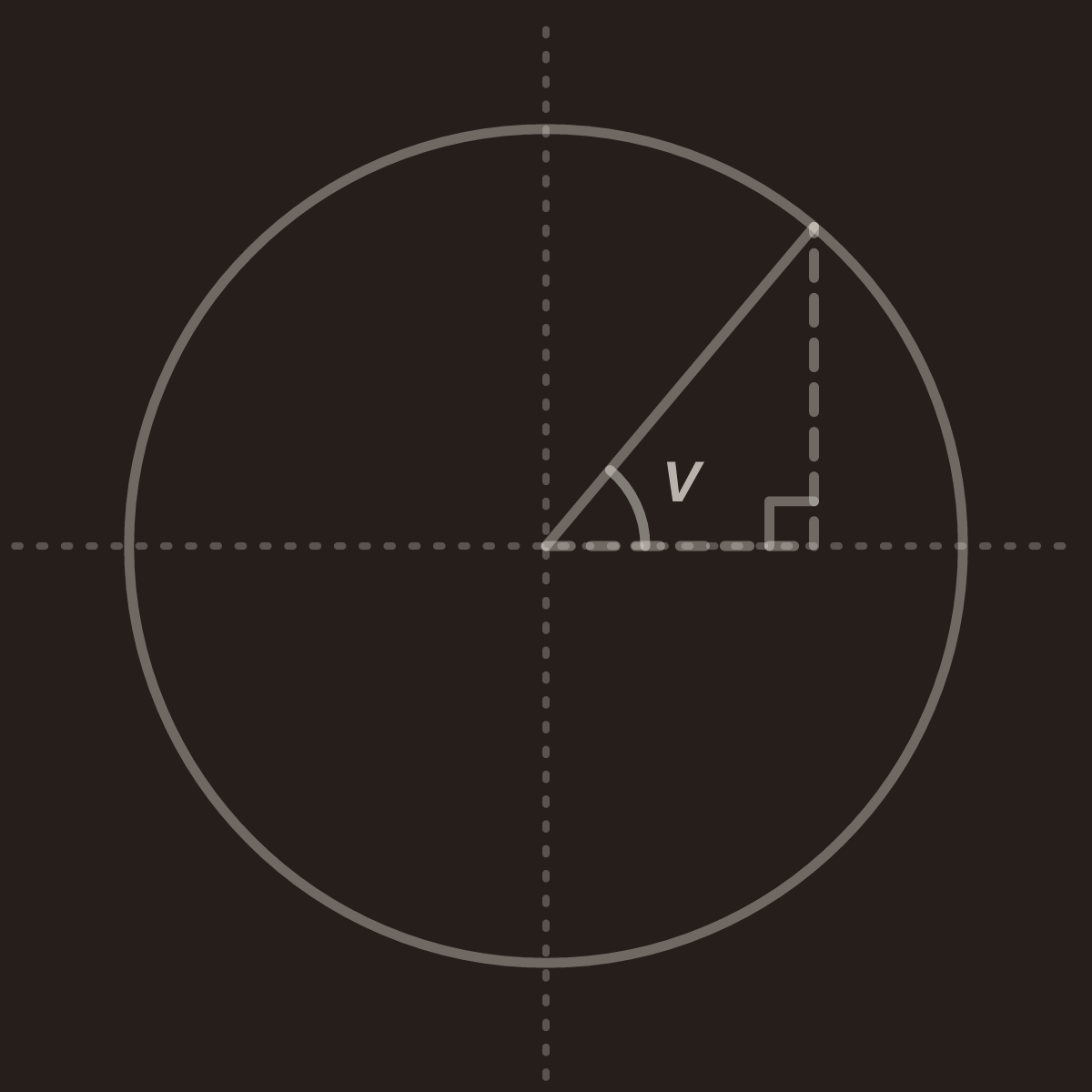
Draw a circle of radius 1 around the origin. Turn a ray from the positive x-axis by the angle v, counterclockwise for a positive angle. The ray cuts the circle at a point (x, y), and x is cos v. The y-coordinate is sin v.
For an acute angle this is the right-triangle ratio adjacent/hypotenuse, since the hypotenuse is the radius 1 (cosine in a right triangle). The circle gives the number a meaning for angles over 90° as well.
Worked examples
- v = 120°. The point is (−1/2, √3/2), so cos 120° = −0.5.
- v = 180°. The point is (−1, 0), so cos 180° = −1.
- v = 270°. The point is (0, −1), so cos 270° = 0.
- v = −60°. A negative angle turns clockwise to (1/2, −√3/2), so cos(−60°) = 0.5.
What it explains
The sign of the cosine follows the side of the y-axis: positive in the first and fourth quadrants, negative in the second and third. Since x² + y² = 1, the Pythagorean identity follows at once, and the reduction formulas are mirror images of the point.
Common mistakes
- Swapping x and y. The cosine is the horizontal coordinate, the sine the vertical.
- Reading cos v as a length. It is a signed coordinate and can be negative.
- Turning clockwise for a positive angle. The positive direction is counterclockwise.
Common questions
Why is the radius 1?
With radius 1 the coordinates are the ratios themselves. A circle of radius r gives x = r·cos v, so the
cosine is the x-coordinate divided by r.