The formula
- y = A sin(B(x − C)) + D
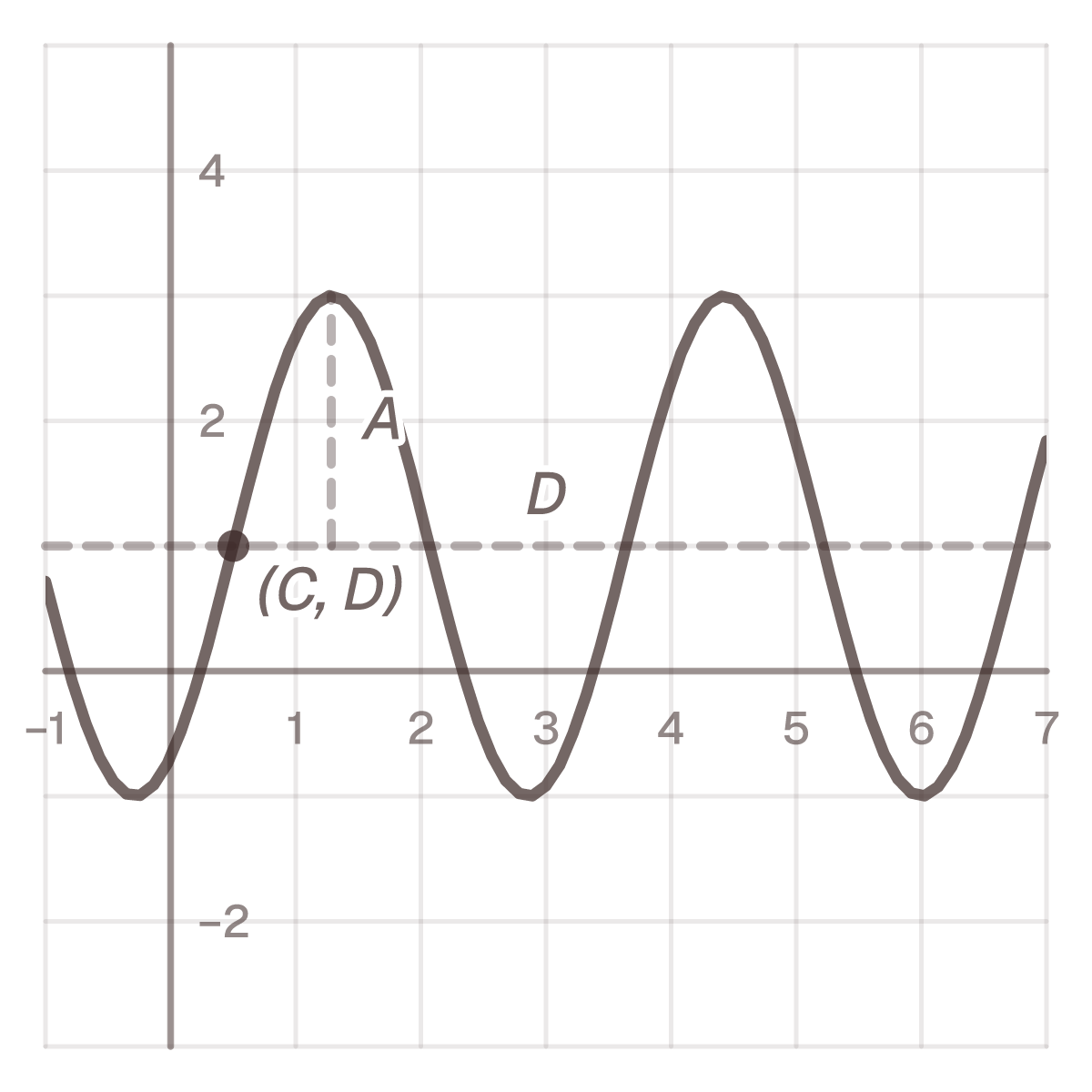
Every sine curve can be written this way, with A > 0 and B > 0. The four constants each do one thing:
| Constant | What it does | How to read it |
|---|---|---|
| A | amplitude: how far the curve reaches above the midline | (max − min) / 2 |
| B | how tightly the waves are packed; the period is 2π/B | B = 2π / period |
| C | horizontal shift | where a period starts on the way up |
| D | the midline, halfway between peak and trough | (max + min) / 2 |
The curve y = 3 sin(2(x − π/4)) + 1 has amplitude 3, period 2π/2 = π, is shifted π/4 to the right and oscillates about y = 1. Its maximum is 1 + 3 = 4 and its minimum 1 − 3 = −2.
The bracket decides the shift
The curve is sometimes written y = A sin(Bx − c) + D instead. It looks like the same thing with c in place of C, but it is not: Bx − c = B(x − c/B), so the shift is c/B, not c.
| Written as | Shift |
|---|---|
| y = 3 sin(2(x − π/4)) + 1 | π/4 |
| y = 3 sin(2x − π/2) + 1, the same curve | π/2 / 2 = π/4, not π/2 |
Read π/2 off the second form and the curve is out by a factor of B, and it still looks like a sine curve. Factor B out first.
Degrees or radians
With x in radians the period is 2π/B. Working in degrees, the period is 360°/B. The curve y = sin 2x has period π, or 180°. The formula above assumes radians, as in degrees to radians.
Reading a graph
A curve has a maximum of 5, a minimum of 1, and one full period is 4 long. Then
- A = (5 − 1) / 2 = 2
- D = (5 + 1) / 2 = 3
- B = 2π / 4 = π/2
The shift C is read where the curve crosses the midline y = 3 on its way up.
Common mistakes
- Reading the shift without factoring out B. In sin(Bx − c) the shift is c/B.
- Taking B for the period. B is the number of periods in 2π; the period is 2π/B.
- Taking the amplitude as the maximum. The amplitude is measured from the midline, not from the x-axis.
Common questions
How do I write a cosine curve this way?
cos x = sin(x + π/2), so a cosine curve is a sine curve shifted π/2 to the left.
How do I solve an equation with a sinusoid in it?
Get the sine on its own first, then use the
general solution — and remember
to divide the period by B as well.