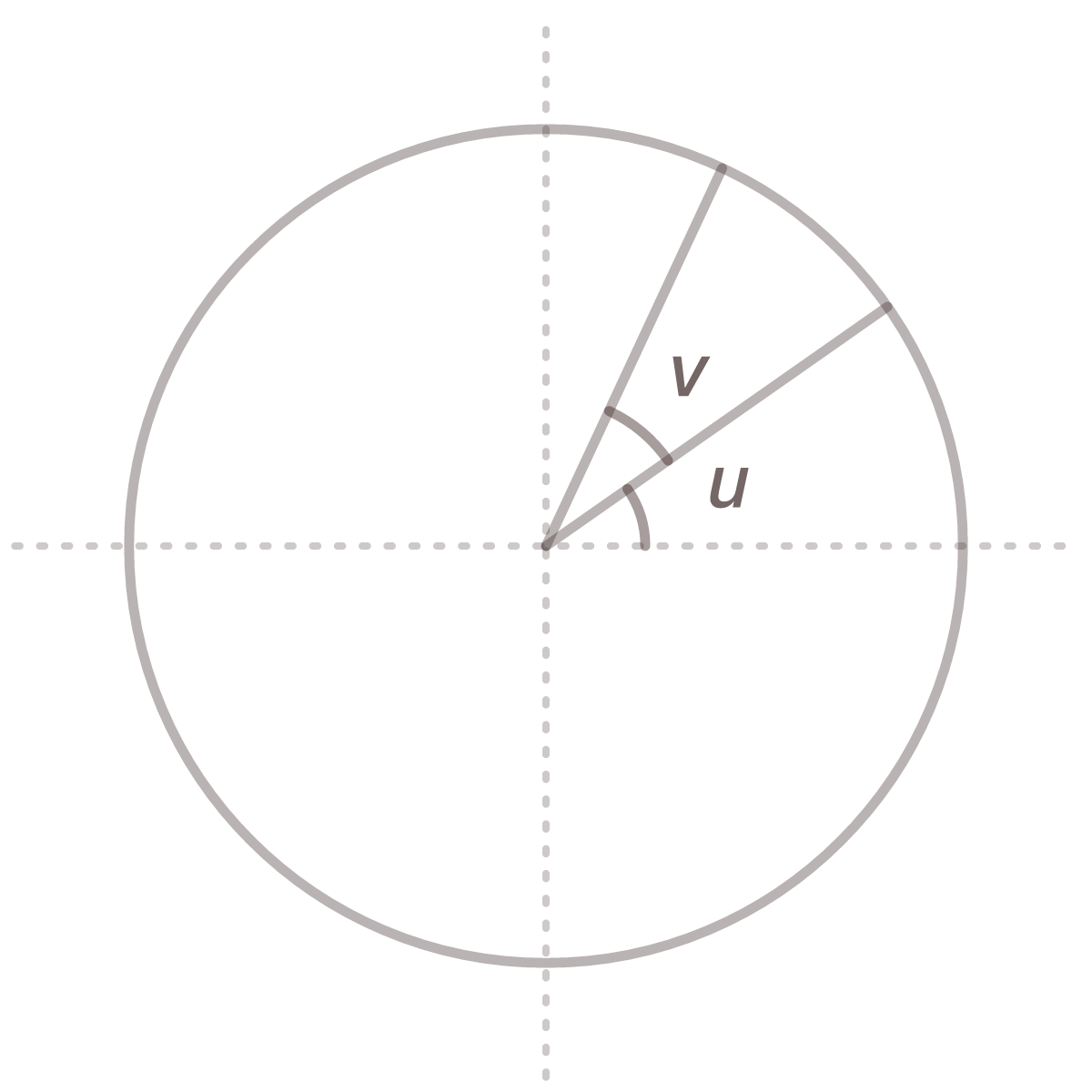
What the formula says
- tan(u + v) = (tan u + tan v) / (1 − tan u · tan v)
Holds when cos u ≠ 0, cos v ≠ 0 and cos(u + v) ≠ 0. The last one is the same as saying the denominator 1 − tan u tan v is not 0, which means u + v is not 90° + n · 180°.
The tangent of a sum is not the sum of the tangents. tan 20° + tan 35° is 1.064, while tan 55° is 1.428. The rule is the sibling of the sine addition formula and the cosine addition formula, and it follows from them. The other direction reads tan(u − v) = (tan u − tan v)/(1 + tan u tan v): the signs swap. English textbooks often name the angles A and B, or α and β; the rule is the same.
Where the formula comes from
The tangent is the sine divided by the cosine, so
- tan(u + v) = sin(u + v)/cos(u + v) = (sin u cos v + cos u sin v)/(cos u cos v − sin u sin v)
Divide the top and the bottom by cos u · cos v. Then sin u cos v / (cos u cos v) = tan u, cos u sin v / (cos u cos v) = tan v, cos u cos v / (cos u cos v) = 1 and sin u sin v / (cos u cos v) = tan u tan v, which leaves the formula above. The division by cos u cos v is also the reason for the conditions: it only works when both cosines are nonzero.
Worked examples
A check. u = 20° and v = 35°: tan 20° ≈ 0.364 and tan 35° ≈ 0.700. The numerator is 0.364 + 0.700 = 1.064 and the denominator 1 − 0.364 · 0.700 = 0.745. The quotient is 1.064 / 0.745 ≈ 1.428, which is tan 55°.
An exact value. tan 75° = tan(45° + 30°) = (1 + 1/√3)/(1 − 1/√3). Multiply top and bottom by √3 to get (√3 + 1)/(√3 − 1), and multiplying by (√3 + 1) gives (4 + 2√3)/2 = 2 + √3 ≈ 3.732.
An angle from two tangent values. If tan u = 2 and tan v = 3 with u and v acute, then tan(u + v) = (2 + 3)/(1 − 2 · 3) = 5/(−5) = −1. The sum lies between 0° and 180° and has tangent −1, so u + v = 135°, that is arctan 2 + arctan 3 = 135°. The tangent alone does not fix the angle, since 135° and −45° have the same tangent, but here the sum is known to exceed 90°.
When the formula does not apply. u = 60° and v = 30°: tan 60° · tan 30° = √3 · (1/√3) = 1, so the denominator is 0. The sum is 90°, and tan 90° does not exist. There is no number to get out, and a calculator reports an error.
Common mistakes
- Adding the tangents directly. tan(u + v) ≠ tan u + tan v. The numerator is right, but without the denominator the answer is wrong.
- The wrong sign in the denominator. The denominator has the opposite sign to the angle sum: a minus in tan(u + v) and a plus in tan(u − v). The numerator follows the sum, a plus for u + v and a minus for u − v.
- Using the formula when the denominator is 0. Check first whether tan u · tan v = 1. Then u + v equals 90° + n · 180° and the left side has no value.
- Forgetting the quadrant. In the example with tan(u + v) = −1, a calculator’s arctan(−1) gives −45°, but the sum of two acute angles is positive. Test whether the answer is plausible before using it.
Common questions
Is there a formula for tan 2v?
Yes. Putting u = v gives tan 2v = 2 tan v/(1 − tan²v), when tan v exists and tan²v ≠ 1. It belongs with
the double angle formula.
Do I need the formula if I have a calculator?
For a single value the calculator is enough. The formula is for angles that give an exact number such as 75°, for
simplifying an expression, or for having the tangent values but not the angles, as in the arctan 2 + arctan 3 example.
What happens when u + v passes 180°?
The formula still holds, because the tangent repeats every 180°. The result is the tangent of the sum, which does not
say by itself which angle the sum is; the quadrant decides that.
How does this relate to the half-angle substitution?
With t = tan(v/2), sine, cosine and tangent of v can be written as fractions in t. They are on the page
tangent half-angle substitution.