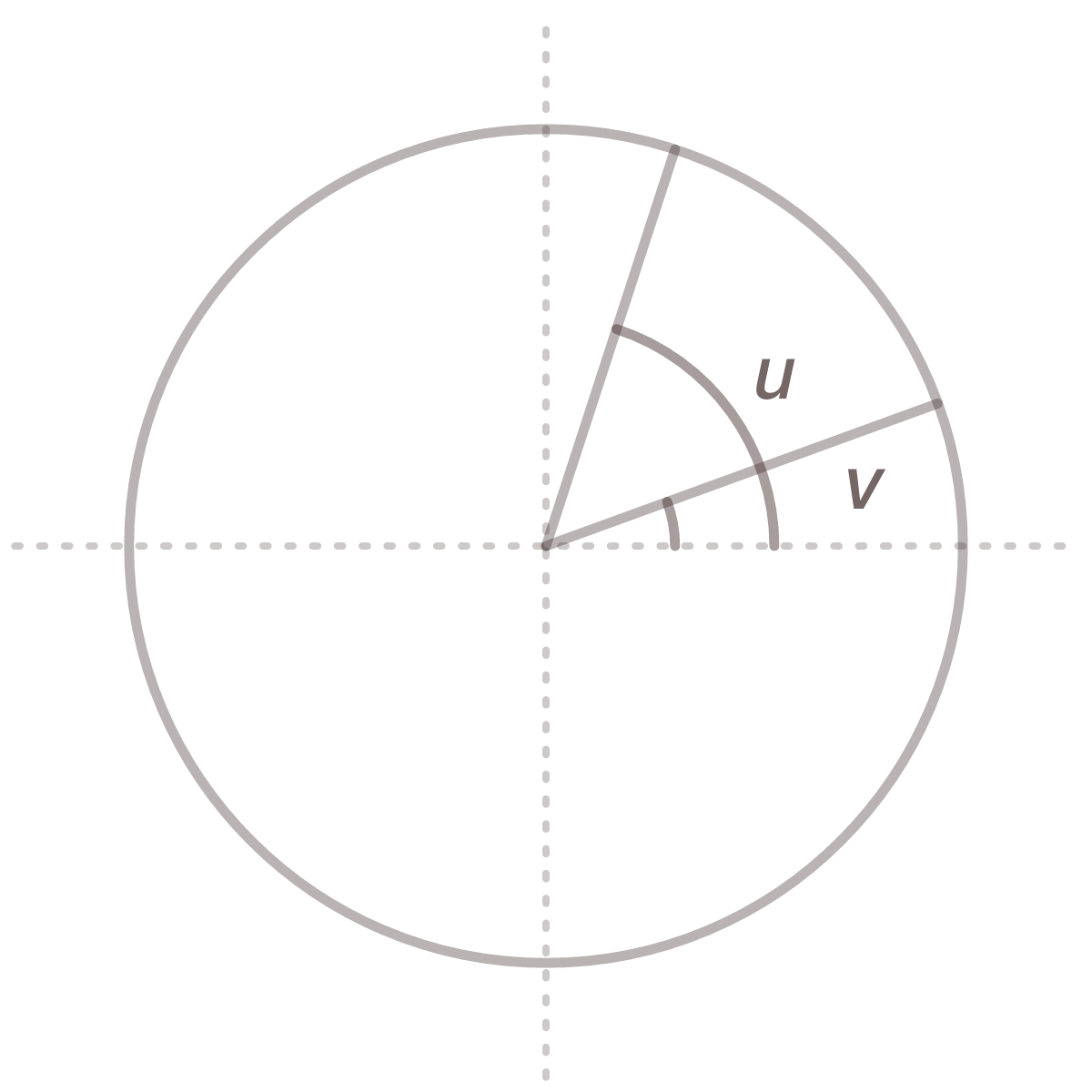
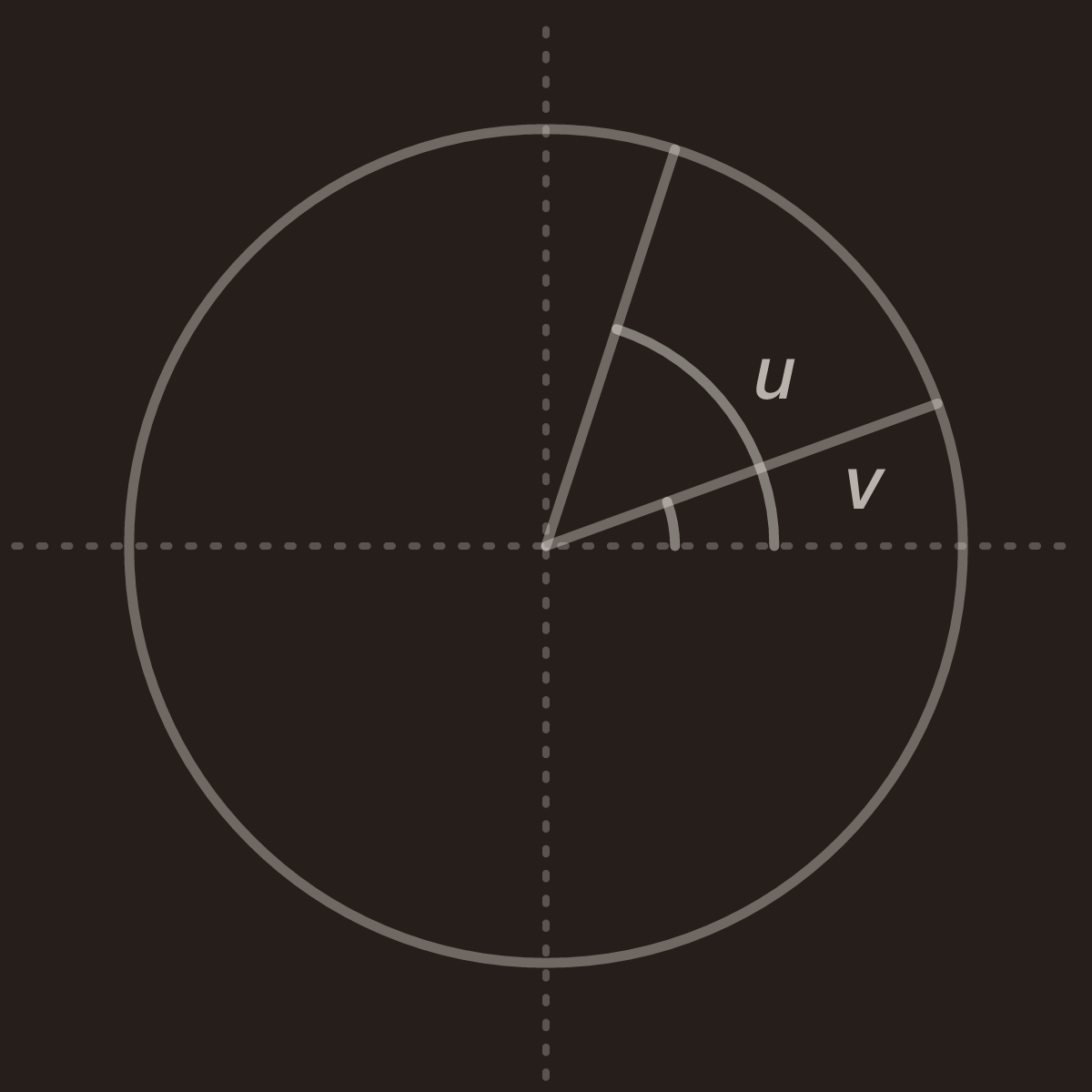
What the formulas say
- sin(u − v) = sin u · cos v − cos u · sin v
- cos(u − v) = cos u · cos v + sin u · sin v
Holds for all angles u and v, as long as both are measured in the same unit.
Compared with the sine addition formula and the cosine addition formula, only the sign in the middle changes. The products, and their order, are the same:
| First term | Sign | Second term | |
|---|---|---|---|
| sin(u + v) | sin u cos v | + | cos u sin v |
| sin(u − v) | sin u cos v | − | cos u sin v |
| cos(u + v) | cos u cos v | − | sin u sin v |
| cos(u − v) | cos u cos v | + | sin u sin v |
The sine keeps the sign of the angle: a minus in u − v gives a minus in the middle. The cosine takes the opposite sign.
Where the formulas come from
The quick way is to put −v into the addition formulas. Since sin(−v) = −sin v and cos(−v) = cos v,
- sin(u + (−v)) = sin u cos(−v) + cos u sin(−v) = sin u cos v − cos u sin v
and the same for the cosine, where the minus from sin(−v) turns its minus into a plus.
The proof on this page takes a different route, which uses only the addition formulas and the Pythagorean identity. Write w = u − v, so that u = w + v. Multiply sin w by 1 = sin² v + cos² v and rearrange:
- sin w = (sin w cos v + cos w sin v) · cos v − (cos w cos v − sin w sin v) · sin v
The first bracket is sin(w + v) and the second is cos(w + v), that is sin u and cos u. What is left is sin u cos v − cos u sin v.
Worked examples
An exact value. 15° = 45° − 30°:
- sin 15° = sin 45° cos 30° − cos 45° sin 30° = (√2/2)(√3/2) − (√2/2)(1/2) = (√6 − √2)/4 ≈ 0.259
- cos 15° = cos 45° cos 30° + sin 45° sin 30° = (√6 + √2)/4 ≈ 0.966
A check with u < v. u = 20° and v = 35°: sin 20° cos 35° − cos 20° sin 35° ≈ 0.3420 · 0.8192 − 0.9397 · 0.5736 = 0.2802 − 0.5390 = −0.2588. That is sin(−15°), and the answer is negative because u − v is negative. With a plus in the middle the result would be 0.8192, which is sin 55°.
Complementary angles. u = 90°: sin(90° − v) = sin 90° cos v − cos 90° sin v = 1 · cos v − 0 · sin v = cos v. The rule that the sine of an angle is the cosine of its complement is a special case.
The same angle twice. u = v in the cosine formula gives cos 0 = cos² v + sin² v, so 1 = sin² v + cos² v: the Pythagorean identity.
Common mistakes
- Splitting the function. sin(u − v) ≠ sin u − sin v. With u = 90° and v = 30°, sin 60° ≈ 0.866, while 1 − 0.5 = 0.5.
- The wrong sign for the cosine. cos(u − v) has a plus in the middle. Carrying the minus over from the angle gives cos(u + v) instead.
- The terms of the sine formula in the wrong order. In sin(u − v), sin u cos v comes first. Swapping the terms gives sin(v − u), the same number with the opposite sign.
- Mixing degrees and radians. The formulas hold in either unit, but both angles have to be in the same one, and the calculator has to be in the matching mode.
Common questions
Do I need to learn both the addition and the subtraction formulas?
The addition formulas and the facts sin(−v) = −sin v and cos(−v) = cos v are enough. The subtraction formulas follow
in one line, but many formula sheets print both with ± to save that step.
What do ± and ∓ mean on a formula sheet?
Sheets often write sin(u ± v) = sin u cos v ± cos u sin v and cos(u ± v) = cos u cos v ∓ sin u sin v. The upper sign
goes with the upper sign: a plus in the angle gives a plus in the sine formula and a minus in the cosine formula.
Is there a subtraction formula for the tangent?
Yes: tan(u − v) = (tan u − tan v)/(1 + tan u tan v), where all three tangents exist. It is on the page for the
tangent addition formula.
What are the formulas used for?
Exact values such as sin 15° and cos 75°, simplifying expressions, and deriving the
product-to-sum formulas, which take their minus term
from here.