Skip to content
LoveToCalc

Definition — what does that mean?

Cartesian to polar coordinates

The point (x, y) is at distance r = √(x² + y²) from the origin, at the angle given by atan2(y, x).
In Swedish: Kartesiska till polära koordinater

Cartesian to polar coordinates

The relation

r=x²+y²

The point (x, y) is at distance r = √(x² + y²) from the origin, at the angle given by atan2(y, x).

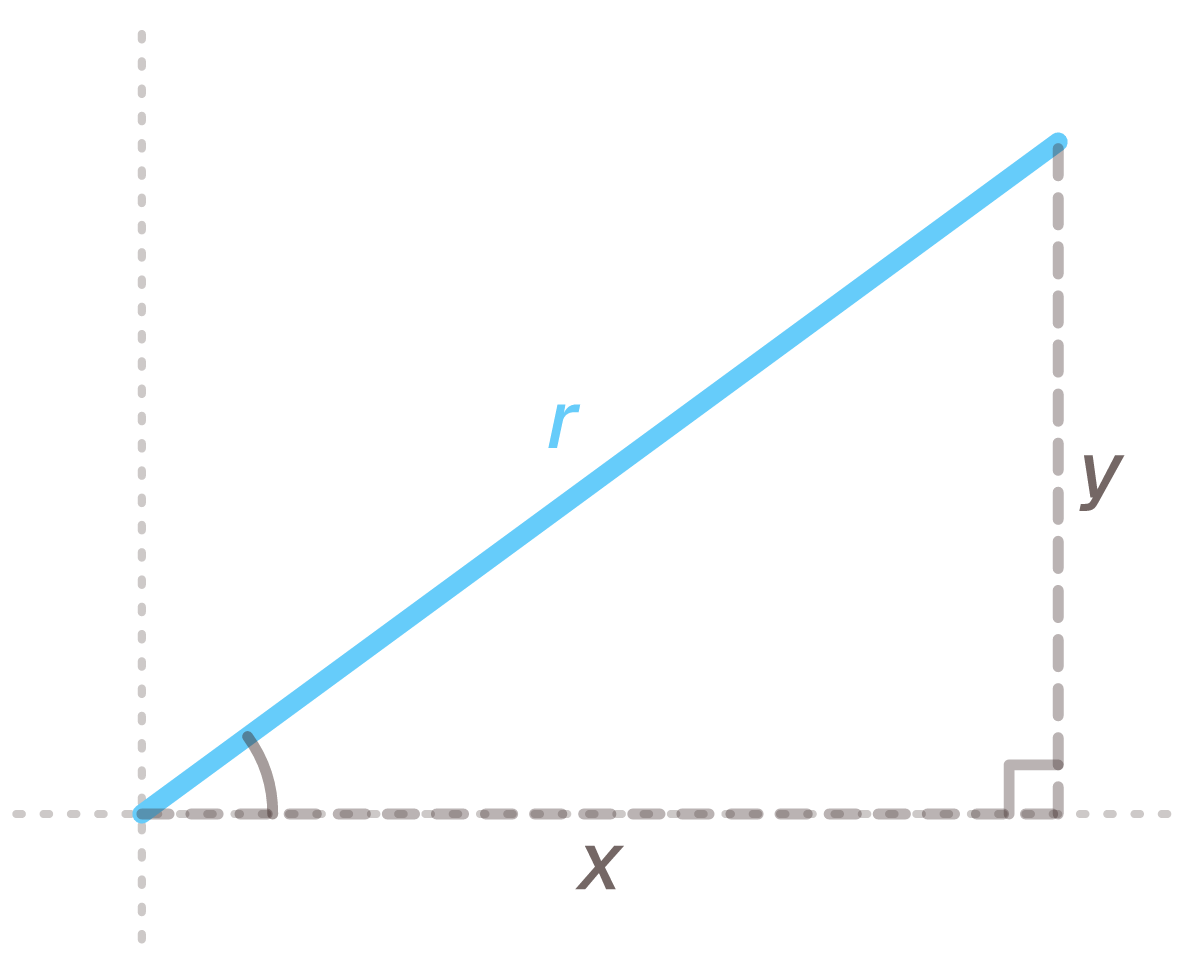
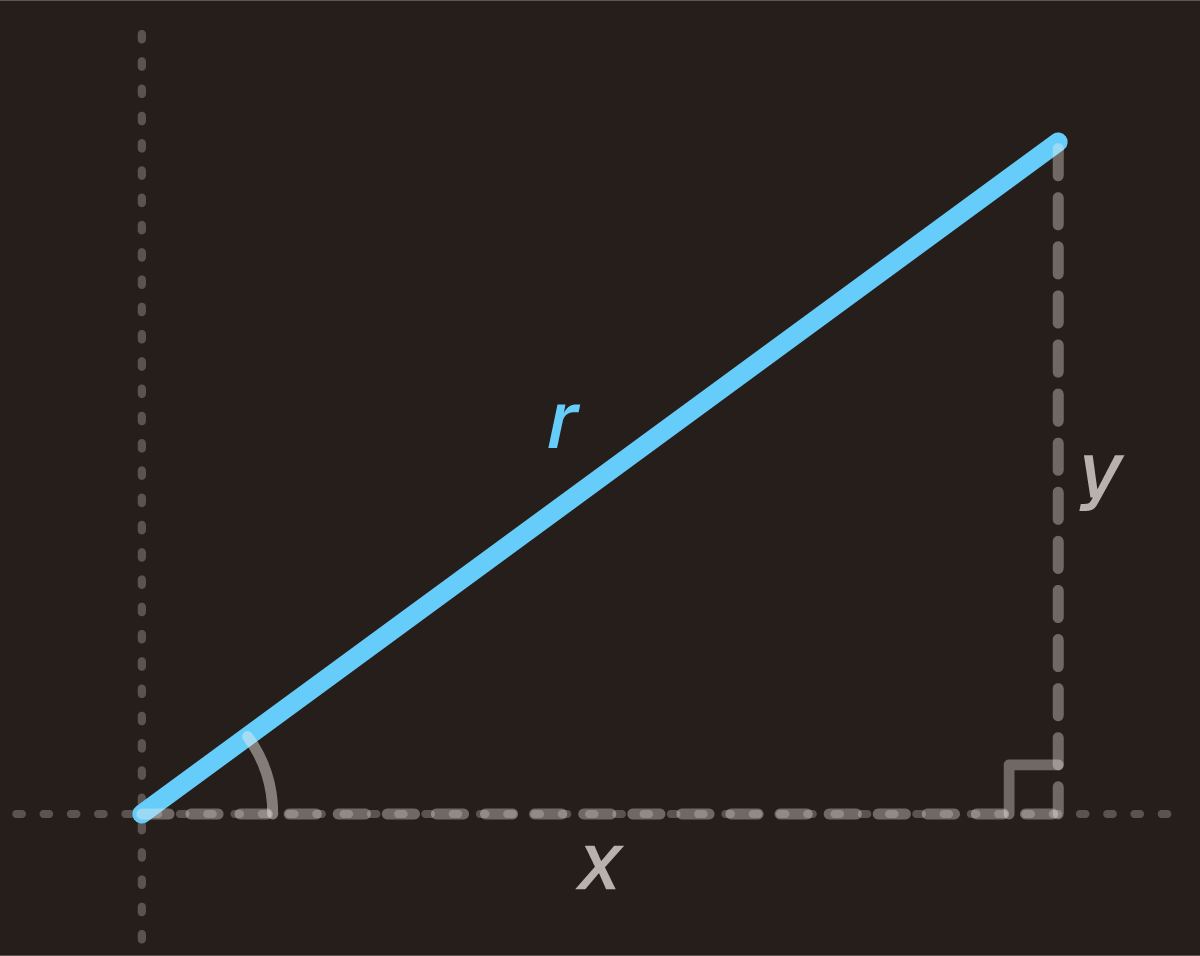
A coordinate system with a point P at (x, y). The dashed horizontal leg is x, the dashed vertical leg is y, and the segment from the origin to P is the distance r, the hypotenuse.
Solve for

r=5

r equals the square root of (3 squared plus 4 squared), equals the square root of (9 plus 16), equals the square root of (25), equals 5. The angle is v = arctan(y/x) only when x > 0. For x < 0 add 180° (the calculator on your device: atan2(y, x)); for x = 0 the angle is 90° or 270° by the sign of y. Measure counter-clockwise from the positive x-axis, giving 0° to 360°.

Working4 steps

Practice questions

You are given

  • x=-8
  • y=6

The formula

r is the distance from the origin, Pythagoras on the two coordinates. v is the angle from the positive x-axis, counter-clockwise, found from both signs by atan2, or from arctan(y / x) with a correction for the quadrant. The card above computes r; the coordinate converter gives the angle too.

A worked example

(3, 4): r = √(9 + 16) = 5, and v = arctan(4 / 3) = 53.13°, since x > 0 and no correction is needed. (−3, −4) has the same r = 5 and the same ratio y / x = 4 / 3, but it lies in the third quadrant: v = 53.13° + 180° = 233.13°.

Why arctan alone is not enough

arctan(y / x) returns an angle between −90° and 90°, so it covers the right half of the plane only; (−3, −4) and (3, 4) give the same answer. The rule: when x > 0 use arctan as it is; when x < 0 add 180°; when x = 0 the angle is 90° or 270° by the sign of y. atan2(y, x) does all of that in one call, and every calculator and programming language has it, though some name the arguments the other way round.

Writing the angle

Conventions differ. 233.13° can also be written −126.87°, and in radians 4.07; a bearing from north is 90° − v. State which one a result uses.

Common mistakes

Frequently asked questions

How do I go the other way? x = r cos v and y = r sin v, on the polar to cartesian page.

Is r the same as a vector’s magnitude? Yes, for the vector from the origin to the point: the magnitude of a vector is the same square root.

And for a complex number? r is the modulus and v the argument of x + iy, on the modulus and argument page.

Looking for another letter? The formula solved for each one
Solved for each letter
Solve forRearrangedWith the numbersComes to
xr²−y²5²−4²3
yr²−x²5²−3²4
rx²+y²3²+4²5

Last reviewed October 20, 2026 ·How pages are reviewed

Calculate it in practice

TrigonometryAll formulas

Put this formula on your site

Copy the code into your page where the formula card should appear. It loads from lovetocalc.com, so it stays current on its own — all we ask is that the credit line comes with it.