Pick the unit your lengths are in. Areas are then labelled in square units and volumes in cubic units; nothing is converted.
What tangent is
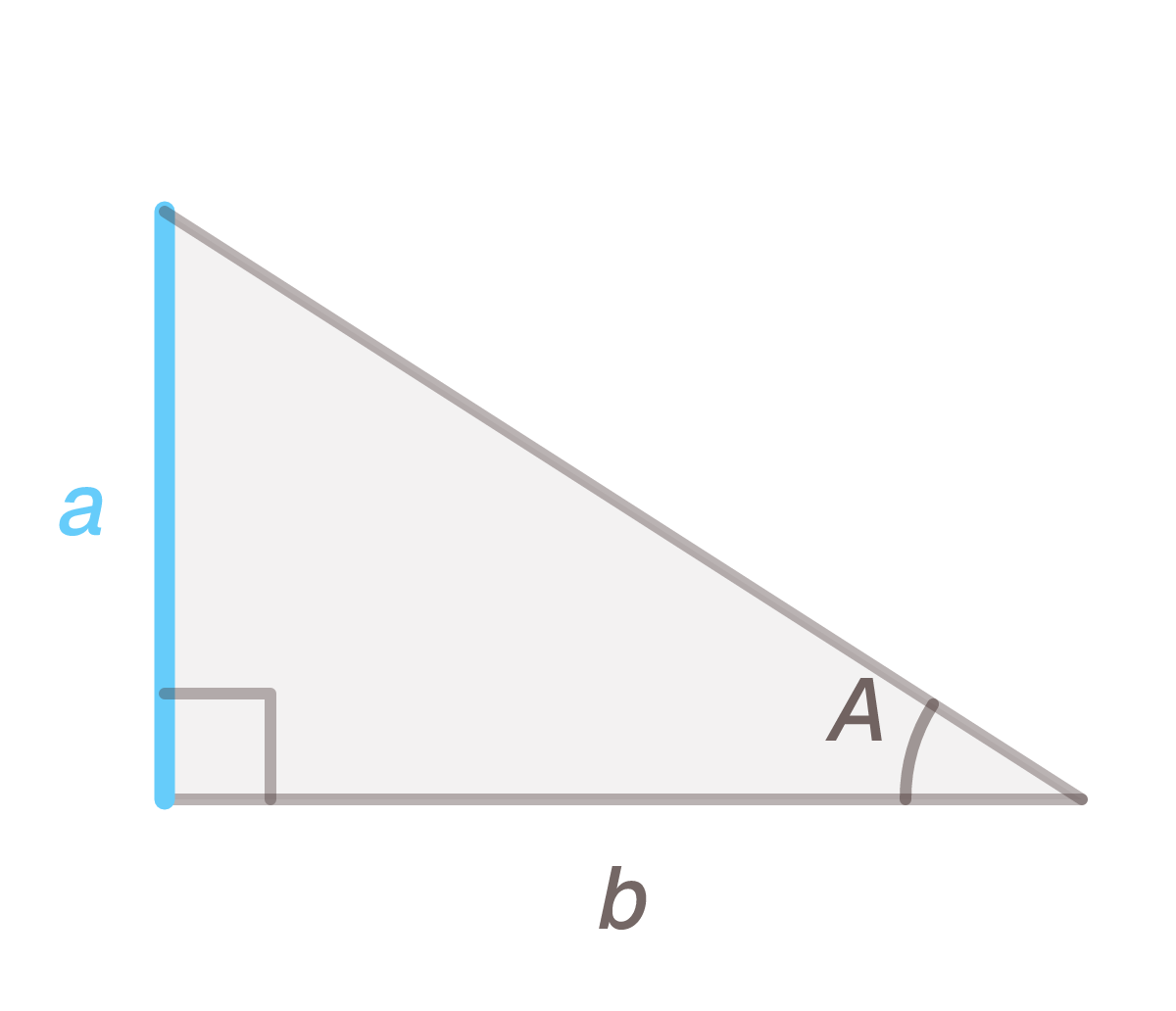
The tangent of an acute angle in a right-angled triangle is the side opposite the angle divided by the
side beside it. The hypotenuse takes no part, and that makes tangent useful: the other
two sides are often the only distances you can actually measure.
Tangent is also the ratio of the other two:
tan A = sin A / cos A
Both have the hypotenuse underneath, so it cancels. That is why a tangent can be any size at all while a
sine or cosine never passes 1 — as the angle approaches 90° the adjacent side shrinks towards nothing and
the ratio runs away. At exactly 90° there is no value.
Worked examples
How tall is the tree? You stand 20 m from a tree and look up at the top at an angle of 35°. Your eye
is 1.7 m above the ground.
The distance is the adjacent side and the height up to the top is the opposite one:
- a = b · tan A = 20 · tan 35°
- a = 20 · 0.7002 = 14.0 m
That is the height above your eye, so the tree is 14.0 + 1.7 = 15.7 m. The eye height is a step that
is often forgotten, and 1.7 m is not nothing on a tree.
The pitch of a roof. A roof rises 2.4 m across a width of 4.0 m. How steep is it?
- tan A = 2.4 / 4.0 = 0.60
- A = arctan 0.60 = 31°
A slope given as a percentage is that same number before the conversion: 0.60 is 60%. The percentage is
the tangent, not the angle — a 100% slope is 45°, not vertical.
Common mistakes
- Forgetting eye height. The tangent gives the height measured from your eye, not from the ground.
Add your own height in the last step.
- Swapping the two sides. Opposite divided by adjacent, in that order. Swap them and you get the
tangent of the other angle in the triangle — a perfectly plausible number and the wrong answer.
- Expecting a tangent to have a ceiling. It has none. tan 89° is 57, and tan 89.9° is 573. A large
answer is not in itself a mistake.
- Using 90°. There is no value there. The card above answers with an explanation rather than a
number, for the same reason a division by zero does.
Frequently asked questions
When should I use tangent rather than sine or cosine?
When the hypotenuse is neither known nor wanted. If you have the two shorter sides, or one of them
and an angle and want the other, the tangent is the direct route. If the hypotenuse is involved it is
sine or
cosine.
Why can a tangent be greater than 1?
Because neither side is the hypotenuse. Sine and cosine always divide by the longest side, so they can
never exceed 1. A tangent divides two short sides by each other, and which of them is longer depends
on the angle: above 45° the opposite side is longer and the ratio passes 1.
Which tangents are exact?
tan 45° is exactly 1, because the two short sides are then equal. tan 30° is 1/√3 and tan 60° is √3.
Most other angles give a value that has to be rounded.