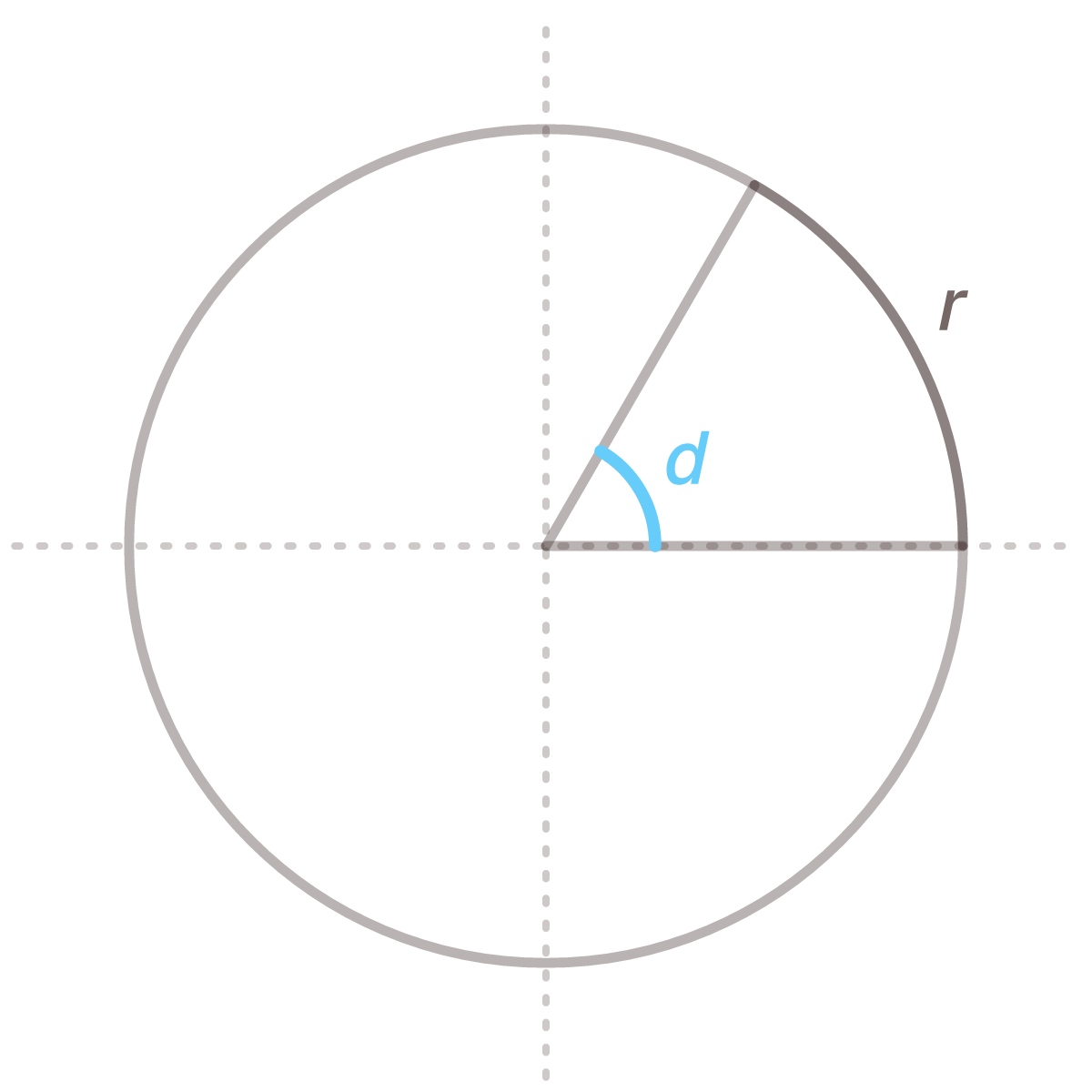
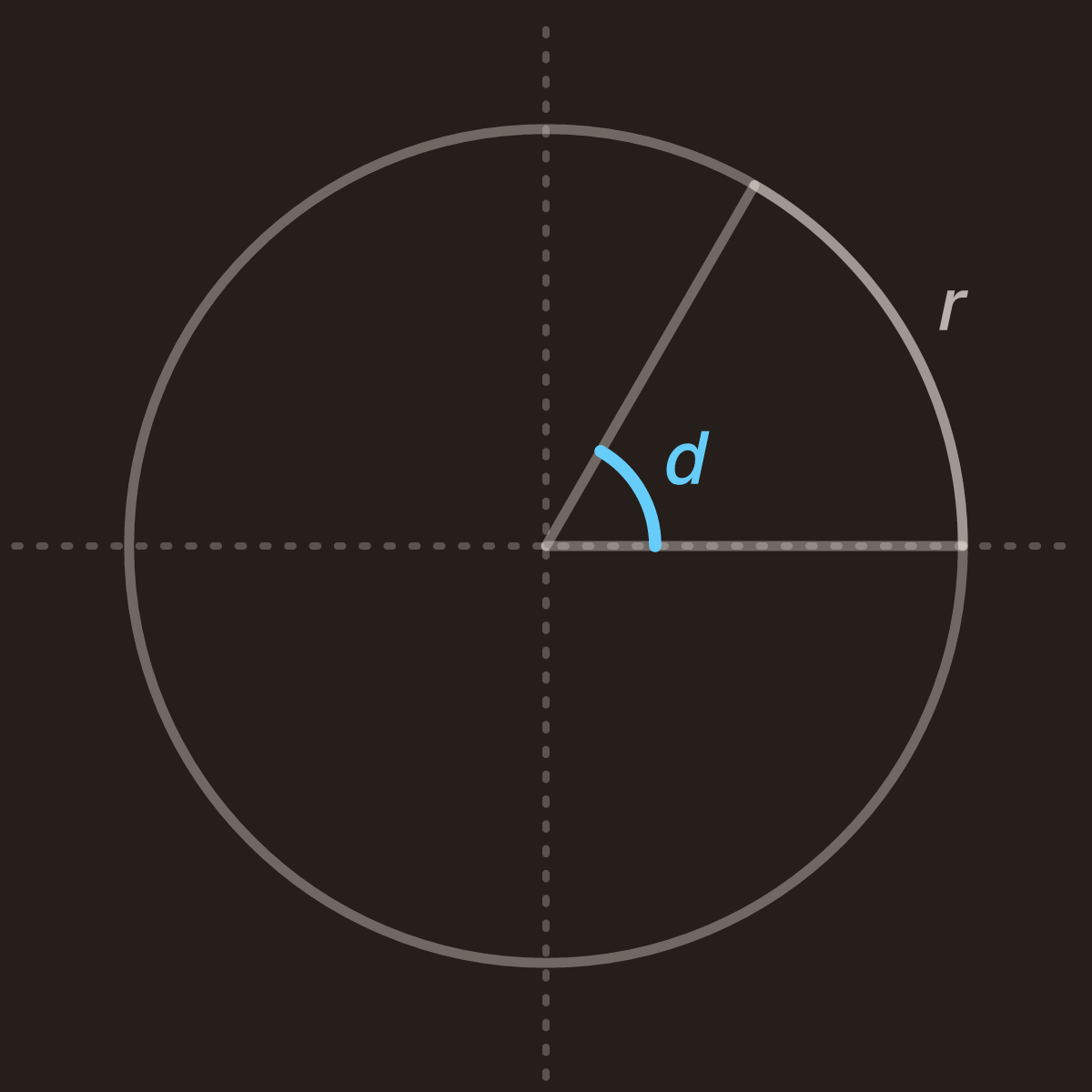
r is the angle in radians and d is the same angle in degrees. The factor 180/π is about 57.2958,
which is why one radian is roughly 57.3° — a number worth remembering, because it is enough to tell
whether an answer is sensible.
The reasoning is the same as the other way round: half a turn is 180° and that same half turn is π
radians, so 180/π is what one radian is worth in degrees.
The table that gets you a long way
| Radians |
Degrees |
| π/6 |
30° |
| π/4 |
45° |
| π/3 |
60° |
| π/2 |
90° |
| 2π/3 |
120° |
| π |
180° |
| 3π/2 |
270° |
| 2π |
360° |
If there is a π in the expression you need no calculator. Swap π for 180 and work it out: 3π/4
becomes 3 · 180/4 = 135°. It works for every angle written with π.
Worked examples
With π in it. 5π/6 becomes 5 · 180/6 = 150°.
A plain decimal. 2 radians gives 2 · 180/π = 114.59°. The check is the rough figure: twice a bit
over 57 is just under 115.
A number off a calculator. 1.047 gives 1.047 · 180/π ≈ 59.99°, which is 60° that was rounded on
the way. If the answer looks like a familiar angle, it probably is one.
Common mistakes
- Multiplying by π instead of dividing. Going this way π is underneath. For positive angles,
degrees are bigger numbers than radians: 1 becomes 57, not 3.14.
- Expecting every radian value to give a tidy angle. 2 radians is 114.59…°, nothing round. It is mainly
values with a π in them, such as π/3, that land on whole degrees.
- Rounding π to 3.14 early. The error is about 0.05° at 90°, which shows as soon as the answer is
given to two decimals. Use the calculator’s π.
- Forgetting which mode the calculator is in. A common mistake, and nothing but the answer
shows it.
Common questions
How big is a radian?
About 57.3°. It is the angle you get when the arc is as long as the radius.
Why does the answer come out as 59.99 instead of 60?
Because the number you typed in was already rounded. 1.047 is not π/3, only very close to it. To get
exact degrees you have to keep the π all the way through.
How do I go the other way?
Multiply by π and divide by 180 — see
degrees to radians. The card here works
both ways, but that page is written for that question.