The solution
Write w = s(cos φ + i sin φ) in polar form. The roots of zⁿ = w are then
| k | Root |
|---|---|
| 0, 1, …, n − 1 | z = ⁿ√s (cos((φ + k · 2π)/n) + i sin((φ + k · 2π)/n)) |
Holds when n is a positive integer and w ≠ 0.
It is De Moivre’s formula read backwards: zⁿ has modulus rⁿ and argument nθ, so rⁿ = s and nθ = φ + k · 2π.
Example
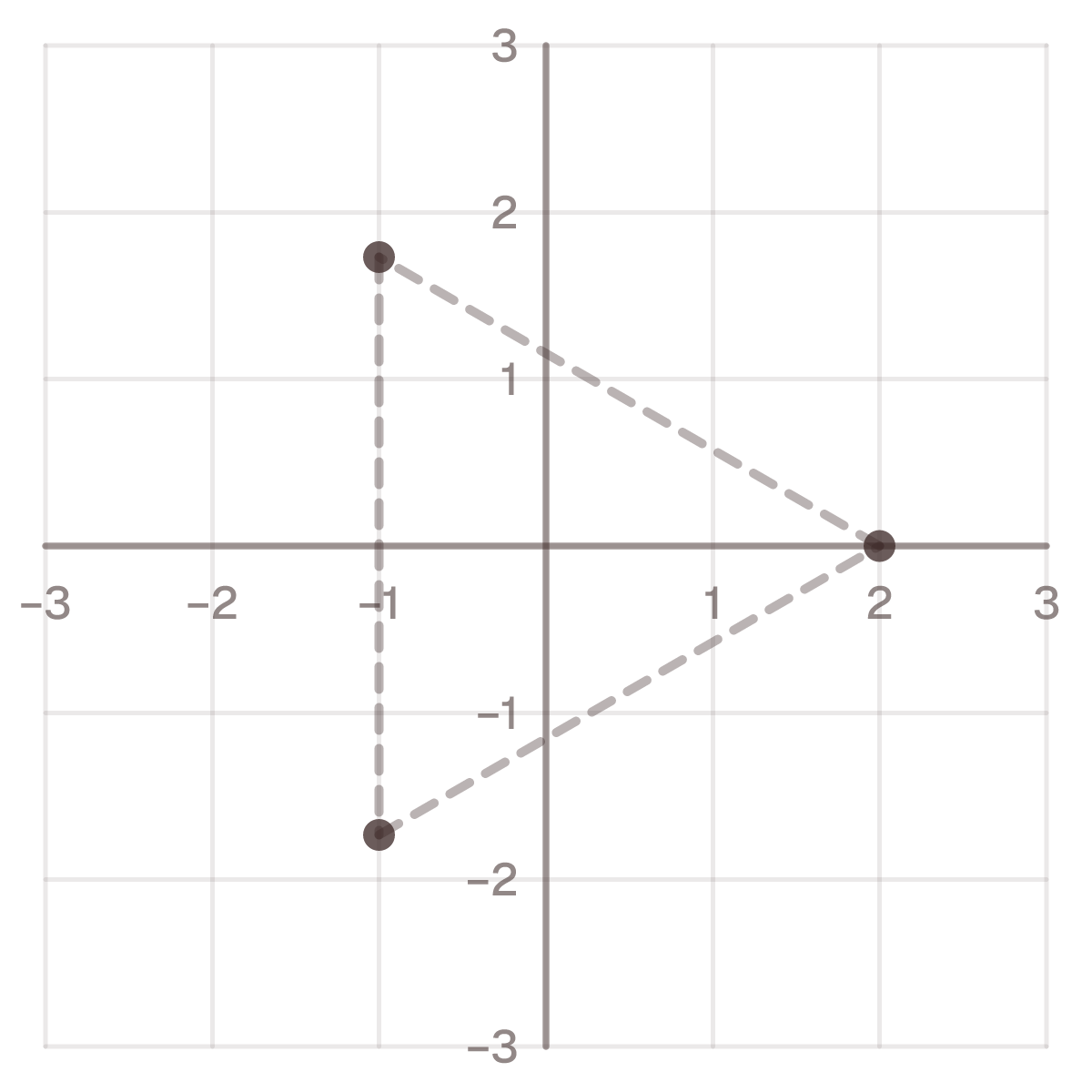
z³ = 8i. Here s = 8 and φ = π/2. The modulus is ∛8 = 2 and the angles are (π/2 + k · 2π)/3:
| k | Angle | Root |
|---|---|---|
| 0 | π/6 | √3 + i |
| 1 | 5π/6 | −√3 + i |
| 2 | 3π/2 | −2i |
Check: (−2i)³ = −8i³ = −8 · (−i) = 8i.
A second example: z⁴ = −16
s = 16 and φ = π, so the modulus is ⁴√16 = 2 and the angles are (π + k · 2π)/4 = π/4, 3π/4, 5π/4, 7π/4. The roots are √2 ± √2 i and −√2 ± √2 i, the four corners of a square. There is no real fourth root of −16, which is what an even power of a real number says.
Where next
- The formula read backwards: De Moivre’s formula.
- The same n-families in trigonometry: solving trigonometric equations.
- The real case with one root: the power equation.
Common mistakes
- Stopping at one root. zⁿ = w has n of them when w ≠ 0.
- Not dividing the period by n. It is (φ + k · 2π)/n, not φ/n + k · 2π.
- Taking more than n values of k. k = n gives the same root as k = 0.
Common questions
Why do the roots lie on a circle?
They all have the same modulus, ⁿ√s, and their angles differ by 2π/n. They are the corners of a regular
n-gon centred on the origin.
Is zⁿ = 1 a special case?
Yes, with s = 1 and φ = 0. The roots are the roots of unity; for n = 3 they are 1 and −1/2 ± (√3/2) i.