What the theorem says
Let p(x) be a polynomial and a a number. Then:
(x − a) is a factor of p(x) exactly when p(a) = 0.
“Exactly when” runs both ways, and that is what makes the theorem useful. If you know a is a root, you know (x − a) divides evenly. If you know (x − a) divides evenly, you know a is a root.
Watch the minus sign. If the root is −2 the factor is (x + 2), because x − (−2) = x + 2.
Factorising with it
The method for polynomials of degree higher than two:
- Guess a root. Try the divisors of the constant term: ±1, ±2, ±3 and so on.
- Check by substitution. If p(a) comes out zero, you have found a factor.
- Divide. Carry out polynomial division by (x − a). What is left has one degree less.
- Repeat until what remains is a quadratic, which the quadratic formula handles.
Step one is not a shot in the dark. If the polynomial has whole-number coefficients and a leading coefficient of 1, every whole-number root has to divide the constant term — that is the entire list you need to try.
Worked examples
Example 1. Factorise p(x) = x³ − 6x² + 11x − 6.
Try x = 1: 1 − 6 + 11 − 6 = 0. So (x − 1) is a factor.
Polynomial division gives x² − 5x + 6, which factorises as (x − 2)(x − 3).
p(x) = (x − 1)(x − 2)(x − 3)
Example 2. Is (x + 2) a factor of x³ + 3x² − 4?
Put in x = −2: −8 + 12 − 4 = 0. Yes.
Example 3. A cubic has zeros at 1, −3 and 4. Write it down.
p(x) = (x − 1)(x + 3)(x − 4), possibly times a constant. The zeros fix the factors but not how steeply the curve rises.
Common mistakes
- The wrong sign in the factor. A root of 5 gives the factor (x − 5); a root of −5 gives (x + 5).
- Only trying positive numbers. Negative divisors of the constant term are just as possible.
- Forgetting the leading coefficient. If it is not 1 the roots can be fractions, and the divisors of the constant term are no longer the whole list.
- Stopping at one factor. A cubic can have up to three linear factors, and the quotient has to be factorised further.
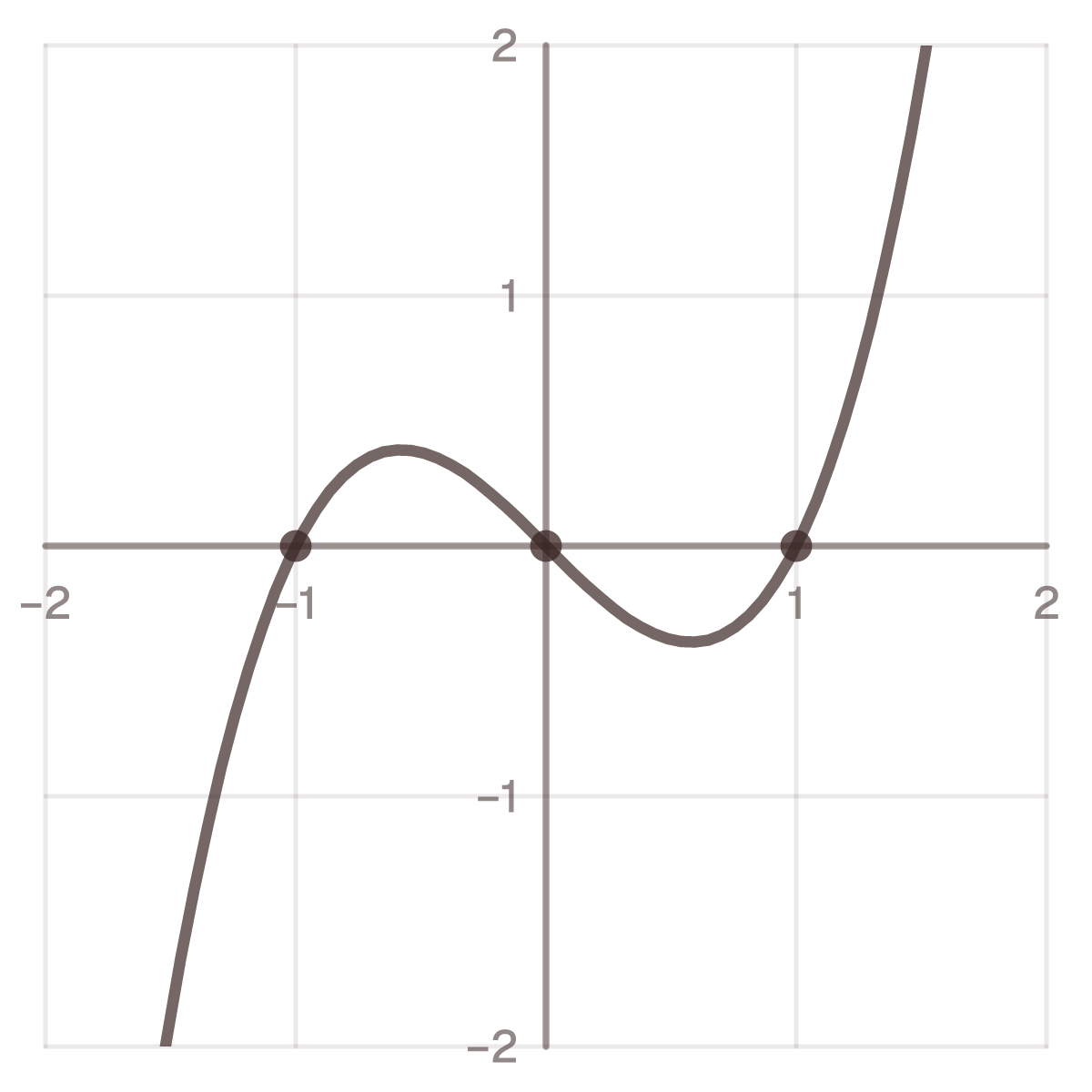
- Confusing a zero with the y-intercept. The zeros are where the curve crosses or touches the x-axis.
Common questions
Can I test a factor on this page?
Not with a card: the theorem is about any polynomial, so there are no fields to fill in. Type the
polynomial and x − a into the polynomial division calculator
instead. If the remainder is zero, x − a is a factor and a is a root.
How is it different from the remainder theorem?
The remainder theorem says what the
remainder is when you divide by (x − a): it is p(a). The factor theorem is the same statement for the
special case where that remainder is zero.
How many roots can a polynomial have?
At most as many as its degree. A cubic has at most three real zeros, and counting complex roots with
multiplicity it has exactly three.